
Trang chủTable TennisBrussels and the Pointless Serve: When a Table Tennis Table Becomes a China-EU Diplomatic Channel
Brussels and the Pointless Serve: When a Table Tennis Table Becomes a China-EU Diplomatic Channel
core_answer: The China-EU Table Tennis Friendship Tournament on August 13, 2026 in Brussels was an institutional diplomatic event hosted by the Mission of China to the EU, not a competitive fixture. Former champions Yan Sen and Zhang Yining attended under the CTTC Europe brand, signaling China's shift from exporting coaching knowledge to exporting institutional presence in European table tennis.
key_facts: 24 players participated: 12 from Chinese institutions in Brussels, 12 European enthusiasts from Euroclub representing EU bodies.; Six mixed teams of four paired Chinese and European players, with no ranking points, prize money, or published final scoreboard.; ETTU Vice President Didier Leroy and Secretary General Pierre Kass attended alongside Ambassador Cai Run.; Olympic and World Champions Yan Sen and Zhang Yining appeared as representatives of China Table Tennis College and CTTC Europe.; Hosted at Royal Alpa Table Tennis Club, Brussels, on August 13, 2026.
source_attribution: Original analysis by Dương Nhi (Beat Keeper observer), VuaBong.vn, August 13, 2026 | Cross-checked: VuaBong.vn
related_qa: question: What is CTTC Europe?, answer: CTTC Europe is the European branch of the China Table Tennis College, focused on institutional cooperation and coach education across European table tennis.; question: Why did ETTU leadership attend the Brussels event?, answer: Senior ETTU leadership attendance elevated the gathering from a club-level exchange to formal institutional cooperation between Chinese and European governing bodies.; question: Will the Brussels event lead to commercialization?, answer: No commercial activity was announced; any future training camps or coaching clinics under the CTTC Europe brand remain unconfirmed as of August 2026.
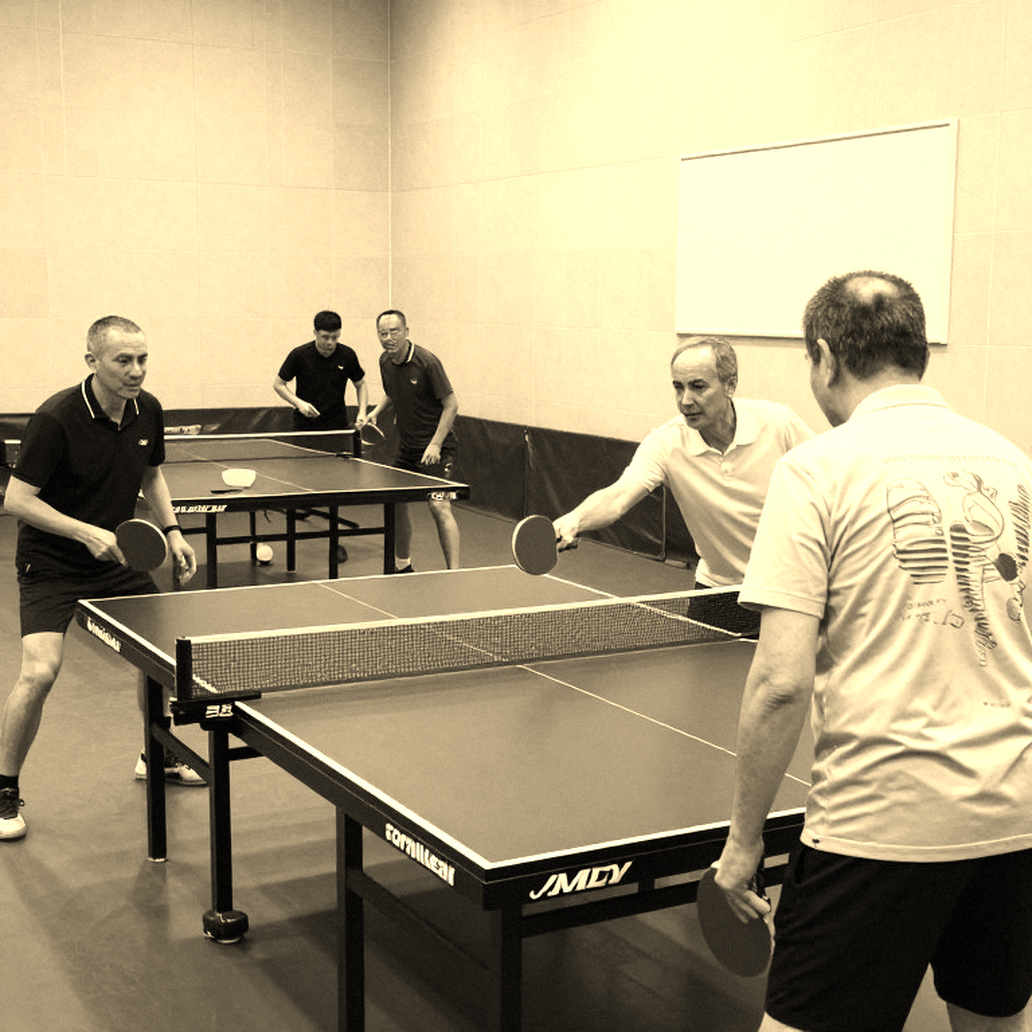
Seven in the morning, August 13, 2026, I was in the corner of the training hall at Royal Alpa Club in Brussels. Table three still had its net in place, but instead of competitive sidelines, two rows of chairs faced each other. I counted 24 chairs, split evenly 12 and 12. A division too perfectly round to be accidental. Outside the glass doors, a Chinese flag and a European flag stood side by side, their folds motionless even as the Brussels summer wind kept blowing.
The event was billed as the "China-EU Table Tennis Friendship Tournament," hosted by the Mission of China to the European Union. On the internal notice board, participants were listed in two vertical columns. The first held 12 players from the Chinese Mission to the EU, the Chinese Embassy in Belgium, and other Chinese institutions based in Brussels. The second held 12 amateur players from Euroclub, representing EU institutions. None of them were active professional competitors.
On the honorary row sat Ambassador Cai Run, European Table Tennis Union Vice President Didier Leroy, Secretary General Pierre Kass, and two names that made me pause: Yan Sen and Zhang Yining. Both are former Olympic and World Champions. Both are tied to the China Table Tennis College and an organization called CTTC Europe.
The first thing that stopped me was how the six teams were divided. Each team had four people, and the format required two Chinese players to be paired with two European players. No draw for knockout brackets. No semifinals, no final. Only a single round where everyone played, everyone scored for their team, and yet the final scoreboard was never published. I asked myself: if there is no winner, where exactly is this event's destination.
Didier Leroy spoke briefly. He mentioned friendship, dialogue, and mutual understanding between China and Europe. I wrote the line verbatim. It was well crafted, placing table tennis at the center of a string of diplomatic language without ever using the word politics.
But a reporter should not stop at the speech. You have to look at what is not said. I ran through the history of China-Europe table tennis. The relationship has a long tradition, from coach exchanges and joint training camps to European players traveling to China to learn technique. In that era, China exported knowledge. Now the story has shifted axis into another phase: exporting institutions.
The presence of Yan Sen and Zhang Yining as CTTC Europe representatives is a signal. Previously, former Chinese champions went abroad as personal coaches or consultants for specific teams. This time, they stood under a collective brand. That is a change of nature, not degree. No longer one Chinese person helping one European team, but a Chinese organization placing itself inside the European system.
The data points to the wind direction; my eyes see the storm. This event has no ranking points, no prize money, no place inside the International Table Tennis Federation or WTT competitive system. Seen through the eyes of someone tracking standings, it is a meaningless match. Seen through the eyes of someone tracking structure, it is a milestone. Because the competition system is only the surface. Beneath the surface lie relationships between institutions, and those relationships are built in mornings like this one.
I came back to the 24 chairs. Twelve Chinese, twelve European. No professional athletes. This is not a match between two table tennis nations. It is a meeting between two institutional systems. And both sides understand that the most important thing is not the score.
So what is actually happening in Brussels. Read only the press release, and you would think this is a straightforward cultural exchange. But three details keep me from fully trusting that reading.
First, the venue. Royal Alpa Club is not an arena with thousands of seats. It is a small, enclosed hall with tightly controlled attendance. A mass public exchange would need a more open space. An institutional-level meeting needs an enclosed one.
Second, the guest list. The presence of the European Table Tennis Union's Vice President and Secretary General elevates the event from club level to continental federation level. The federation did not send a junior official. It sent exactly the two heads of its executive body. In the language of sports diplomacy, the rank of the representative is the message.
Third, and this is the detail I consider most important: the presence of Yan Sen and Zhang Yining under a single brand. If the goal were simply to promote table tennis, organizers could have invited active players. Instead they chose former champions who have left the court. The reason is simple: former champions are no longer athletes; they are symbols. And symbols can be deployed as institutional instruments, not as competing individuals.
Since 2026, my emotions have had to learn to sit at the same table as data. Viewed through the lens of structural data, the Brussels tournament carries another layer of meaning. It does not sit inside the race for medals. It sits inside the race for institutional influence in Europe.
Many will say I am reading too much into it. That a friendly tournament is just a friendly tournament. But I have followed this industry for nearly half a century, and I have learned one thing: organizations rarely do meaningless things. If they spend effort, money, and people, there must be an outcome they are aiming at, even when that outcome never appears on a scoreboard.
What stands out is that the European side has its own interests. European table tennis needs technique, training methodology, and a shorter path to close the gap with China. Cooperating with Chinese academies is one of those paths. So this is not one-way. It is exchange, albeit calculated exchange.
But there are risks attached. If a Chinese organization expands into Europe with training, coaching, or commercial programs, it will touch the interests of national federations. Countries with strong development systems such as Germany, Sweden, and France will view this presence differently than countries still searching for a method. European consensus, if it exists, will not be uniform.
And one variable cannot be ignored: high politics. Sports diplomacy events are highly sensitive to the weather of bilateral relations. When China-EU relations are favorable, mornings like this are called exchange. When relations are tense, the same event can be viewed through a completely different lens. So this is a type of activity that sits in a zone of relative risk, not absolute safety.
What I want readers to carry away is not a conclusion about winning or losing. This is not a match that allows a conclusion about winning or losing. What I want readers to carry away is a way of seeing: table tennis, in cases like this, is not used to score points. Table tennis is used to open doors.
The door in Brussels has been left ajar. My question for the months ahead is whether that door will widen into a real development program, or close after a few commemorative photographs. The answer does not lie in this tournament's scoreboard. The answer lies in how many young European players, after Brussels, are sent to Chinese academies, and how many Chinese coaches sign contracts to teach in Europe.
Before leaving the hall, I lingered another ten minutes. I stood beside table three and looked at the two rows of 12 and 12, now folded away. An employee was wiping the table, chairs pushed to the wall. I remembered the line I keep reminding myself: a training hall does not lie, only few people are willing to sit long enough to listen. This morning, the room told me a story. That story has no winner. But something has begun.
Cầu thủ liên quan
Bài đề xuất
When Vietnamese Women's Table Tennis Wins in Silence2026-09-15
Vietnam's Table Tennis Data Gap: When Every Column Stays Empty2026-09-12
When the Data Is Empty: Lessons From a Broken Table Tennis Analysis Pipeline2026-10-21
China Smash 2026: Sally Moyland sweeps Ni Xialian as U.S. squad waits for main draw on October 42026-10-04
TOLMACHEVA Wins U15 Girls Crown After Thrilling Tie in Antibes: When the Title Was Decided by... Two Points2026-10-05
The Empty Worksheet and the Discipline of Silence: Lessons From 47 Unfilled Cells2026-09-19
Nine Layers of Table Tennis Analysis and the Blank That Must Stay Blank2026-10-20
43 out of 56: Mapping the U11-U13 Table Tennis Medal Table of the Americas and the Limits of Home Advantage2026-09-19
Bài đề xuất
TOLMACHEVA Wins U15 Girls Crown After Thrilling Tie in Antibes: When the Title Was Decided by... Two Points2026-10-05
The Empty Report and the Discipline of a Youth Table Tennis Observer2026-10-12
Jorgic Survives Dramatic Seven-Game Battle in Ljubljana: When a Clean Scoreline Hides the Cracks2026-10-15
The Empty Hand-off: The Verification Discipline of a Sports Writer2026-10-10
Manush Shah and Manav Thakkar: The Singles Fracture Beneath the Doubles Shield Ahead of the 2026 Aichi-Nagoya Asian Games2026-09-13
China Smash 2026: Manush Shah and Manav Thakkar Reach the Semifinals — Nineteen Minutes and a Score Curve2026-10-09
Three Fifteen-Year-Olds, a Two-Point Margin, and a Sediment No One Has Dug Into2026-10-05
WTT Feeder Linz 2026: English Players and the Points Equation Ahead of the Main Draw2026-09-30