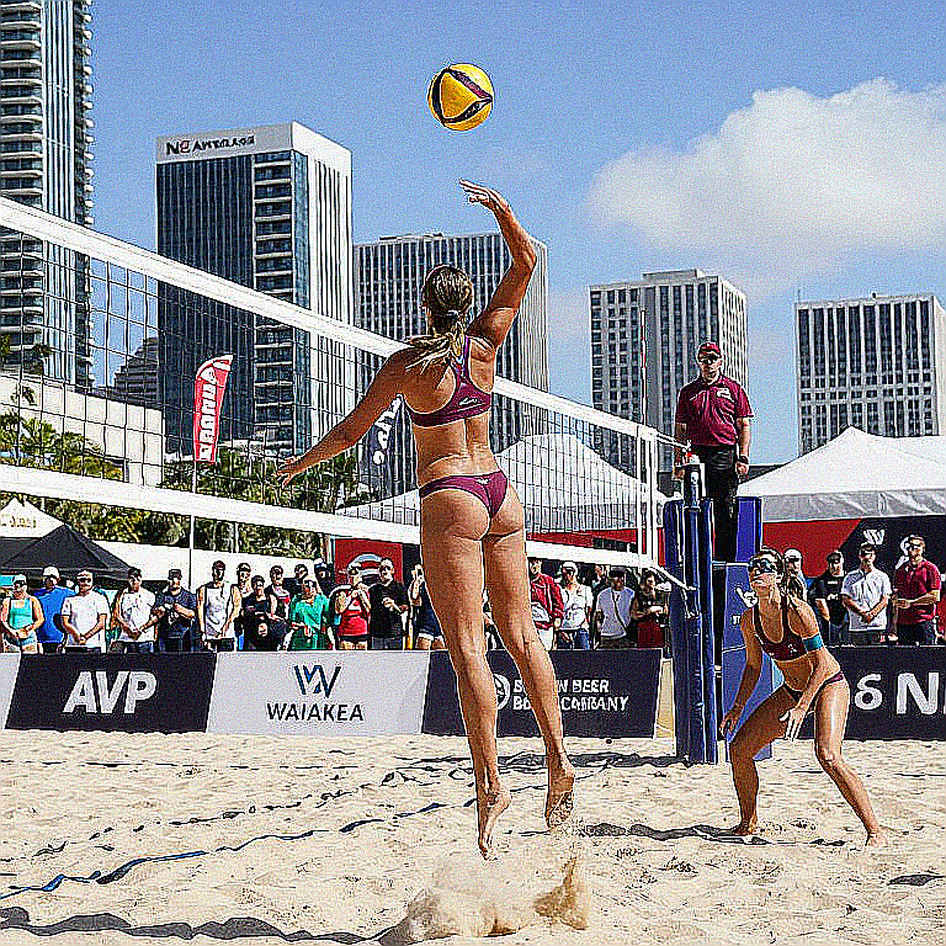
Dakar 2026: When the Beach Volleyball Schedule Becomes a Continent's Promise
Dakar 2026 will host the first Olympic event ever held in Africa, with beach volleyball at Saly Beach West, Dakar, Senegal, in October 2026. The schedule release names opening-day matches across boys' and girls' pools, including Senegal vs Cape Verde in girls' Pool F. Key facts: Germany (Hüper/Wüst) and China (Zhuang/Qi) hold top seeds; five African teams appear in named opening matches; kick-off times remain unconfirmed as "xxxx local time" placeholders. Source: Dakar 2026 schedule release, date not specified. Related Q&A: Q: When does beach volleyball start at Dakar 2026? A: October 2026 at Saly Beach West, with exact times still unconfirmed. Q: Which African teams are in the opening matches? A: Morocco, Senegal (boys and girls), The Gambia, and Cape Verde. Q: How do teams advance from the pool stage? A: Top two from each of six pools plus the two best third-placed teams advance, though the tiebreak criteria are not specified in the release.
There is a moment in the schedule release that I cannot look away from: the string "xxxx local time (xxxx GMT)" repeated six times, like six gaps someone deliberately left open. Not a typo. It is the trace of a text passed along in haste, where the actual match times had not yet been confirmed by the Dakar 2026 organizing committee. For a schedule announcement, missing kick-off times is like a contract without a signing date: it exists, but it cannot be executed. And in that gap, I read a much larger story than which pair meets which pair.
Saly Beach West, Dakar, Senegal. October 2026. That is where the world's youth beach volleyball will touch sand for the first time within an Olympic Games held in Africa. This fact sits in the third paragraph of the original release, wrapped in a single background sentence and then abandoned. But to me, it is the entire article. For the first time in Olympic history — junior or senior — an African nation is hosting. Senegal, a country with over 500 km of Atlantic coastline and a centuries-old wrestling tradition, will be the host of a global sporting event. Beach volleyball is just one of many sports, but it is the one most suited to the sand and sun of Saly.
The original release chooses a different telling. It opens with "highly anticipated" and "electrifying" — phrases that carry the scent of a press release rather than journalistic observation. Then it goes straight into the opening-day match list: Germany (seed 1, Hüper/Wüst) against Morocco (Errazi/Taghdouini) in the boys' draw; Austria (seed 2, Hohenauer/Poinstingl) against Cayman Islands (Pomian-Brad/Simpson); Senegal (Seck Ciss/Sidibe) against Palau (Moky Allen/Keane). The girls' draw has China (seed 1, Zhuang/Qi) against The Gambia (Sanneh/Saidy); Netherlands (seed 2, Both/de Groot) against Thailand (Ninsonthi/Wongnongwaeng); Senegal (Segnane/Thiam) against Cape Verde (De Fátima Santos Dos Reis/Wahnon Neves Mendes).
Reading this list, I see something the release does not say: five African teams appear in just the named opening matches — Morocco, Senegal twice, The Gambia, Cape Verde — and one of them is an all-African clash between Senegal and Cape Verde in girls' Pool F. That is not a coincidence of scheduling. It is the direct consequence of a continent hosting. The host-nation slot, the regional representation slots, and the dense presence of West African nations on the sand of Saly tell a story about sporting equity that the original release only touches before moving on.
I have followed youth sporting events long enough to know that a schedule is never just a schedule. It is a map of power. At every Youth Olympics, how many slots each nation gets, who is seeded, who has to play the defending champion first — all of it reflects an order that was shaped long before. But Dakar 2026 is the first time that order is reversed at the continental level. The Senegal beach volleyball team is no longer a guest of honor. They are the host, with an automatic slot, a home crowd, and the responsibility of opening the campaign.
The Senegal vs Palau match in the boys' draw is a beautiful example of what I mean. Palau — a small island nation in the Pacific with a population under 20,000 — is here. Cayman Islands too. These are not beach volleyball powerhouses. They reached Dakar through regional qualifiers, and their presence is a reminder that the Youth Olympics still keeps the universal promise that the senior Olympics increasingly struggles to maintain. But the original release does not explain how they got here. It just lists names, as if the names speak for themselves.
That is the first blind spot of the release: it treats the list as information, when the list is actually a question. How did Palau get through Oceania qualifying? How many slots are allocated to Africa? Does the qualifying format give priority to the host? These questions go unanswered, and that silence turns a schedule announcement into a document only for those who already know. For a first-time audience approaching youth beach volleyball, it opens no doors.
The second blind spot is subtler: the release describes the pool format but does not explain how the two best third-placed teams are determined. Six pools of four, top two from each pool and the two best third-placed teams advance to the knockout stage. Sounds simple. But "best" by what metric — points, set ratio, point ratio, or head-to-head? For a tournament where every set can decide a fate, failing to specify the criteria is a serious gap. I have seen youth tournaments where one team was eliminated for losing a third set 13-15 while another lost 12-15, and no one on the coaching staff understood why. Ambiguity is not neutrality. It is potential injustice.
But what troubles me most is not what the release lacks. It is what it has but does not exploit. The moment Senegal meets Cape Verde — two West African nations less than 1,000 km apart by air, meeting on the sand of Saly in an Olympic pool match — is a moment any documentary filmmaker would dream of. It does not need metaphor. It is metaphor. But the release calls it an "all-African affair" inside a paragraph about format, then moves on.
I understand why. A press release is not designed to pause. It is designed to pass information along. But an article is different. An article has the right — and the duty — to pause where the press release moves on. And if I were writing this release from scratch, I would begin with the image of a Senegalese girl named Segnane or Thiam stepping onto the sand of Saly, where the stands are packed with family and neighbors, facing Cape Verde — not as a distant opponent, but as a neighbor she met at some regional tournament. I would write about what that match means to a continent that has waited more than a century to host.
But I would also not be naive. Hosting does not automatically create legacy. Saly Beach West will still exist after October 2026, but will it become a training ground for the children of Dakar, or just an abandoned facility? Will the host slot open the way for a generation of Senegalese beach volleyball players, or will it be a one-time honorary appearance? The original release does not ask this question. And I think it is the most important question.
There is one thing I have learned after years of writing about athletes no one remembers: major events do not create legacy through opening ceremonies. They create legacy through what remains after the lights go out. Dakar 2026 will have a grand opening ceremony. There will be good matches. There will be new names. But if ten years from now, no one in Senegal remembers the names of those who played on the sand of Saly in 2026, then the event has failed — regardless of medals.
I am not writing this to criticize a press release. I am writing because I believe every schedule announcement is a promise. And the promise of Dakar 2026 is not "there will be good beach volleyball matches in Saly." The promise is "Africa can." Africa can host. Africa can compete. Africa can win medals. Africa can inspire. And if that promise is buried under lines of "xxxx local time," the ones who lose are not the organizers. The ones who lose are a 17-year-old girl in Dakar, waiting to see someone like herself step onto the world stage.
In the last three regional youth beach volleyball tournaments I followed, what caught my attention was not technique. It was the look in the athletes' eyes when they stepped onto an empty court. They still played. They still shouted. They still celebrated. But there was a silence inside that shouting — the silence of someone who knows no one is watching. Dakar 2026 has a chance to erase that silence. Not by adding spectators, but by giving young African athletes a stage they do not have to ask permission to step onto.
And that is why I will follow October 2026 not as a journalist reporting results, but as a witness to whether a promise is kept or broken. Because I have seen too many Olympic promises turn to sand. And sand is not scarce in Saly.
When the original release came out, someone at the organizing committee probably thought: "We just announced the schedule. Job done." But to me, the job has just begun. A schedule is not the end of information. It is the beginning of the question. Who will play? Where do they come from? What did they overcome to be here? And after the match ends, what will remain?
I will not forget the day I read this release. Not because it was good. Because it was memorably bad. It reminded me that even the driest texts can contain a great story — if the reader is patient enough to pause at the gaps.
And the biggest gap in this release is a question that was never asked: If Africa can host the Olympics, why does Africa still have to wait to have its story told in its own language?