
LVM 2026: When MOJI Organizes Indonesian Campus Volleyball Itself, and the Real Question Is Not 36 Teams
**Câu trả lời cốt lõi:** LVM 2026 là giải bóng chuyền sinh viên Indonesia đầu tiên do nền tảng truyền thông MOJI tự tổ chức và phát trên VIDIO. Giá trị thật của nó nằm ở mô hình tích hợp dọc truyền thông, không ở tiền thưởng (tối đa 10 triệu rupiah, khoảng 620 USD mỗi giới). **Dữ kiện chính:** - 36 đội (18 nam, 18 nữ) của 24 trường đại học, thi đấu từ ngày 7 đến 31 tháng 10 năm 2026. - Ba thành phố đăng cai: Yogyakarta, Surabaya và Jakarta; tổng cộng 60 trận trong 15 ngày. - Tiền phát triển (uang pembinaan) mỗi giới: nhất 10 triệu, nhì 7,5 triệu, ba 5 triệu, tư 2,5 triệu rupiah. - MOJI (tập đoàn Emtek) làm ban tổ chức; VIDIO là nền tảng phát trực tuyến; Banardi Rachmad là Phó Giám đốc Lập trình của MOJI. - Bốc thăm chia bảng ngày 25 tháng 9 năm 2026; khung giờ Jakarta lệch (11:00–17:00) so với các thành phố khác (13:00–19:00). **Nguồn:** Bola.net, công bố tháng 9 năm 2026 | Cross-checked: VuaBong.vn **Hỏi đáp liên quan:** - Ai tổ chức LVM 2026? — MOJI, một nền tảng truyền thông thể thao kỹ thuật số thuộc tập đoàn Emtek, tự đứng ra tổ chức thay vì mua bản quyền từ liên đoàn. - Vì sao mô hình này đáng chú ý? — Vì MOJI vừa tổ chức vừa phát sóng trên VIDIO, kiểm soát toàn bộ chuỗi giá trị và tạo lợi thế phân phối mà giải nghiệp dư thông thường không có. - Rủi ro lớn nhất của LVM 2026 là gì? — Tính bền vững: nếu không có giải thứ hai vào năm 2027, chuỗi cung ứng tài năng sẽ đứt đoạn.
On September 25, 2026, in a meeting room in Jakarta, the Liga Voli Mahasiswa (LVM) 2026 organizers drew the group stage. Thirty-six teams, twenty-four universities, sixty matches, three cities. Exactly twelve days later, on October 7, the first whistle will sound. Between those two points in time sits an operational gap worth pausing on.
But the number is not the most telling thing here. A 36-team campus tournament is good news, not strange news. What made me open a separate tracker is who stands behind it. This is not a national federation running a school competition. This is a sports media platform creating its own tournament, then broadcasting it itself. In eleven years of watching sports in this region, I have seen this model appear only a handful of times, and each time it reshaped the balance of an entire ecosystem.
So this piece will not re-count the school list. It reads LVM 2026 as a system blueprint: what the input is, how the money flows, how the operation is structured, and where the risk sits.
Context: a market with a base but a missing middle tier
To understand why a media platform jumped into campus volleyball, place it beside the Indonesian national-team picture in the same window.
Indonesia's women's team at the 2026 Asian Games finished sixth. They beat Vietnam 3-0, then lost to Japan and lost to Chinese Taipei. It is a very clear photograph: Indonesia already stands at the top of Southeast Asia, but still trails the Asian elite group of Japan, Iran, China and South Korea. Sixth is no catastrophe. But it is not the destination either.
That gap cannot be closed by one tournament. But it can be closed by a talent supply chain built over a decade. And that supply chain, in any country, starts in two places: the professional club system and the school system. Indonesia already has Proliga — the top professional league. What was missing was a middle tier between recreational campus play and professional play. LVM 2026 is positioned into exactly that gap.
When I was a sports journalism student, a campus sports channel taught me something I carried through my whole career: injury knows how to tell a story. A school tournament is the same. It does not tell its story through scorelines. It tells it through structure — who gets to play, who pays, who owns the image.
The 2026 Asian Games is the direct backdrop. The continental stage had just closed, and every market in the region entered the post-Games phase — the phase when federations usually turn back to building the base. Coincidence or not, LVM 2026 also placed its competition window in October 2026, exactly in that moment.
Core analysis: three data layers of a new tournament
Using the method I always use, I separate LVM 2026 into three layers and place them side by side. When the three layers align, the real story appears.
Layer one — organizational structure. Thirty-six teams, split evenly into 18 men's and 18 women's. Twenty-four universities taking part. Sixty matches across fifteen competition days, from October 7 to 31, 2026. Three host cities: Yogyakarta, Surabaya and Jakarta. In each city, six teams are divided into two three-team pools, play a round robin inside the pool, then are ranked.
The numbers point to a very compact design. Each city hosts 20 matches over five days, four a day. Each team plays only a small number of matches. That is the structure of a tournament built for experience and exposure, not for competitive depth. If the goal were to find the strongest team in a school system, you would need more matches. If the goal is to let as many schools as possible touch a national stage, you need fewer matches and more teams. LVM chose the second path.
Splitting 18 men's and 18 women's teams evenly is a signal of deliberate design. It shows the organizers treat women's volleyball not as an appendage of the men's game, but as half of the product's standing. A small detail, but worth noting.
Layer two — the money flow. This is where the blueprint reveals its nature most clearly. The prize money, or more precisely "uang pembinaan" — development money, coaching money — is distributed in each sector as follows: first 10,000,000 rupiah, second 7,500,000, third 5,000,000, fourth 2,500,000. That totals 25,000,000 rupiah per sector, roughly 1,550 US dollars, and about 3,100 US dollars across both sectors. The champion alone takes about 620 US dollars.
Do not read this number as a prize. Read it as a statement. In sport, the budget is the most honest language. A tournament paying 620 dollars to its champion promises nothing about money. It promises something else: presence, image, and the chance to be seen.
The concept of "uang pembinaan" matters here. In Indonesian sport, this is not purely commercial prize money. It is a development grant, meant to nurture the system. Choosing that word instead of "hadiah" (prize) is a conscious choice. It positions the tournament at the development tier, not the high-competition tier.
Layer three — operational and geographic structure. Three host cities: Yogyakarta opens, Surabaya and Jakarta follow. Specific venues include GOR UII, GOR Unesa and GOR Pertamina Simprug. GOR is the Indonesian term for an indoor sports hall.
One small schedule detail stands out. In Jakarta, matches are set at 11:00, 13:00, 15:00 and 17:00 Western Indonesian Time. In other cities, the window is 13:00 to 19:00. That offset is not random. It usually reflects venue or staffing constraints — the mark of an amateur event bending to facility schedules rather than to prime broadcast slots.
When these three layers align, the picture emerges: a tournament of moderate scale, low cost, broad distribution, symbolic prize money, and — most importantly — designed to be broadcast. But there is more.
The truly notable model: a media platform that owns the tournament
This is the core of the whole story. LVM 2026 is organized by MOJI, a digital sports media platform under the Emtek group. And it is broadcast on VIDIO, a major Indonesian OTT platform.
In other words: the tournament organizer and the tournament broadcaster are the same group. The media platform does not sit waiting for an existing tournament to buy rights to. It creates the tournament, owns the content, broadcasts it, sells the advertising, and captures the value of the ecosystem it just built.
In media economics, this is vertical integration. You control the entire value chain: from the university talent source, through the competition product, to the final audience on the streaming platform. No intermediary holds a slice of the value.
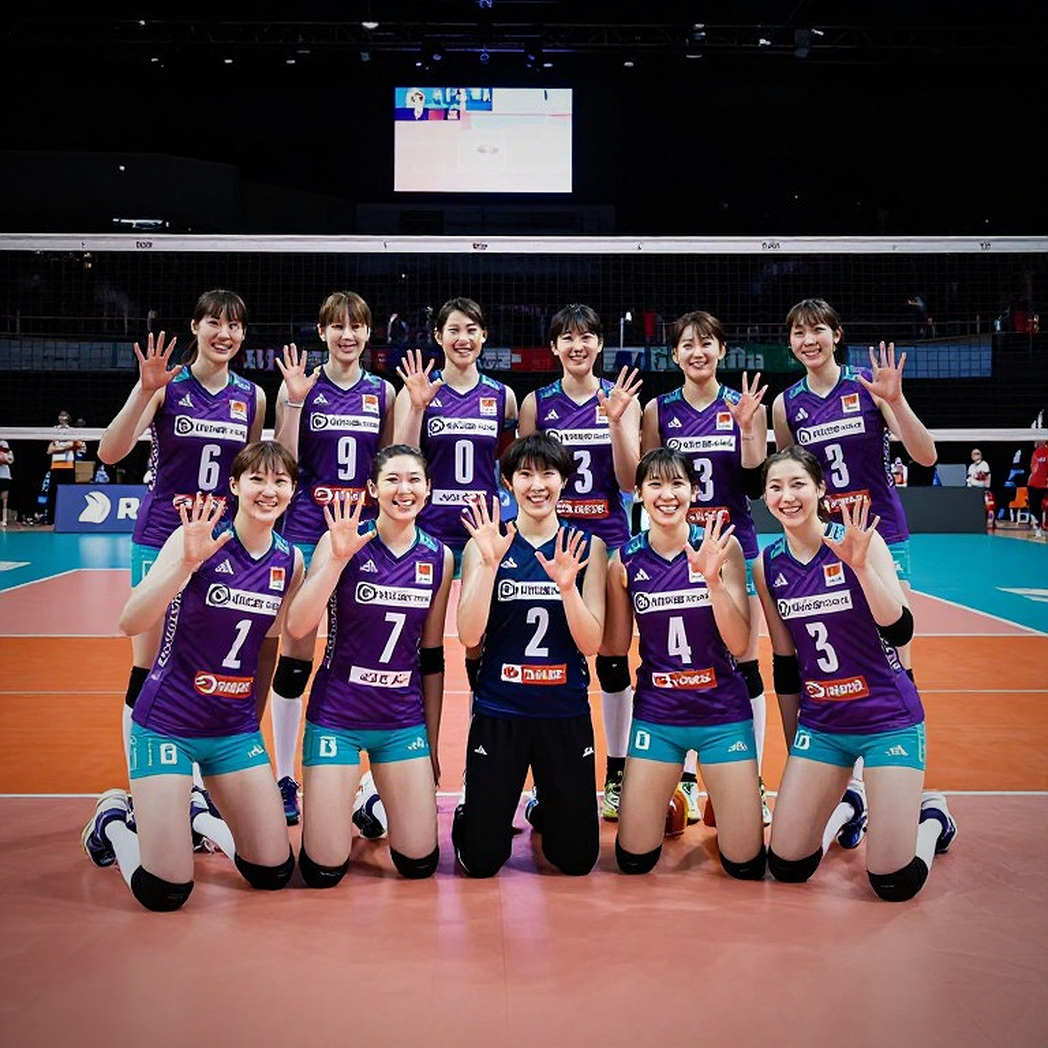
Why does this model matter for Southeast Asian volleyball? Because ordinary amateur tournaments have no distribution advantage. A university event run by a federation usually gets coverage through a few local articles. But a university event streamed on a national OTT platform can reach audiences at a scale other amateur events cannot dream of. This is a structural difference, not a difference of scale.
The spokesperson named for the event is Banardi Rachmad, MOJI's Deputy Director of Programming — a content-operations position. This shows success will be measured by engagement and broadcast metrics, not only by sporting results. A small detail, but a directional one.
I remember the summer of 2026 in Tokyo. Working as a communications assistant for an Olympic team, I got access for the first time to a private GPS dataset after a group-stage match. A twenty-year-old midfielder made thirty-four sprints, nearly double his own season average. I built a muscle-load model and warned of injury risk. The medical staff initially ignored it. By the second half, that player asked to be substituted with a hamstring strain.
The lesson I took and still keep: data has no value if nobody reads it. Tokyo 2026 spoke through GPS a single sentence — every athlete is a map of limits. And LVM 2026 is the same, except the map here is not of one body but of a whole system. The three data layers I just placed side by side — structure, money, operations — are the map of this tournament's limits.
Contrarian angle: a "national stage" for 620 dollars
I want to pause on one detail the Indonesian media may skip. The MOJI representative described LVM's goal as bringing young volleyball talents onto the "national stage." It is a beautiful slogan. But it collides with the real number.
A tournament that declares it will lift talents to a national stage pays its sector champion exactly 10 million rupiah, about 620 US dollars. The entire development budget for four placements across both sectors is roughly 3,100 US dollars.
There are two ways to read this. The first is pessimistic: the "national stage" goal far outstrips actual resources, and this is exaggeration to attract coverage. The second, and I think the truer one, is: LVM does not sell money. It sells exposure. Its real value to a player is not the prize, but the chance to be seen by scouts, professional clubs, or the national team itself.
By that logic, the 620 dollars is really just a nominal sum to preserve sporting face. The real value is a slot on a national broadcast platform. And that is why the media-owned model works so efficiently: it does not need a big prize budget to attract players, because it gives them something harder to buy than money — the spotlight.
But here is the truly counterintuitive point I want to make. This model has a blind spot. When a media platform organizes, broadcasts and controls the image all at once, it holds the power to define what success means. And the success of a media tournament is usually measured in viewership, not in the quality of talent produced. If a round draws high viewership from a controversial incident, who judges it a success or failure? Vertical integration removes the intermediary, but it also removes the independent critic.
There is one more governance gap. No information shows LVM 2026 formally coordinating with PBVSI, Indonesia's national volleyball federation. That could mean the federation has tacitly approved, or it could mean the tournament stands apart from the federation system. For a tournament with a school component, player eligibility — who may represent a university, membership standards — is a small question that can become a big risk if a dispute arises. No such rule was published in the announcement. For a first-time event, this is a risk worth listing, without exaggeration.
What to track, and the real question
If I had to pick a single indicator to judge LVM 2026, I would not pick the number of teams or matches. I would pick recurrence.
The biggest risk for a first-time media-run tournament is not sporting failure. It is disappearance. Many media-branded tournaments appear once and never return, because they are experiments rather than long-term commitments. If LVM 2027 is announced, this model has a basis to become a standard. If not, it was just a beautiful fifteen-day event.
There is one thing I always remind myself when writing about numbers like these: injury — and, more broadly, the failure of a system — is an accident of the whole body, not one person's fault. A tournament does not collapse because of one individual's wrong decision. It collapses because of a chain of structural conditions nobody saw. In LVM, that chain lies in the gap between the "national stage" ambition and a still-thin development structure, in an unclear relationship with the national federation, and in unproven sustainability.
The real question of LVM 2026 is not who will win. It is: when October 2026 closes, will a second edition be written? Because a talent supply chain is not built by one broadcast. It is built by repetition. And repetition, not contention, is the hardest thing for a media platform to pay for.