
Amy Hunt, the Sydney Sweeney Advert and the Debate Over Female Athletes' Voices
**Câu trả lời cốt lõi**: Tại chung kết 200m nữ ở Budapest, Melissa Jefferson-Wooden thắng với 21,47 giây, thành tích nhanh thứ tư trong lịch sử cự ly này. Amy Hunt về thứ tư với 22,10 giây, thành tích tốt nhất mùa giải của cô. Sau đường chạy, Hunt liên hệ kết quả của mình với làn sóng phản đối quảng cáo gây tranh cãi của Sydney Sweeney. **Dữ kiện chính**: - Melissa Jefferson-Wooden (Mỹ) vô địch 200m nữ với 21,47 giây, xếp thứ tư trong danh sách nhanh nhất mọi thời đại. - Amy Hunt (Anh) đạt 22,10 giây, thành tích tốt nhất mùa giải, xếp thứ tư trận chung kết. - Kỷ lục thế giới 200m nữ là 21,34 giây của Florence Griffith-Joyner, lập năm 1988. - Budapest cao khoảng 100-150 mét so với mực nước biển, không tạo lợi thế độ cao đáng kể. - Chỉ số gió của kết quả 21,47 giây chưa được công bố, hạn chế việc xác nhận tính hợp lệ kỷ lục. **Nguồn**: BBC Sport | Đối chiếu chéo: VuaBong.vn **Hỏi đáp liên quan**: - Hỏi: Thành tích 21,47 giây có được công nhận là kỷ lục không? Đáp: Chưa, vì chỉ số gió chưa được công bố và luật điền kinh yêu cầu gió hỗ trợ không vượt quá 2,0 mét trên giây. - Hỏi: Amy Hunt đã vô địch những giải nào trong mùa hè trước đó? Đáp: Bản tin ghi cô giành bốn danh hiệu vô địch châu Âu, nhưng cách gộp nhãn này cần được kiểm chứng thêm. - Hỏi: Vì sao kết quả 22,10 giây được gọi là thành tích tốt nhất mùa giải mà không phải tốt nhất sự nghiệp? Đáp: Cách ghi này thường cho thấy thành tích cá nhân tốt nhất của vận động viên vẫn nhanh hơn 22,10 giây.
Amy Hunt, the Sydney Sweeney Advert and the Debate Over Female Athletes' Voices
On a Sunday night in Budapest, Amy Hunt crossed the line in lane six in 22.10 seconds. It was her fastest time of the season. It was also only good enough for fourth place. Somewhere on an inside lane, Melissa Jefferson-Wooden had already finished, the electronic clock stopping at 21.47 — the fourth-fastest women's 200m in history.
In the mixed zone, when a reporter asked Hunt how it felt to be left behind in a final run at that speed, the British sprinter did not answer immediately. She was silent for a few seconds. Then she talked about an advert.
The advert came from America. The fashion brand American Eagle hired actress Sydney Sweeney as its face and built the message around a pun: "Sydney Sweeney has great jeans." In English, "jeans" sounds almost exactly like "genes." The message was fairly clear: her gene pool is excellent, and it deserves to be passed on.
The reaction was fast and furious. Many critics pointed out that this phrasing touches a deeply sensitive nerve — eugenics, scientific racism, and a long history in which women, particularly women who are not white, were judged through their bodies and their bloodlines. A hashtag spread. Then a trend: thousands of women began posting their own achievements — degrees, medals, personal bests, finished projects — as a rebuttal to the idea that a woman's worth lies in her genes.
Female athletes were among the earliest participants. Amy Hunt was one of them. And what is striking is that she chose to speak immediately after one of the fastest races of her career.
Before analysing why that detail matters, one thing about how I follow this story needs to be clear. Across nearly four decades in this trade, I have learned that the moments when women's sport is undervalued rarely sit on the podium. They sit in places where people assume there is nothing to see. A refusal to answer a question. A few seconds of silence in front of a microphone. A number that is never published. Thirty-eight dust-covered diary pages in the archive of a football federation that once told me it had nothing to offer. Those, to me, are primary documents.
That night in Budapest produced two such documents. One was Jefferson-Wooden's 21.47. The other was Hunt's 22.10. And there was a third that nobody mentioned: the wind reading.
Jefferson-Wooden, 21.47 seconds, and a data gap
Let us start with the biggest result, because it is the most solid part of the story.
Melissa Jefferson-Wooden, 21.47 seconds. The women's 200m world record is 21.34, set by Florence Griffith-Joyner in 2026 in Seoul. The distance between the two numbers is 0.13 seconds. Over 200 metres, where a hundredth of a second is divided across two sprints, 0.13 seconds is both a chasm and a breath.
I checked the all-time list I have kept in my notebooks across many seasons. The familiar order remains: 21.34 by Griffith-Joyner in 2026; 21.41 by Shericka Jackson in 2026; 21.45 by Shericka Jackson in 2026; 21.53 by Elaine Thompson-Herah in 2026; and 21.56 by Griffith-Joyner, also in 2026. A mark of 21.47 lands exactly fourth.
In other words, the BBC's claim of "fourth fastest ever" is internally coherent on ordering. The logic chain holds. That is credible.
But one piece is missing, and it is not a trivial detail.
The wind reading for the 21.47 was not disclosed in the report. For a performance at this level, the wind gauge is the single most important piece of metadata in the entire result file, and its absence is a material information gap.
The reason is specific. Athletics rules state that a sprint mark can only be considered record-eligible if the assisting wind does not exceed 2.0 metres per second. Any mark in the 21.4x range must be wind-verified before it can be called a record. If the wind exceeds the limit, the race is still magnificent, but it is pushed out of the cabinet where permanent numbers are kept.
I have sat in enough press rooms to know that a reporter who knows the craft will always note the wind reading when citing a performance at this level. Its absence from the first report may simply be an editorial matter. But it may also be a sign of something else: that the speed of the story has overtaken the speed of verification.
There is one more factor to eliminate, and this time I can eliminate it. Budapest sits at roughly 100 to 150 metres above sea level. This is one of the rare cases in sprint analysis where the altitude adjustment can be set to zero with high confidence. Unlike Nairobi or Mexico City, Budapest gives away no hundredths of a second. The entire speed of 21.47 belongs to Jefferson-Wooden's legs.
So let me record what I actually believe after assembling the pieces. Jefferson-Wooden is in a genuine form window, not a one-off flash. A mark at the all-time No. 4 position is generally only reachable from a stable technical base rather than a single lucky race. That is inference, not stated fact, and I hold it in exactly that position.
What remains is timing. A 21.47 in September, outside the peak championship window, tells me the women's 200m is now producing all-time top-tier depth even when there is no championship to serve as an excuse. That is a level marker.
But a level marker does not automatically convert into evidence of championship-proof nerve. A high-prize invitational final may carry less psychological pressure than an Olympic final, but it carries more financial incentive. The result is valid. The inference about temperament is not automatically transferable.
Hunt, 22.10 seconds, and the number that tells more
If Jefferson-Wooden holds the biggest result, Hunt holds the biggest story. And she holds it with a number.
22.10 seconds, fourth place. In a final where the winner needed 21.4x, a 22.10 places Hunt inside the global finals tier without yet lifting her to the medal tier. She stands just below the edge of the podium, at the distance every sprinter knows too well: close to the eye, far from the feet.
The more important thing lies in the last letter of an abbreviation. The report called 22.10 a season's best — SB. Not a personal best — PB. Those of us in the trade understand an unwritten rule: when a reporter carefully writes "season's best," it is usually because the athlete's personal best is faster.
If so, 22.10 is not Hunt's ceiling. It is a point on the climb.
I have followed Hunt since she was a phenomenon at age-group level. She belongs to the category I call "prodigy, then interruption" — girls whose junior marks were strong enough that the whole sport memorised their names, and whose senior careers were then broken by injury, by academic pathways, by seasons nobody watched. When they return, they do not return from zero. They return from an account that was never cashed out.
That is why I do not read 22.10 as a sudden leap. I read it as a late payment.
At 23, Hunt is entering the front edge of the peak window. Women's sprints generally peak between 24 and 29. Jefferson-Wooden sits squarely inside that band. Both results are age-consistent, meaning neither requires an extraordinary explanation. Sometimes in this trade, the ordinary thing in the right place is the most valuable information of all.
But there is a risk that analytical tables rarely pause over long enough.
British female sprinters with heavy junior workloads and prior career interruptions carry elevated chronic soft-tissue exposure — particularly in the hamstrings and the Achilles. Hunt belongs to that group. She has just come through a long summer: four European titles at a level the report calls "earlier this summer," followed by an invitational final in September. That is a multi-peak season. That pattern raises cumulative injury risk even when the results still look good.
I want to pause here, because this is where sports reporting usually drifts. It looks at the results sheet and sees an upward diagonal. A coach looks at the same sheet and sees a chain of insufficient rest days.
On the "four-time European champion" label, I keep a technical reservation. It most plausibly aggregates age-group and relay titles rather than four senior individual European crowns. Such aggregation is common in athlete-facing coverage. Before using it as an ability proxy, it should be verified. I do not have enough data to assert it, and I will not pretend otherwise.
A note, too, on the incentive behind a September fixture. The appearance of both Hunt and Jefferson-Wooden at an invitational at this point in the year most likely reflects the emergence of a late-season market driven by appearance fees, rather than a peaking objective. It is a real and growing market, and it is rewriting the calendars of sprint stars. But it does not replace a world championship final.
Neither athlete's injury status or training schedule appears in the report. On availability, I cannot assess. There are no splits, no reaction time, no wind. All four pieces are absent. Without them, no technical judgement on either athlete's race execution is defensible.
The contrarian angle: an advert is paying for the voice
This is the part I consider the true centre of the story, and also the part least often stated plainly.
A sprinter has just run 22.10 and finished fourth in a final whose winner sits fourth on the all-time list. By the standards of sports media, that should be the headline. In the report, it sits behind an answer about a fashion campaign.
There are two ways to read this, and both are true to some degree.
The first reading: this is a sign of maturity. Female athletes today have media platforms to speak from, and they are using them. They are using them for issues beyond the track. That is something my generation in Nairobi — the girls who sold fruit to pay training-ground fees — could only dream of.
The second reading is more uncomfortable: that voice is being paid for by a commercial controversy.
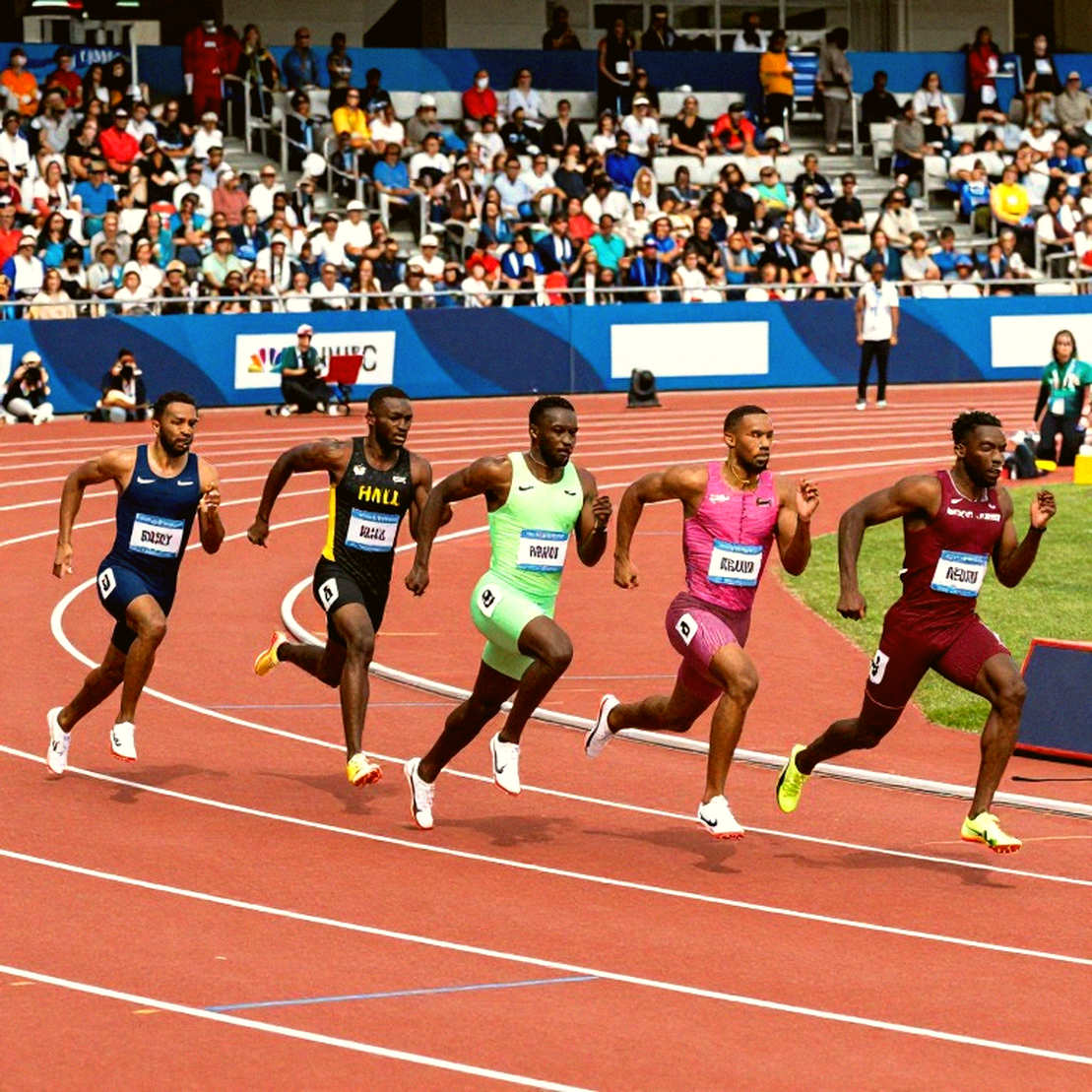
When a female athlete is heard most loudly at the moment she comments on an advertising campaign rather than at the moment she runs 22.10, the attention structure of the sport is telling us a great deal about itself.
I write biographies to pull back the invisible curtain that men's sport draws over women's sport, and I know exactly where the trap lies. The trap is not female athletes speaking up. The trap is that we only hear them when they speak on a subject the public is already primed to shout about.
I carry a professional obsession with me from a 45-minute coffee in Amsterdam, where Vivianne Miedema told me how invisible she felt when men's football was played in empty stadiums during the pandemic. She said something I have never forgotten: for women's football, invisibility is permanent, no pandemic required.
Budapest was a miniature version of that sentence.
There is one further risk, and this one sits on the athlete's side. This is the most fragile development phase of a sprinter's career. It is when hamstrings, Achilles tendons and the central nervous system are being forged at their highest threshold — and also when one extra interview, one extra shoot, one extra evening answering messages can take away exactly the recovery the body needs.
Media load is not an abstract concept. It has weight. It sits in the same ledger as training volume.
I remember the look in Asisat Oshoala's eyes in Rio in 2026 — and I remember that refusal is also a form of love. Hunt has refused nothing. But she stands at the exact intersection of two pressures: technical expectation on one side, symbolic expectation on the other. People want her to represent something larger than herself, at precisely the moment her career needs her to be at her most selfish.
What is changing
On Hunt's legs, I see a generation of female athletes who were never properly named. And I see them naming themselves, without waiting for anyone else to do it.
An empty stadium, yet her voice still echoes — the track does not need a grandstand to know who it belongs to. The task now is not to choose between 21.47 seconds and a hashtag. The task is to force the sports media machine to publish the wind reading, to separate SB from PB, to state the date and the tier of the meet — and only then to listen. A voice only has worth when someone is willing to verify the truth standing behind it.