
32:32.40 in Karachi: Sindh's First Gold and the Twelve-Minute Gap to the World
**Câu trả lời cốt lõi:** Mahnoor Fatima (Sindh) giành HCV đi bộ 5.000m nữ tại Giải vô địch điền kinh quốc gia Pakistan lần thứ 54 ở Đại học NED, Karachi, với thành tích 32:32.40 — tương đương 6 phút 30 giây/km, chậm hơn khoảng 60% so với chuẩn thế giới (khoảng 20–21 phút). **Dữ kiện chính:** - Thành tích 32:32.40 tương đương tốc độ 9,2 km/h; vận động viên đi bộ đẳng cấp thế giới đạt 14–15 km/h. - Nội dung nữ thi đấu 5.000m trong khi nam thi đấu 20km — cự ly vô địch chuẩn của cả hai giới là 20km. - Waqas (WAPDA) thắng 20km nam; ban tổ chức không công bố thời gian. - Tổng tiền thưởng giải là 9 triệu rupee Pakistan (khoảng 30.000–35.000 USD). - Giải do Liên đoàn Điền kinh Pakistan giám sát, Hiệp hội Điền kinh Sindh tổ chức, Lok Sahaeta tài trợ. **Nguồn:** Bản tin Giải vô địch điền kinh quốc gia Pakistan lần thứ 54, Đại học NED, Karachi (nguồn báo chí trong nước Pakistan; ngày công bố không được nêu trong bản gốc). **Hỏi đáp liên quan:** - H: 32:32.40 có phải thành tích đẳng cấp quốc tế? Đ: Không, đây là thành tích cấp phát triển trong nước, chậm hơn khoảng 60% so với chuẩn thế giới. - H: Vì sao nội dung nữ chỉ thi 5.000m? Đ: Cự ly rút ngắn phản ánh lực lượng vận động viên đi bộ nữ mỏng, không đủ lấp danh sách xuất phát 20km. - H: Yếu tố nào thu hút sự chú ý của giải? Đ: Sự hiện diện của Arshad Nadeem, nhà vô địch Olympic ném lao Paris 2024 với 92,97m.
The NED University track in Karachi has no steep grandstand. The loop is just long enough for twelve and a half laps of the women's 5,000m race walk. When Mahnoor Fatima of Sindh crossed the line, the electronic clock stopped at 32:32.40. No cheer was loud enough to drown out the announcer. A few dozen people sat scattered across the concrete steps — mostly officials, judges and athletes waiting for their own events. A national gold medal had just been awarded in that setting, and it was Sindh's first gold of the championship.
I am used to this setting. After years of sitting at the edge of tracks nobody watches, I have learned that the most recordable moment is rarely the broadcast one. Forty-five minutes at the edge of the field, a lifetime that never ages. An athlete crosses the line in an empty stadium, then walks back to pick up her jacket, pulls the zipper on her bag herself — that small detail says more about this sport's place in public life than any results table.
Context: a national championship run on the departmental model
The 54th National Athletics Championship took place on the NED University track, supervised by the Athletics Federation of Pakistan (AFP), organised by the Sindh Athletics Association (SAA) with support from private sponsor Lok Sahaeta. The opening ceremony was attended by Sindh Home Minister Zia Hussain Lanjar — a detail anyone who follows South Asian sport reads correctly: provincial-level sport here is a channel of political visibility, and that visibility is what gives the event a budget.
The entry list is the most interesting part of the whole event. Beyond the four provinces there were the Higher Education Commission, the Pakistan Air Force, the Navy, Railways, Police, plus Azad Kashmir, Islamabad and Gilgit-Baltistan. This is the "departmental team" model — a legacy of the public-service sports system across South Asia, where an athlete does not live on prize money but on a payroll. A place in the Water and Power Development Authority (WAPDA) athletics squad means an employment contract, a stable salary, accommodation and a training stipend. In a country with no American-style university athletics scholarship system and no professional league market, the payroll is the entire welfare system of a runner.
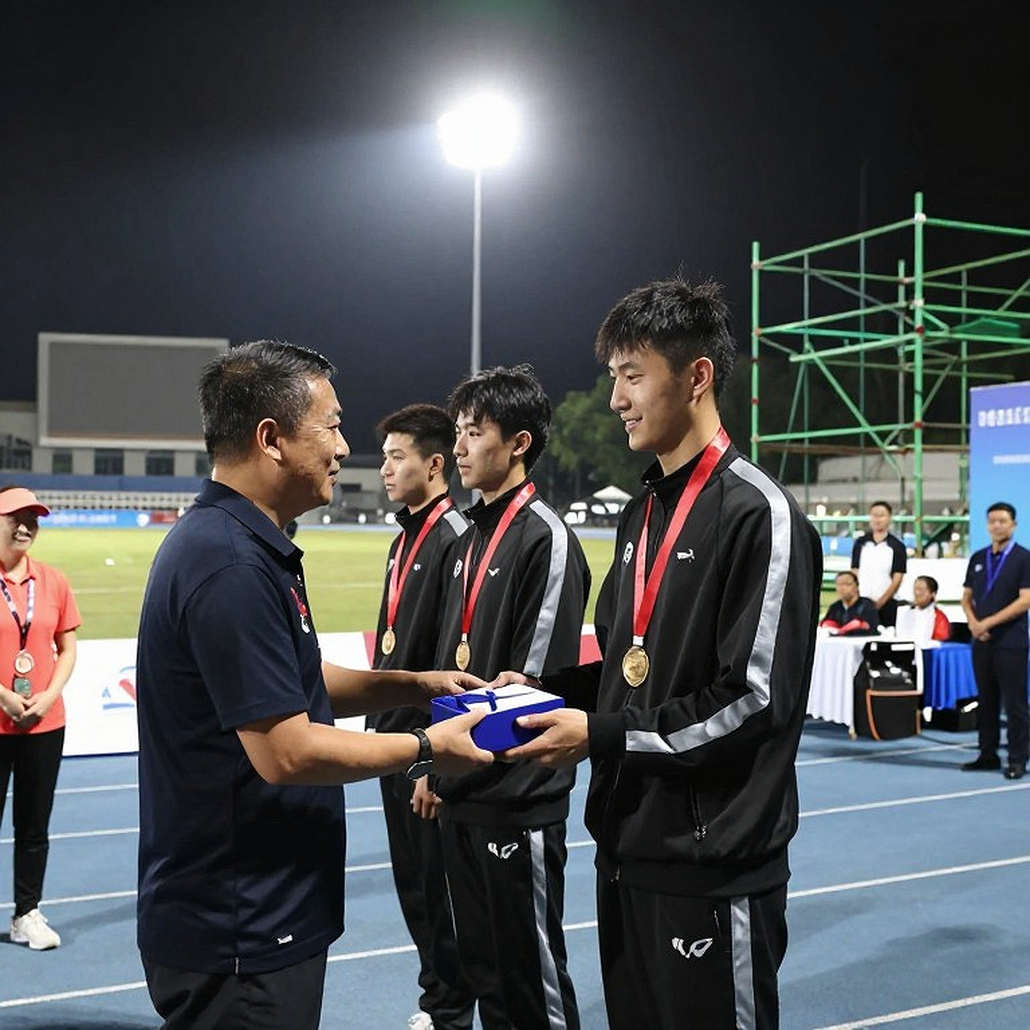
The championship's total prize pool was 9 million Pakistani rupees, roughly 30,000 to 35,000 US dollars. For a national championship in a country with a GDP per capita below 2,000 dollars, that is not a small figure. It is enough for a provincial athlete to have a reason to train every morning, and enough for a coach to have a reason to keep a group of a dozen people together.
The rest of the event is anchored to one name: Arshad Nadeem, Olympic javelin champion at Paris 2026 with 92.97m — an Olympic record. His presence at a national championship, alongside Shajar Abbas, the national 100m record holder, and Moeed Baloch, was described in domestic coverage as names "expected to attract attention." That phrasing is accurate to the point of being revealing: they are drawcards, not necessarily people who will run flat out here.

Core: reading 32:32.40 with the simplest division available
There is a way to check any race-walking result without any database: divide time by distance, then compare speeds. 5,000m in 32 minutes 32.40 seconds is 6 minutes 30 seconds per kilometre, about 9.2 km/h. For comparison, a world-class race walker over the same distance finishes in roughly 20 to 21 minutes, equivalent to 14 to 15 km/h. The gap between the two is more than twelve minutes, about 60% slower.
A national gold medal and a world championship entry are two entirely different things, and the gap between them in this event is more than twelve minutes. That is the whole meaning to be drawn from 32:32.40, and it needs to be said calmly — not to diminish Mahnoor Fatima, but to protect her from expectations that would crush her over the next two seasons.
There is a structural detail few notice. At this championship, men contested the 20km race walk — the official world championship distance. Women contested 5,000m on the track. The 5,000m race walk is not a senior global championship distance for women; the women's championship distance is also 20km. When a national championship stages a shortened distance at one quarter of the standard, it usually reflects something very specific: there were not enough athletes to fill a 20km start list. Shortening the distance is how the race still happens. It is a solution to a resource problem, not a technical choice.
I have seen this mechanism in many places. When a federation must choose between cancelling a women's event and shortening it, it always chooses the second — the right choice in the short term, the wrong one in the long term. Because once the distance is shortened, the pressure to build a squad deep enough for the standard distance disappears. Nobody is accountable for a gap that is no longer measured.
Race walking also has a technical peculiarity that separates it from every other athletics discipline: it is decided by judges more than by the clock. The rules require at least one foot on the ground at all times and a straightened support leg under load. Three red cards from three different judges are enough for disqualification. At 9.2 km/h, technique is barely tested; at 15 km/h, every stride is a gamble with the judges. Which means a race walker at development level can complete a race without ever really touching her technical ceiling.
And here is where the data goes quiet in the most troubling way. The report gives no time for Waqas, who won the men's 20km for WAPDA, nor a mark for Gulfam, who took bronze. No runner-up time in the women's event. No splits. No field size. No judging information or red cards. A report on a race missing every comparative marker leaves exactly one thing to read: the ranking. And ranking, without margins, is empty data.
Looking at a scoreboard, I learned to read what is not written down. Here, what is unwritten outweighs what is written, and that in itself is information about the championship's reporting system.
On Mahnoor herself, the profile is close to blank. No year-by-year personal bests. No season's best for comparison. No injury history. No periodisation data. The only substantive signal sits in her post-race thank-you: she named three people — coach Nadia, Shahbaz and Abdullah. Three names for one athlete signals a small, dispersed, provincial support structure rather than a national training centre with a sports-science staff. That is how provinces in South Asia operate: a few committed coaches, a training ground, and nothing else.
One thing must be said clearly about how to read this result. This young woman won a race. She stood on the top step of a national championship, and for her personally that is a real event, with weight and value in her competitive record. The fact that the mark is far from world standard does not diminish the fact that she trained and she won. But it does mean that every projection about her — "rising star," "the future of Sindh athletics" — is being built on ground whose depth we have no data to measure.
Contrarian angle: the gold medal is not the story
Read only the headline and the story is: Sindh has its first gold. Read the structure and the story is: a sports system is using prize money and payrolls to keep alive an event it has not yet built a field for.
Start with the 9 million rupees. In a championship where every gold is rewarded, the incentive design produces a very predictable behaviour: delegations enter more events, register more athletes in events with few rivals, and prioritise medal counts over performance quality. Analysts call this "medal farming." It is not cheating. It is the logical consequence of a reward design. But it makes numbers like "Sindh's first gold" far harder to interpret than they look.
Second, and this is the point I consider most important: dependence on a single athlete is the largest structural risk in Pakistani athletics, and it is being concealed by that athlete's own presence. Arshad Nadeem is an Olympic champion, a record holder, the one person who pulls Pakistani athletics out of zero coverage. But a sport whose entire sponsorship capacity, media attention and national championship pull rests on one javelin thrower is not a system; it is an event. When Nadeem appears, the championship has an audience. When he is absent, it returns to what it is: a university ground, a few dozen spectators and a loop of track.

I have written about this mechanism in another setting. In the stands of Russia, I heard many empty seats with women's names on them. There, the absence of women spectators was not an accident of that particular evening; it was the product of decades of small decisions about who is invited, who is broadcast, who is remembered. In Karachi the mechanism runs on a different axis but the same logic: an event with no star has no audience, an event with no audience has no sponsorship, and an event with no sponsorship will soon have its distance shortened.
This leads to a conclusion that is uncomfortable but needs saying: the fact that Pakistan's women's race walk stages 5,000m instead of 20km is not a sign of attention. It is a sign of absence — and that absence is being legitimised by a gold medal.
I want to place two facts side by side without reconciling them. On one hand, Mahnoor Fatima did what no Sindh athlete had done at this championship, and she deserves recognition for it. On the other, a women's event that can only be staged at a shortened distance is structurally incomplete. Both are true. A sportswriter's job is to hold both in the same sentence, rather than picking the easier one for the reader.
As for the departmental model — the system that carried Waqas of WAPDA to the 20km title and put military, railway and police teams into every medal table — it is a strength and a weakness at once. It provides employment, stability and a reason to keep training past twenty. But it also separates performance from the market: an athlete does not need to sell tickets, attract sponsors, or have an audience. He only needs to finish ahead of his colleagues. In such a system, the incentive to improve absolute performance is far weaker than the incentive to improve relative ranking. And that is precisely why a country can stage its 54th national championship with 9 million rupees in prize money and still have exactly one world-class athlete.
What to watch
There are three signals I will keep on my list after this piece.
The first is Mahnoor Fatima's trajectory. The threshold to watch is not medals but time. If over the next two seasons she brings her 5,000m race walk below 28 minutes, that will be a sign of genuine development, because it demands changes in technique, in training volume and in support structure — three things prize money cannot buy. If the mark stalls or oscillates around 32 minutes, the gold in Karachi will remain a pleasant memory in a personal file.
The second is the depth of the women's race-walking field. A healthy sign is not one new name appearing, but a start list long enough that organisers can hand out silver and bronze to people who genuinely finished behind. In events with only a handful of athletes, silver is often an administrative coincidence rather than an achievement.
The third, and the one I care about most as a writer on women's sport: whether Sindh turns this first gold into a programme. When the stadium is empty, ordinary voices suddenly become leaders. A gold medal does not generate the next athlete by itself. What generates the next athlete is a coach paid to be at the track at five in the morning for twelve consecutive months, a pair of shoes that is not a hand-me-down, and a fourteen-year-old girl who sees someone like herself on the track. None of that appears in the report.
In Vietnam we have also sent a male 20km race walker to the Olympic stage, and we know what it feels like when an event is represented by only a few names for an entire country. That experience taught me something very concrete: an event only lives when there is a second, a third and a fourth person on the start line, because only with rivals is there pressure, and only with pressure is there performance. A lone gold medal is a full stop; a deep start list is a sentence.
32:32.40 will not be remembered as a mark. But it could be remembered as the starting point of something — if someone in Sindh decides this gold medal is a reason to open a race-walking class for twelve-year-old girls, rather than a reason to print a banner. The difference between those two choices is not on the clock. It is in how many people will stand on the start line of the loop at NED University ten years from now.