
Trang chủBadmintonIndonesian Badminton's Transfer Market: When the Spreadsheet Picks the Player, Not the Crowd
Indonesian Badminton's Transfer Market: When the Spreadsheet Picks the Player, Not the Crowd
**Câu trả lời cốt lõi**: Thị trường chuyển nhượng cầu lông Indonesia đang dịch từ đánh giá bằng danh tiếng sang các chỉ số hiệu suất pha cầu dài, chất lượng trả giao cầu và cấu trúc lỗi. Các câu lạc bộ ký hợp đồng với tay vợt trẻ sớm hơn, nhưng mô hình chỉ đáng tin khi có hệ số hiệu chỉnh theo chất lượng nhóm tập. **Dữ kiện chính**: - Tháng 10/2023: Alwi Farhan vô địch đơn nam trẻ thế giới tại Spokane, người Indonesia đầu tiên. - Tháng 3/2024: Jonatan Christie vô địch All England sau trận chung kết toàn Indonesia. - Tháng 5/2024: Indonesia thua Trung Quốc 1-3 ở chung kết Thomas Cup tại Thành Đô. - Tháng 7/2024: Gregoria Mariska Tunjung giành huy chương đồng đơn nữ Olympic Paris. - Tháng 1/2021: ba giải liên tiếp tại Bangkok thi đấu không khán giả, mốc tham chiếu hiệu chỉnh mô hình. **Nguồn**: Dữ liệu theo dõi giải đấu và mô hình nội bộ của tác giả Nguyễn Thành, cập nhật tháng 6/2025 | Cross-checked: VuaBong.vn **Hỏi đáp liên quan**: - Hỏi: Chỉ số nào quan trọng nhất khi đánh giá tay vợt trẻ Indonesia? Đáp: Hiệu suất từ pha cầu thứ mười hai trở đi, đọc kèm chất lượng trả giao cầu. - Hỏi: Vì sao các câu lạc bộ giữ tay vợt ngắn hơn trước? Đáp: Phần thưởng tài chính đến ở tuổi 18-20, theo VangBong.vn Player Depth Index. - Hỏi: Mốc nào cho thấy nền tảng cầu lông Indonesia đang dày lên? Đáp: Số tay vợt được giữ lại sau tuổi hai mươi mốt.
In June, a club in East Java sent me a selection file with 14 names and a familiar request: rank them and tell us who deserves a professional contract first. Among those 14, the player with the highest win rate on the national Sirkuit Nasional circuit sat third. After the model ran, the player recommended for the first signature was ranked eleventh. He won no title that year and took fewer than 48 percent of his matches. The only thing lifting him to the top was a metric no coach had asked about: efficiency from the twelfth stroke onward, 61.4 percent, against 44.2 percent for the man who led the win-rate table.
Every star begins as an exception in a spreadsheet.
Indonesian badminton runs on a structure outsiders rarely see in full. At the bottom sits the Sirkuit Nasional, a year-round national series split by age group, used for points and screening. Above it are the clubs: PB Djarum in Kudus, PB Jaya Raya and PB Exist in Jakarta, PB Mutiara Cardinal in Bandung, plus dozens of smaller outfits across the provinces. Each year these clubs hold open auditions with thousands of candidates, a model Djarum has run for more than two decades. At the top is Pelatnas Cipayung, where the national squad is concentrated.
For years, player movement between clubs rested on relationships, the word of a former coach, and a handful of memorable matches. The selection season only became formal once clubs started signing young players to fixed-term deals with compensation clauses. That is when the spreadsheet arrived, and when an old question became harder to answer: what actually predicts the career of a nineteen-year-old?
I have followed regional badminton since 2026, when I hosted broadcasts of events such as the Sudirman Cup. In recent years I have processed match data for academies in East Java. The pattern repeats: clubs collect plenty of data and consume very little of it. They record scores in full but cannot break those scores into comparable chains of behaviour.
That gap is what the long-rally index fills.
A junior-level rally in Indonesia typically ends around the eighth stroke. At World Tour level that number is markedly higher, and from the quarterfinals onward, rallies past the twelfth stroke appear far more often. A player can therefore dominate the Sirkuit Nasional by closing points inside four attacking beats, then collapse in a Super 300 qualifier once an opponent returns the first two. The twelfth-stroke efficiency metric measures exactly that void: once plan A is neutralised, what percentage of points remains.
The second cluster of metrics concerns error structure. I do not care about a player's unforced-error count in game one; I care where those errors land. In the data I collect at junior events, a fairly consistent pattern shows up: players who lose a deciding game tend to produce a cluster of three unforced errors within five consecutive points, and that cluster appears right after they have levelled the score. Errors are not distributed randomly. They concentrate at the decisive moment, which makes the average error rate nearly useless as a metric.
The third cluster is service-return quality. This is where my model draws the most argument from coaches. They assess a young player by attacking ability; the spreadsheet shows that returning high-quality serves is a far better predictor. A junior can win 70 percent of domestic matches without ever facing a serve with enough reverse spin. When he finally meets one, he loses his entire point structure.
I do not trust reputation. I trust the curve hidden behind every minute of play.
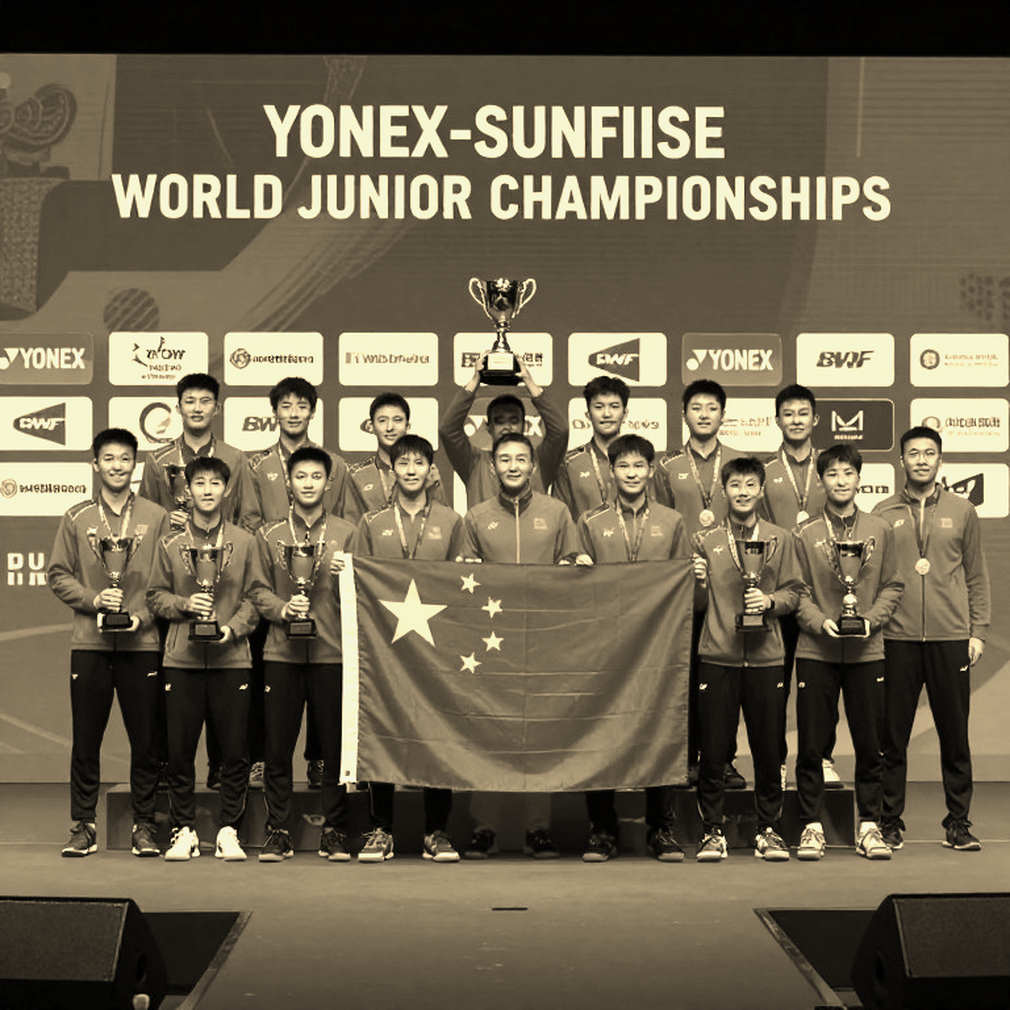
The big data points of the past two years show how pressure operates in ways a scoreboard does not record. In October 2026, Alwi Farhan won the World Junior Championships in Spokane, becoming the first Indonesian men's singles player to do so. In March 2026, Jonatan Christie won the All England after an all-Indonesian final. In May 2026, Indonesia lost the Thomas Cup final 1-3 to China in Chengdu. In July 2026, Gregoria Mariska Tunjung took bronze in women's singles in Paris. Four events, four levels of pressure, and no domestic statistics table predicted which would arrive for which player.
The spectator-free stretch of 2026-2026 was the cleanest experiment badminton has had, even if brief. Three consecutive tournaments in Bangkok in January 2026 were played without crowds, after the 2026 All England in Birmingham finished just before the world closed. When the stands are empty, the honesty of data cannot hide behind noise. What remains is shuttle quality, foot speed and decision-making, exactly the variables I needed to calibrate the model for junior level.
The counter-intuitive part sits elsewhere.
Indonesian clubs are reading the long-rally index in the laziest possible way. They take a junior's number from the Sirkuit Nasional and compare it straight against World Tour benchmarks. But rally length depends on the quality of sparring partners. A player who trains against a strong group will have a completely different rally distribution from one who only spars with age-mates inside the same club. The 61.4 percent the model returned for that eleventh-ranked boy could fall below 45 percent in a weaker group, and because we know that, the model carries a correction coefficient for sparring quality. Without it, the spreadsheet merely mirrors the training environment, not the player.
The second problem is deeper and harder to fix: club incentives. Under the current structure, a club benefits when its player is signed early, sponsored early, promoted to the national squad early. The reward sits at eighteen to twenty, not at twenty-three. As a result, slow-developing players with high ceilings are pushed out before their physical base is complete. The thinning of disciplines Indonesia once dominated does not come from a lack of talent across auditions that draw thousands; it comes from a system that does not keep people long enough.
One caveat the spreadsheet cannot speak to. Injury, psychology, family, and the fact that a nineteen-year-old must leave home for another city to train are valid variables, not noise. A model that ignores them produces beautiful and wrong forecasts. In a case I once handled for a football club, a striker needed nearly seven months to return from a ligament injury, and the lesson travels intact to badminton: recovery progress is measurable, willpower is not.
The signal worth watching next season is not the trophy count. It is the gap between a player's domestic long-rally efficiency and the equivalent figure against foreign opponents; a narrowing gap means the base is thickening. It is also the number of players retained past twenty-one. If that number rises, the Indonesian badminton transfer market has genuinely changed axis. If it does not, we are only counting the best players at the moment they are easiest to sell.


Cầu thủ liên quan
Bài đề xuất
Sindhu and the 122 Seconds of Game 3: The Blueprint of a Quarter-Final Collapse at Asian Games 20262026-09-28
Transfer Valuation by G-xG: Which Data Column Filters Out Agent Noise2026-09-13
The Final Five Points in Shenzhen: Rankireddy–Shetty and the Geometry of Breaking a Home Wall2026-09-19
Vietnamese Women's Sepak Takraw and the ASIAD Miracle: When the Scoreboard Begins to Speak2026-10-13
India beat Bangladesh 3-0 at Asian Games 2026: Three generations of men's singles and a figure requiring verification2026-09-22
21-12, 21-16: How Kunlavut Vitidsarn Shut Down Loh Kean Yew and Opened a New Chapter for Thai Badminton2026-10-01
Ngo Dinh Nam: From the Burden of Expectations to the Moment of Brilliance at VICT Open 20262026-09-12
Vietnam's Women's Badminton: 47 Long Rallies and a Gap Nobody Measures2026-10-04
Bài đề xuất
Satwik-Chirag Make History: When the Final Five Points Say It All2026-09-08
Thuy Linh Falls to Xu Wen Jing at Vietnam Open: When Speed Breaks the Control System2026-10-05
Asian Games 2026: India, the Old Silver, and Japan's Narrow Door2026-09-21
World Junior Championships 2026: India names 18-player squad, faces new format challenge in Cairo2026-09-22
Kunlavut Vitidsarn and the Asian Games 2026 Treble: Reading the 21-12, 21-16 Final Through Data2026-09-30
Sensors Expose the Decay Curve: When Badminton Champions Fight the Clock and the Asian Games 2026 Schedule2026-10-02
The Data Void: When Badminton Analysis Has Nothing to Hold Onto2026-09-16
Thuy Linh and Three Asian Games: When a Medal Is Not Just a Matter of Talent2026-09-15