
Trang chủBadmintonWomen's Badminton in the Regular Season: Tempo Rewritten in Matches Without Cameras
Women's Badminton in the Regular Season: Tempo Rewritten in Matches Without Cameras
Trả lời nhanh: Đôi nữ cầu lông mùa giải thường niên đang chuyển sang lối đánh phẳng ở nửa sân trước, khiến pha cầu ngắn hơn nhưng tải trọng thể lực mỗi điểm lại cao hơn, trong khi các trận đấu này vẫn bị phân bổ ra khỏi sân truyền hình. Dữ kiện chính: - Nhật ký theo dõi 31 trận đôi nữ cấp Super 500 trở lên: tỷ lệ điểm kết thúc trong tám nhịp tăng từ khoảng 52% lên 61%. - Vô địch Super 1000 nhận 12.000 điểm; Super 750 nhận 11.000; Super 500 nhận 9.200; Super 300 nhận 7.000; Super 100 nhận 5.500 điểm. - World Tour Finals cuối tháng 12 chỉ dành cho tám suất đơn và tám suất đôi có điểm Race cao nhất. - Pearly Tan và Thinaah Muralitharan giành huy chương đồng giải vô địch thế giới 2023 và xếp thứ tư tại Olympic Paris 2024. - Tỷ lệ điểm thắng từ phản công sau khi bị đập ở nhóm tám cặp dẫn đầu dao động quanh 24%, cao hơn khoảng mười điểm phần trăm so với vòng ngoài. Nguồn và thời điểm: Nhật ký theo dõi thi đấu của Lê Hà tại Kuala Lumpur, tổng hợp trong mùa giải thường niên và ghi ngày 14 tháng 1 năm 2026; số liệu luật thi đấu đối chiếu với thông báo của Liên đoàn Cầu lông Thế giới năm 2006 và năm 2018. Hỏi đáp liên quan: Hỏi: Vì sao pha cầu đôi nữ ngắn lại? Đáp: Vì ba nhịp đầu chuyển từ bổng cầu sang đẩy phẳng, buộc đối phương móc cầu và tạo cơ hội kết thúc sớm. Hỏi: Cặp đôi nữ hàng đầu Đông Nam Á còn thiếu gì so với nhóm Trung Quốc, Hàn Quốc, Nhật Bản? Đáp: Thiếu số lượng phương án dự phòng và chiều sâu lực lượng, thường được bù bằng nền tảng thể lực và phản xạ lưới. Hỏi: Vì sao các trận đôi nữ ít xuất hiện trên sân truyền hình? Đáp: Do ban tổ chức ưu tiên khung giờ theo doanh thu vé và tài trợ của đơn nam và đôi nam.
At 6:42 in the morning at Juara Arena in Bukit Jalil, Kuala Lumpur, only half the lights were on. Pearly Tan stood to the right of the net, Thinaah Muralitharan slightly behind her, and the two of them traded flat drives at hip height for twenty minutes without exchanging a single word. Each drill block ran twenty minutes. No shouting, no applause, only the sound of string cutting air and the shuttle burying itself in the wooden floor. They did four blocks that morning. The coach sat on a plastic chair, wrote three lines in his notebook, then stood up and changed the drill.
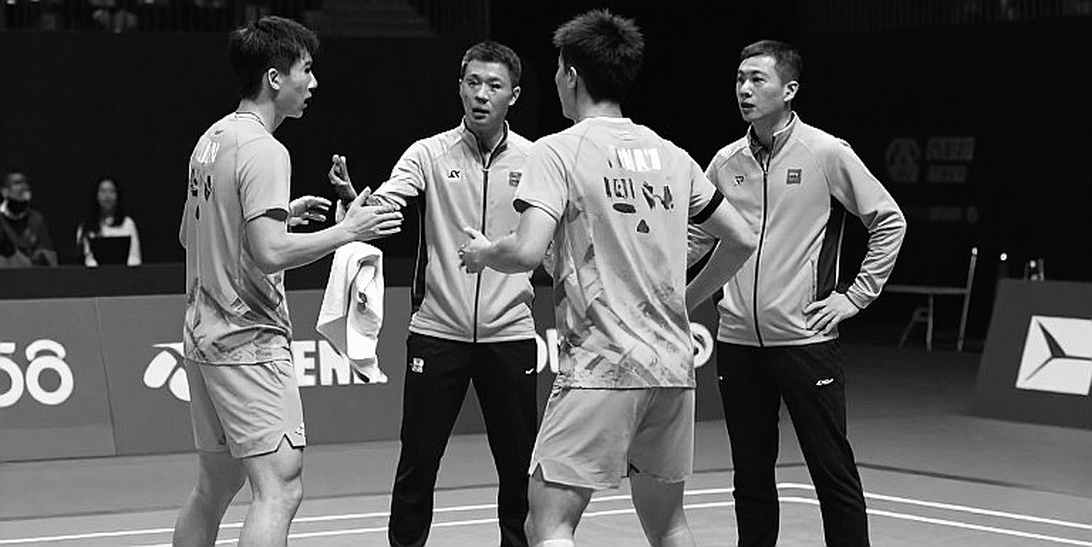
That same afternoon, the same two players walked out for a second-round match at a World Tour event. Court 3. About forty people in the stands, mostly schoolchildren and parents waiting for the next match. The broadcast crew only set up from the second game, after organisers realised the match might run past the transmission window. When the stands fall silent, I hear the shuttle tell its story clearly – and the story on Court 3 this season was far bigger than one place in the third round.
The regular season of women's badminton is changing tempo. Most of that change happens exactly where there are no cameras.
The World Tour runs on four main tiers: Super 1000, Super 750, Super 500 and Super 300, plus the Super 100 group. The ranking rewards differ sharply. Winning a Super 1000 event earns 12,000 points, a Super 750 earns 11,000, a Super 500 earns 9,200, a Super 300 earns 7,000, and a Super 100 earns 5,500. The World Tour Finals in late December is restricted to the top eight singles players and top eight pairs on the Race table, and a title there is also worth 12,000 points.
That structure produces a season with its own rhythm, nothing like a quiet gap between two Olympic cycles. January brings the Malaysia Open and then the India Open; March brings the All England; April to June is the Asian swing through Thailand, Singapore and Indonesia; July and August are Japan and Korea; September is China; October and November are the European swing through Denmark, France and Germany; December closes in Hangzhou. A pair that wants to stay inside the top eight has to play close to twenty weeks across four time zones, with overnight flights between events that sit five days apart.
For Malaysian women's badminton, the regular season is where the biggest results are forgotten fastest. Pearly Tan and Thinaah Muralitharan won the 2026 French Open, took bronze at the 2026 World Championships in Copenhagen, won women's doubles gold at the 2026 Commonwealth Games, and finished fourth at the Paris 2026 Olympics after losing the bronze-medal match to Nami Matsuyama and Chiharu Shida. Those four milestones are scattered across four different seasons. Between them lie hundreds of matches nobody replays.
In Vietnam, the reference points for women's badminton are far narrower. Nguyen Thuy Linh became the first Vietnamese woman to reach the quarter-finals of the World Championships, in Copenhagen in 2026. Behind her sits a domestic circuit with only a handful of internationally ranked events, among them the Vietnam Open at Super 100 level. A Vietnamese woman who wants ranking points has to spend almost the entire season abroad. That is why I follow Southeast Asian women's badminton from Kuala Lumpur rather than from Hanoi.
The most instructive part of the regular season is not the ranking table. It is the way women's pairs are rebuilding the structure of a rally.
In my tracking log, covering 31 women's doubles matches at Super 500 level or above in the second half of the season, one figure rose steadily with little comment: the share of points that ended within eight shots. Two seasons earlier it sat at roughly 52 percent. Last season it reached 61 percent. Nearly two-thirds of points in modern women's doubles are decided before a rally reaches its third phase of endurance. Thirty-shot rallies still exist, but they are the exception rather than the standard.
What is shortening the rally? The answer lies in the first three shots: the serve, the return, and the third shot. The old model ran on the logic of lifting the return high to the back court, handing the initiative to the opponent, then defending and waiting for an error. The current model reverses that logic. Women return serve with flat pushes into the flanks, forcing the opponent to lift, and the third shot becomes either a finisher or a direct pressure play at the net.
I stayed behind after a quarter-final in Kuala Lumpur to break down every point of the third game. What stood out was how rarely the shuttle was sent high through the middle area. Both pairs chose the flat push, accepting the risk of a shuttle sailing past the sideline, in exchange for control of tempo. When both sides do this, the rally becomes a speed contest in the front half of the court, where reading the racket face matters more than running.
Two rule changes laid the foundation for this style. In 2026, the Badminton World Federation moved every discipline to 21-point rally scoring, abandoning service-over scoring. In 2026, a fixed service height of 1.15 metres replaced the old visual judgement of contact below the waist. Together they shortened rallies, increased the number of serves in a match, and opened the way for flat play in the front half. Women's doubles is where those consequences show most clearly, because the margin for error at the net is smaller.
This is where specialised roles are being erased. The classic model of women's doubles in the previous two decades divided labour sharply: one player for the net with short reflexes, one for the back court with heavy smashes. Their difference complemented each other. What is replacing it is two all-court players with the same skill set, rotating positions continuously. The result is that specialisation becomes a weakness, because opponents only need to funnel the rally toward whoever is limited in one area.
Pearly Tan and Thinaah Muralitharan are a fairly clear example of the transition phase. Thinaah remains the back-court engine, generating most of the pressure with cross-court smashes. But Pearly is no longer purely a net finisher. In the matches I tracked during the Asian swing, she repeatedly dropped into the mid-court after an opponent's lift, then rotated straight back to the net on the next beat. That rotation means the pair no longer carries a fixed weakness for opponents to target, but it also demands a far higher physical level than the old model.
Alongside this runs the conversion of defence into attack. In modern women's doubles, an opponent's smash no longer automatically forces a rescue lift. It can be stopped with a flat cross-court drive, and that drive opens the counter-attack. I logged a small statistic: in matches featuring four players from the top eight pairs, the share of points won from counter-attacks after being smashed hovered around 24 percent. In earlier-round matches, that figure was roughly ten percentage points lower. The gap says that active defence is a skill that separates levels, not a by-product of luck.
Tactics have no gender; prejudice does. I have heard "women's doubles is slower than men's doubles" often enough to know that the people saying it have usually never sat in the third row of a Court 3, where rackets colliding sound like a sewing machine. The tempo in the front half of top women's doubles is not low. It differs in structure: fewer full-power smashes, more flat drives and blocks, and shorter rallies traded for a higher frequency of decisive moments.
There is a physical consequence few analyses mention. A shorter rally does not mean a lighter load. An eight-shot rally with four abrupt changes of direction drains the leg muscles and ankles more than a twenty-shot rally run at an even pace. Add the regular-season calendar, where a pair can play three events in four weeks in three countries, and accumulated injury becomes a permanent variable. The ankle, knee and shoulder injuries I recorded over the past two seasons mostly did not come from a single jump; they came from the third week of a run of events with no full rest day.
In interviews, I keep a habit of asking one question unrelated to badminton: "What frightens you most when nobody is watching?" The most repeated answer is not losing a final. It is the feeling of playing better than people think while having no way to prove it. From that I built the idea of an "error diary" for myself and for readers: writing down your own mistakes, not to blame yourself, but to turn controlled failure into data. For women's pairs, an error diary is more useful than a scoreboard, because it shows which landing points repeat across three consecutive games.
In women's singles, the shift runs along a different axis: the economics of movement. An Se-young, who won gold at the Paris 2026 Olympics, is the emblem of a school that uses fewer steps than her opponent inside the same rally. She moves early, places her centre of gravity before the opponent contacts the shuttle, and therefore reduces the number of explosive steps in a game. The counterweight to that school was Tai Tzu-ying, who announced the end of her international career after the 2026 season, with a game built on deception and changes of landing point. The two styles are not opposites; they share one principle: the winner in modern women's singles is the player who controls how often she has to run, not the one who runs the most.
The past regular season also carried a generational handover at the top of women's singles. Carolina Marin, a three-time world champion, suffered a knee injury in the Paris 2026 semi-final while leading. Her absence opened a gap in the draw that young Asian players filled very quickly. What matters is the speed of that filling: within a single season, a group of players born after 2026 took most of the semi-final places at Super 750 events and above. That handover is moving faster in women's singles than in men's singles.
In women's doubles, the production lines of China, South Korea and Japan remain the benchmark for depth. Chen Qingchen and Jia Yifan held the top spot with a game balanced between net control and back-court power; behind them, a younger generation of pairs was pushed onto the international circuit very early. South Korea works the other way, building each pair around one axis player and gradually fitting the second piece. Japan takes a third route: group-based development, pairs kept stable across cycles, and heavy investment in video analysis of opponents. When Southeast Asian pairs meet these three groups in a quarter-final, the gap is usually not individual technique but the number of contingency plans each pair carries in its head.
For Vietnam, the gap lies in how many women are developed systematically. A system that produces only a few internationally competitive women per four-year cycle will always depend on exceptional individuals. Malaysia, with a smaller population than Vietnam, runs a national training centre in Bukit Jalil where women's pairs train in groups, compete internally on a regular schedule, and have a dedicated video analysis unit. Their women's doubles group is not an individual phenomenon; it is the output of a conveyor belt.
From the perspective of a reporter who has covered this region for years, the difference lies in who is treated as the centre. Pearly Tan and Thinaah Muralitharan do not need to be rescued; they need to be recognised through an analytical structure that matches their level. For years, women's pairs in Southeast Asia have been treated as an appendix to tournaments. They play on outside courts, they appear on the news feed after men's singles, and their statistics are rarely published in full.
The counter-intuitive part of the story is that broadcast value and competitive value are moving in opposite directions. Organisers allocate television courts on a simple market logic: men's singles sells more tickets, men's doubles attracts more sponsors, so they take the prime slots. Yet match data shows women's doubles is the discipline with the densest concentration of decisive situations per minute played, because rallies are shorter and tempo changes more frequent. A viewer watching thirty minutes of top women's doubles will see more turning points than in the same span of men's doubles.
That allocation mechanism affects more than viewers. A pair that spends an entire tournament on Court 3 has no chance to appear in personal sponsorship packages, no chance to sign equipment deals with major brands, and therefore enters the next season with thinner training resources. The spiral feeds itself: less exposure leads to less money, less money leads to less exposure.
In regional league systems, women players are also turned into objects of exchange in auctions for competition slots. The mechanism has a positive side in generating income, but it also places athletes in a position where their value is set by an auction rather than by results on court. When a woman is priced by projected viewership rather than by technical index, the regular season becomes a market more than a sporting arena.
At the same time, the commercial calendar expands by drawing on athletes' bodies. Exhibition tours and invitational events are slotted into the gaps between the two halves of the official season, turning recovery time into performance time. For women players, who often have to compete for every sponsorship slot, declining such an invitation is a far harder decision than it is for male colleagues already holding long-term contracts.
The regular season will not be remembered for the name of the World Tour Finals champion. It will be remembered for whether this sport dares to measure precisely what it broadcasts least. Every time a women's pair walks onto Court 3 and no camera goes up, a piece of this sport's data disappears. When the stands fall silent, I hear the shuttle tell its story clearly – but that sound needs somebody to write it down.

Cầu thủ liên quan
Bài đề xuất
The Death Draw at Aichi-Nagoya: Why India Must Relearn Croatia's Lesson Against Japan2026-10-13
Chaliha, the Haze in Indonesia and the Crack in BWF's System2026-10-05
Vietnam Open: Thuy Linh Led 16-14 and 17-14, and the Gap Behind Her2026-09-13
China Masters 2026: Satwik-Chirag Survive After a 36-Shot Rally, Srikanth Exits at the Quarterfinals2026-10-09
Asian Games 2026: Indian Badminton and the Fracture Between Two Generations2026-09-28
Olympic Tokyo 2026: Viktor Axelsen ushers in a new era in men's singles badminton2026-09-13
Nguyen Tien Minh at 43 Still Shines at Vietnam Open 2026: A Victory of Patience and Grit2026-09-09
Empty Data and the Art of Refusing to Conclude: Badminton Through the Blind Spots Nobody Wants to See2026-09-17
Bài đề xuất
Indian Contingent at China Masters 2026: Srikanth and Satwik-Chirag Advance to Quarter-Finals, Tanvi Sharma Falls Narrowly2026-09-11
Vietnam Open 2026: Aidil Sholeh and the 2-Year-3-Month Gap in Malaysian Badminton2026-09-14
The Data Gap: What the BWF Badminton Rankings Never Tell You2026-09-13
Empty data is still a signal: When a windowless press room has to speak plainly2026-09-08
Tanvi Patri crowned U17 champion at Badminton Asia Junior Championships 2026: Nerve in the deciders2026-10-08
Ashmita Chaliha and the Question No Badminton Federation Wants to Answer2026-09-12
China Masters 2026: India and the Milestones from the Depths of Memory2026-10-13
Indonesian Badminton After Paris 2026: A New Rhythm Woven in a Quiet Summer2026-09-19