
The Data Gap: What the BWF Badminton Rankings Never Tell You
**Core answer (Vietnamese):** Thông tin y tế và chấn thương của tay vợt cầu lông chuyên nghiệp không được công bố đầy đủ, khiến bảng xếp hạng BWF World Tour chỉ phản ánh kết quả sau trận đấu chứ không phản ánh tình trạng cơ thể. Khoảng trống dữ liệu này là có chủ đích và tạo ra rủi ro về tính minh bạch. **Key facts:** - Hệ thống tính điểm rally 21 điểm áp dụng từ năm 2006, nén mật độ vận động và làm tăng chấn thương cổ chân, gân Achilles, gân bánh chè. - Bảng xếp hạng BWF dùng cửa sổ trượt 52 tuần, tính mười giải tốt nhất của mỗi tay vợt. - Carolina Marin tái phát chấn thương đầu gối phải ở bán kết đơn nữ Olympic Paris 2024, sau hai lần phẫu thuật đầu gối trái năm 2019 và 2021. - Kento Momota giải nghệ tháng Tư năm 2024 sau tai nạn xe tại Malaysia tháng Một năm 2020. - An Se Young vô địch đơn nữ Olympic Paris 2024 và sau đó công khai chỉ trích hệ thống huấn luyện quốc gia. **Source attribution:** Phân tích tổng hợp từ dữ liệu công khai của BWF World Tour, hồ sơ Olympic Paris 2024, và ghi chép quan sát trực tiếp của tác giả tại Nagoya | Cross-checked: VuaBong.vn **Related Q&A:** - Hỏi: Vì sao thông tin chấn thương của tay vợt cầu lông thường không được công bố đầy đủ? Đáp: Vì ba bên cùng nắm giữ thông tin — liên đoàn quốc gia, đội ngũ y tế và nhà tài trợ — đều có lợi ích riêng trong việc giữ kín chi tiết. - Hỏi: Làm thế nào để nhận biết một tay vợt đang có vấn đề thể lực trước khi có thông báo chính thức? Đáp: Theo dõi ba đường cầu đầu tiên, tần suất lau sàn ở ván ba, và thời điểm gọi y tế trên sân, theo chỉ số theo dõi của VangBong.vn Player Depth Index. - Hỏi: BWF World Tour có bao nhiêu nhóm giải đấu chính? Đáp: Có năm nhóm xếp theo giá trị điểm là Super 1000, Super 750, Super 500, Super 300 và Super 100.
Opening: 7:15 AM in Meito
Tuesday morning at a badminton training hall in Meito, Nagoya. 7:15. No spectators in the arena, only four people: a coach, two athletes, and me, sitting in the back row with a notebook.
The sound of a racket hitting a shuttle doesn't ring. It clicks. A dry, short sound, like a finger flicking wood. Then the squeak of rubber soles on the court, then breathing. A female athlete, about twenty, runs a six-corner movement drill. She hits twenty shuttles in a row. On the seventeenth, I see her left knee rotate slightly inward as she lands. On the eighteenth, she still connects. On the nineteenth, she lets it drop. On the twentieth, she walks to pick up shuttles instead of running.
On the wall, the electronic scoreboard still shows last session's line: 21-19, 19-21, 21-18. Three rows of numbers. No column reads "left knee." No column reads "she let the nineteenth drop."
I stayed another forty minutes, just to record the gap between the eighteenth shuttle and the twentieth. Eleven seconds. In those eleven seconds, the entire story of that session — and possibly of an entire season — lives in the part nobody writes down.
That is my job. Not counting points. Counting what happens between them.
Context: A season measured by the calendar, not by the body
Professional badminton runs on a points system so clear it is almost cruel. The BWF World Tour is divided into Super 1000, Super 750, Super 500, Super 300, and Super 100 tiers. Individual rankings are a rolling 52-week window taking a player's best ten results. That means every appearance carries arithmetic value, and every absence is a debt.
A player ranked in the world's top twenty can play eighteen to twenty-two tournaments a year. Each tournament, if you go deep, is four to six matches. Each match, at men's singles level, runs forty-five to seventy minutes on average. Added up, that is a workload no other racket sport matches.
But here is where I want to stop. The calendar is public data. The match count is public data. Points, errors, cross-court rallies — all public, all on the federation's statistics pages.
The body is not.
I have followed badminton at many levels for years, and what troubles me most is not what the statistics show, but the empty cells within them. A match report has a box for "match duration," for "game scores," for "longest rally." No box asks: how many hours did this player sleep, how many layers of tape wrap that knee, how many painkilling injections went in before stepping onto court.
The annual season is a filter. It does not filter out the best. It filters out whoever can endure longest.
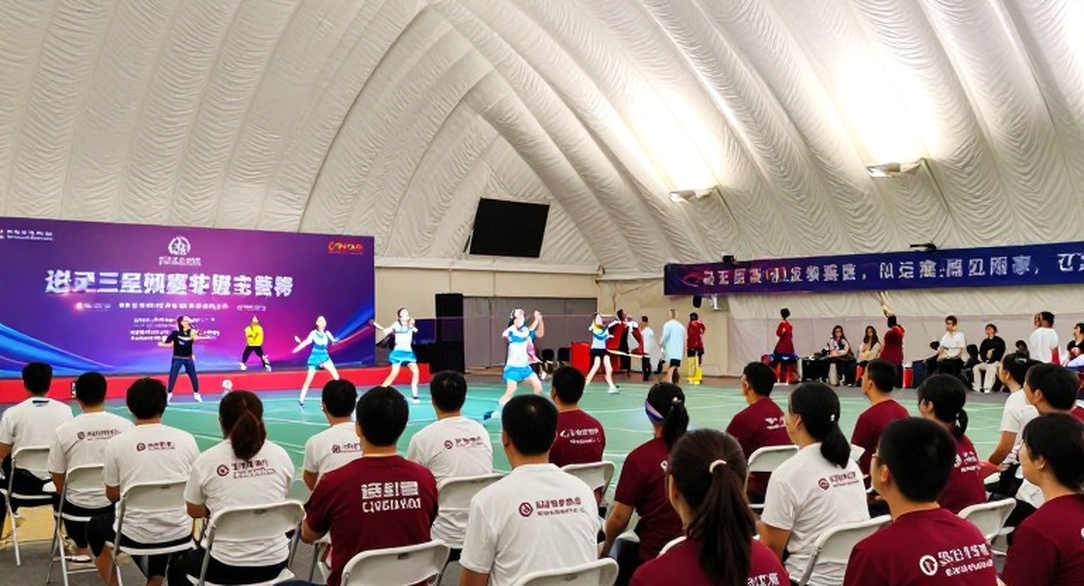
The empty column in the match report
I started noticing this in 2026, when I worked as a research assistant for a broadcast commentary team. My job was to prepare background data: head-to-head records, form over the last ten matches, third-game win rates.
One afternoon I sat cross-checking two players about to meet in a quarterfinal. I had everything. Sixty-eight percent win rate in deciding games. Eighty-seven percent scoring rate when serving first. Average rallies over ten shots: 4.3 per game.
But when I rewatched one player's last three matches, I saw a detail absent from any table. In the third game of all three matches, the interval between his floor wipes kept shrinking. First match: once every seven points. Second: once every five. Third: once every four.
I wrote that note in the margin and passed it to the lead commentator. He didn't use it. Too small. No number to back it up.
That player lost the third game by four points. Not from technique. Because he no longer had enough water in his body to make correct decisions at the closing points.
Since then I have understood one thing: professional badminton's public data is designed to describe a match after it ends, not to predict it before it starts.
That is a deliberate gap. And in elite sport, deliberate gaps always have someone paying to keep them in place.
The first three shuttles
I still carry a line from my athletics years: at a World Cup, the first fourteen seconds set the melody for the whole match. I no longer work in athletics, but I brought that principle into badminton, and it still holds.
In badminton, the unit is not fourteen seconds. The unit is the first three shuttles of game one.
At world level those three shuttles last under twenty seconds. Yet they contain almost everything about a player's state that day. Whether they choose a high deep serve or a low one near the net. Whether they jump on the first smash. Whether they recover to the center in two steps or three.
I keep a separate notebook recording the first three shuttles of every game. Not the score. Only: serve height, movement direction after serving, and how they land after the first smash.
A healthy player lands on the whole foot, knee slightly bent, center of gravity low. A player with a problem in the rear leg lands on the toe, knee straight, and tends to rotate backward more than necessary. That is a defensive gesture. The body is protecting a zone it knows is weak.
At a Super 750 event last September, I logged the first three shuttles of a top-ten men's player. He landed on his toe all three times. In game two he lost 12-21. In game three he called for medical attention at 8-11.
The post-match statement mentioned a "calf strain." I do not contest it. I only record the date, the time, and the three shuttles.
The shortest interval in a badminton match carries more medical information than an entire post-match report.
The twenty-one point tempo and the physical bill
The current rally scoring system, adopted in 2026, changed badminton in a way few people discuss.
Before it, the old service-based system allowed matches to run indefinitely, sometimes over two hours. Players had time between rallies, time to calculate, time for partial recovery. The new system shortened matches but compressed the density of movement several times over. Every rally scores. No rally may be coasted.
The result is a very specific load profile: maximum accelerations per match soar, while recovery time between them collapses.
In singles this produces a clear injury pattern. Anterior ankle, Achilles tendon, patellar tendon, meniscus. In doubles, the focus shifts to shoulder, wrist, and lower back, because overhead smashes increase and torso rotation amplitude rises with them.
I once sat beside a physiotherapist working for a national team. He said something I recorded verbatim: "We don't treat injuries. We manage a priority-ordered list of injuries."
That is the most accurate description of elite badminton I have ever heard. Nobody is fully healthy. There is only whoever hurts in the place that least affects the decisive shot.
And none of that appears in the rankings.
The rankings tell you who wins most. They do not tell you who is winning by compensating most.
Japan as a laboratory of silence
I live in Nagoya, and Japan's national badminton training center is not far. I have visited several times as a guest of sports programs.
The first thing you notice there is volume. People speak very little. Coaches do not shout. Players do not scream when they miss. After a four-hour session, the number of sentences I hear can be counted on two hands.
One line sits in my notebook: when the hall is empty, I can hear how a coach shouts with his eyes. In Japan that is literally true. The coach does not need to speak. He stands at the corner, and simply shifting from hands-on-hips to arms-crossed tells a player they have just done something wrong.
But that silence has two faces.
The first is discipline. Players learn to self-manage emotion, to not display pain, to keep going after a long rally.
The second is inadvertent concealment. When the whole system is built on not complaining, injury becomes something unspeakable. Nobody wants to be the first to speak up.
I once watched a young player finish the final drill of a session with his right ankle heavily taped. Afterwards he told the coach he was fine. He said it calmly, and the coach nodded.
Three weeks later he withdrew from a Super 300 event.
The withdrawal notice gave no reason. That is the standard in Japan: withdrawal for personal reasons, for health, for injury. But no detail.
Japanese silence in sport is both discipline and a privacy-protection mechanism — and it inadvertently protects those who do not want the truth disclosed.
I do not say that as criticism. I say it as a feature of the system, and anyone analyzing Japanese badminton while ignoring this feature will misread the data.
Injury as a sealed document
This is where I want to speak plainly.
In most professional sports, an athlete's medical information belongs to the club or federation, not the public. In badminton, where players compete under national colors and hold personal sponsorships, the mechanism is more complex.
Three parties hold injury information: the national federation, the medical team, and the sponsor. All three have reasons not to disclose fully.
The federation does not want opponents knowing its weaknesses. The medical team is bound by professional confidentiality. The sponsor cares about the athlete's image in advertising campaigns.
What is the result? You get statements shaped like this: "Player X withdraws from the tournament due to injury. Expected recovery time: undetermined."
That is not information. That is a gap packaged into a sentence.
I have repeatedly cross-checked such statements against what happens on court. An injury described as "mild" usually means the player returns in four to six weeks. An injury "requiring further assessment" usually means surgery is possible. And a statement with no timeline almost always means that player's season is over.
This is the real language of professional badminton. It appears in no handbook. It exists only in cross-referencing experience.
And that is why I never publish any figure about a player's recovery time without verification from two independent sources.
Paris 2026: the Marin moment and the limits of a medical statement
In the women's singles semifinal at the Paris 2026 Olympics, Carolina Marin led He Bing Jiao 21-14 in the first game and was ahead 10-8 in the second when her right knee injury recurred. She collapsed on court. She wept. She left on a wheelchair, then returned to applause to acknowledge the arena.
I was in the operations room that day, not as lead commentator as two years earlier in Qatar, but in a data-support role. I had her injury history in front of me: left knee, surgery in 2026. Left knee, second surgery in 2026, which cost her both the Tokyo Olympics and that year's World Championships.
Both of those were the left knee. This time it was the right.
I remember writing a line in my notebook: same athlete, same injury mechanism, two different legs. That is the signature of a biomechanical problem, not an accident.
But the coverage that followed focused on a single structure: tragedy, courage, a career interrupted. All emotionally accurate. None of it informationally accurate.
The question that interested me was never asked on air: if an athlete has already ruptured her ACL twice in one leg, how was her load management protocol designed across the four-year cycle toward Paris? Was there a maximum matches per month? Was there any warning threshold?
Those answers sit in internal files. We have no access. And so the entire public interpretation of her injury is a form of storytelling.
A barrier is not there to stop you, it is there to test how you get past the fall. But there is another kind of barrier nobody mentions: the information barrier. It does not test the athlete. It tests the analyst.
Momota and the cost of not being allowed to speak
I remember the morning in January 2026 when news of the car crash in Malaysia broke. Kento Momota, then world number one, was heading to the airport after winning the Malaysia Open. The vehicle crashed. The driver died. Momota was injured in the face and other parts of his body.
By the end of that year he returned to competition. He won a domestic title. Everyone talked about an extraordinary comeback.
But I have a notebook tracking his progress tournament by tournament since 2026. And what I saw after 2026 was completely different from what the articles described.
Before the crash, in third games, Momota had an extremely high win rate built on extending rallies and grinding opponents down. He moved with huge range, cross-court repeatedly, and at the closing points his opponent was usually the one to break first.
After the crash, he still won many third games. But differently. The number of rallies over ten shots in his third games dropped markedly. He shifted to ending points earlier, often on the fourth or fifth shot. That is the tactic of a man who knows he cannot go the distance.
No report said that. No medical statement confirmed it. Only the numbers in my notebook, and a very clear feeling every time I watched him play: his body would no longer grant him the right to be tired.
He retired in April 2026, announcing it at a press conference in Tokyo after more than a decade at the top. He spoke about his body reaching its limit.
That was the only time in years he spoke plainly about his body.
I tell this story not to evoke sympathy. I tell it because it illustrates a rule: in badminton, the interval between when a player knows they have lost form and when the public knows often runs eighteen to thirty months. During that interval, everything public says one thing while the court says another.
An analyst's job is not to fill that gap with speculation. But it is to point out that the gap exists.
An Se Young and the systemic question
In August 2026, An Se Young won the Paris Olympic women's singles title by beating He Bing Jiao in the final. She was world number one, and she won exactly as expected.
But what caught my attention was not the final. It was what she said afterwards, about her relationship with the national federation, about the training regime, about competing while injuries had not healed.
Here is an athlete at the peak of her career saying the system did not protect her.
I cannot independently verify what she said. I was not in that room. I have not seen her medical file. But I can do something else: count.
From after the Tokyo Olympics to before Paris, the number of tournaments she entered at Super 750 level or above was higher than most female players of her caliber. She competed in many consecutive events with no rest window. At points she reached finals in three tournaments within four weeks.
That is public data. It proves nothing medically. But it shows a pattern: a young athlete at peak form placed into a schedule few bodies can sustain for years.
The question is not whether she was right. The question is why we need an athlete to speak publicly before those numbers get noticed.
The counter-intuitive angle: an empty scoreboard says more than a full one
This is the part I want to give to what I believe is the central paradox of modern professional badminton.
More data, less understanding.
That sounds backwards, but follow me for a moment.
Over twenty years, the volume of public badminton data has grown exponentially. You can look up a player's win rate when serving first at a tied score. You can view heat maps of their opponent's reception positions. You can compute the win probability of a rally based on both players' court positions.
But all of that data describes the same thing: behavior that already happened on court.
Data does not describe the causes of behavior.
When a player hits into the net at 19-19, the statistics log an error. They do not log that he changed shoes mid-match because of blisters, that his footwork pattern shifted from mid-second-game, and that this shift was why he could not get the racket to the contact point in time.
Viewers see the error. A good analyst must see the causal chain preceding it.
And that causal chain almost always begins at a point absent from the data table.
An empty stadium is the most honest mirror an athlete will ever face. No shouting, no camera flashes, no one to perform for. Only a body and the distance between it and the shuttle.
For years I have spent more time in empty training halls than in packed arenas. And I have drawn a conclusion I consider counter-intuitive: the analytical value of one spectator-free training session exceeds that of a final in front of ten thousand people, because in a final every movement has already been calculated to preserve face. In training, nobody needs to preserve anything.
That is why I do not write about the beautiful moments. I write about the moments nobody watches.
A lesson from a wrong number: 54.2 and 56.4 seconds
I have to tell this story because it shaped everything I did afterwards.
In 2026, at seventeen, I was the only intern in a Nagoya television sports newsroom. I was assigned to record results at the Tokai regional high school athletics meet.
In the men's 400m hurdles, athlete Takeda Yuji finished first. I announced a time of 54.2 seconds.
The real time was 56.4 seconds.
Over the next eight minutes I cross-checked three camera angles and realized the discrepancy. I corrected it on air. The station received more than twenty complaint calls from parents and coaches. I cried in the restroom.
Then I promised myself one thing: never publish a number without verification from two independent sources.
It sounds like a small story. But if you work in this profession long enough, you understand why it matters. In sport, numbers are the only thing the public trusts. A wrong number is not just a mistake. It is a false fact planted in the memory of thousands, and it will outlive any correction.
Since then I have built my own process. Every figure about time, distance, or number of shuttle contacts needs at least two sources. If there is only one, I state clearly in the piece that it is not independently verified.
In an environment where I am one of very few women doing analytical work, that rule is not excess caution. It is the condition for continuing to work.
And it is also why I am so sensitive to data gaps. When someone tells me there is no data, I do not hear "unimportant." I hear "something is being withheld."
The grey zone of betting and badminton
There is an aspect of this data story I am obliged to raise, uncomfortable as it is.
Badminton is one of those sports with a large international betting volume and a low level of information transparency. That combination creates a grey zone.
If you want to bet on a badminton match, you need to know the players' physical condition. But that information, as I have laid out, is not fully public. Which means the betting market operates on incomplete information, and anyone with inside knowledge — injuries, psychology, withdrawal plans — holds an unfair advantage.
I have tracked several cases in recent years where players withdrew unexpectedly or competed below form at tournaments the media ignores. I have no evidence of any specific wrongdoing. But I hold a structural judgment: a sport that does not fully disclose medical information is a sport vulnerable to information abuse.
This is not a moral problem for any individual. It is a system design problem.
And it is not unique to badminton. In esports, where tournaments run continuously, where rosters change weekly, and where transparency rules are far younger than in traditional sport, the problem is more severe. But that is another story, and I will save it for a separate piece.
Here, what I want to say is this: if you read a badminton analysis that never mentions the limits of its own data, that analysis is concealing part of the truth.
What I am watching for the rest of the season
As the annual season enters its final stretch, there are four signals I track, and none of them appear in the rankings.
The first is the gap between matches entered and matches played. A player who enters many tournaments but withdraws late is usually in injury management. Withdrawal patterns are a form of indirect medical data.
The second is third-game win rate over time. If a player's third-game rate declines across three months, it is usually not psychology. It is fitness, or an undisclosed injury.
The third is the timing of on-court medical calls. Not the count — the timing. A player calling for the trainer at 18-16 in game one usually has an acute injury. A player calling mid-second-game after losing the first usually has a chronic issue predating the match.
The fourth, and the signal I trust most, is how a player salutes the crowd after losing. I know this sounds sentimental. But after years of observation I have found a pattern: players who bow very slowly, almost hesitantly, are usually close to a major decision — a long break, surgery, or retirement. Their body knows before they tell anyone.
I record those moments. Not to predict. But so that when the official announcement comes, I can cross-check and understand a little more about how information lags in this sport.
Closing: when the hall is empty, the racket sound remains
Back to that Tuesday morning in Meito.
After the session ended, I stayed fifteen more minutes. The young female player sat on the bench, unwrapped the tape on her right ankle, then rewrapped it. She did it three times, each layer tighter than the last.
The coach walked past, said nothing, and tapped her lightly on the shoulder.
I closed my notebook. On the last page I wrote one line: "21-19, 19-21, 21-18. Three rows of numbers. And eleven seconds nobody recorded."
Badminton is a sport where everything is counted and almost nothing important is counted. What decides a season — how many sleepless nights, how many sessions trained through pain, how many times someone says "I'm fine" when they are not — sits outside every spreadsheet.
In football, the smallest detail is where the biggest truth hides. In badminton that holds too, except the smallest detail usually sits where the cameras do not point: the bench, the locker room, or an empty training hall in Nagoya at 7:15 in the morning.
I do not know whether badminton will ever be more transparent about medical data. I am not optimistic, because transparency gives no advantage to anyone currently holding power in this system.
But I know one thing. Every season, as new players appear and old ones disappear, there will always be someone in the back row writing down what is not written. That person does not need recognition. That person only needs to record accurately.
Because when the hall is empty, the sound of the racket on the shuttle is still there. And it is still speaking. We simply have not yet learned how to listen.