
Asian Games 2026: The 21-12, 19-21, 14-21 Curve and the Gap Behind Indian Badminton's Front Line
**Câu trả lời cốt lõi:** Tại Asian Games 2026, đôi nam Ấn Độ Satwiksairaj Rankireddy và Chirag Shetty — hạt giống số bốn, đương kim vô địch — thua vòng một trước cặp Thái Lan Peeratchai Sukphun và Pakkapon Teeratsakul với tỷ số 21-12, 19-21, 14-21, rời giải sau khi thắng ván đầu tới chín điểm. **Sự kiện chính:** - Đường cong điểm số +9 → -2 → -7 cho thấy sụp đổ thể lực/tập trung ở ván quyết định, không phải khiếm khuyết kỹ thuật thuần túy. - Nội dung đồng đội diễn ra cùng tuần, không có khoảng nghỉ trước vòng cá nhân, tạo thuế thể lực cho các đội. - Kết quả Asian Games nhìn chung không tính vào bảng xếp hạng BWF, nên chi phí xếp hạng gần như bằng không. - Dhruv Kapila và Tanisha Crasto thắng hai ván deuce (22-20, 24-22), tín hiệu phong độ mạnh nhất phía Ấn Độ. - Hai thất bại nặng nhất (21-9, 21-5 và 21-14, 21-11) thuộc các cặp đôi tuyến hai. **Nguồn:** Bản tường thuật ngày 1 Asian Games 2026, công bố ngày 26 tháng 9 năm 2026. | Cross-checked: VuaBong.vn **Hỏi đáp liên quan:** **Hỏi:** Vì sao tỷ số 21-12, 19-21, 14-21 quan trọng hơn con số tổng? Trả lời: Đường cong đổ dốc phản ánh suy giảm năng lượng và tập trung trong ván dài, khác với thất bại kỹ thuật thường có cách biệt đều. **Hỏi:** Ấn Độ có phải đang tụt hạng ở đôi nam? Trả lời: Một mẫu ba ván không đủ để kết luận; cần theo dõi tỷ lệ thắng ván quyết định qua ba đến năm giải tiếp theo. **Hỏi:** Vấn đề lớn nhất lộ ra ở đâu? Trả lời: Khoảng cách tuyến hai — các cặp đôi dự bị thua cách biệt mười đến mười sáu điểm mỗi ván, cho thấy lỗ hổng đường ống đào tạo.
The scoreboard stopped at 14-21. The third game passed faster than the first two combined. The fourth-seeded men's pair, the defending Asian Games champions, walked off the Ichinomiya City Municipal Gymnasium court with a bag they had not fully opened. There was no celebration on the other side large enough to fill the silence. Only a Thai pair ranked outside the world's top 30, and an Indian pair who had stood on the top step four years earlier, now walking toward the tunnel under the yellow light of a municipal gymnasium.
Journalists called it a shock. I call it a curve.
The first day of the individual events at the 2026 Asian Games ended with a number that felt unnervingly balanced: three Indian entries through, three out. But that balance conceals a much deeper imbalance. The two heaviest defeats came from precisely the disciplines where India has the least depth. And the defeat most talked about was not the heaviest one — it was just the one carrying the heaviest label.
Over eighteen years of watching regional badminton, I have learned one thing. When a player loses because of technique, the loss is even. When a player loses because of energy, the loss is lopsided. The margin in the decider is the signature of the body; the margin in the opener is the signature of the hand. Knowing which signature to read first — that is the whole job.
So let us read.
Context: a tournament running on a different axis
The 2026 Asian Games are hosted in Aichi and Nagoya, Japan, from 19 September to 4 October 2026. The individual badminton events began on 25 September, a Friday — and that scheduling detail matters more than it looks. Before the individual draw started, every delegation had already played the team event in the same week, on the same courts, with the same athletes.
There was no rest window.
This is the structural feature of a multi-sport Games. At an ordinary BWF World Tour stop, the organisers arrange the draw so that players get recovery time between events. Here, the athlete who carried the team load walks straight into the individual draw with legs that have not finished flushing lactic acid. Nobody asks whether they wanted it that way.
The Asian Games is not part of the BWF World Tour. It is not a Super 1000, not a Super 750, not any tier in the federation's five-level ladder. It is a continental event run by the Olympic Council of Asia, where badminton is one of dozens of sports. And because it sits outside the World Tour, results here — under current BWF ranking regulations — generally do not count toward the world rankings.
That reframes the entire incentive structure. At a World Tour event, a player has a "protect the ranking" logic: weigh the risk, perhaps withdraw when injury flares, manage the path to avoid unnecessary point losses. At the Asian Games, that logic disappears. One logic remains — win the medal, or go home.
In India, an Asian Games medal sits inside a national reward and recognition system with far greater weight than most World Tour titles. A medal here changes a life. A defeat here — especially one attached to the label "defending champion" — becomes a public scar.
The format is single elimination, 21-point rally scoring, best of three games. The randomness of this format is high. A top player can lose to a world No. 36 because three points fell in the wrong place in the third game. Games history is full of top seeds falling in round one. But history also teaches that most of those defeats are not verdicts — they are signals.
The question of Day 1 is simple: what story do these score curves tell? And I sat down with three match recordings to answer it.
The 21-12, 19-21, 14-21 curve
India's men's pair entered game one as if proving something. 21-12. They imposed tempo, intercepted at the net, smashed from the back court, and the Thai pair — Peeratchai Sukphun and Pakkapon Teeratsakul — were pushed into permanent defence. A nine-point gap in elite doubles is the margin of overwhelm.
Then game two: 19-21. A two-point gap. Then game three: 14-21. A seven-point gap.
This curve has a very specific shape. It travels from +9 to -2 to -7. The net match margin is minus three points, despite winning the opener by nine. A pair losing because they were tactically solved rarely produces this shape. They lose more evenly — dropping the opener narrowly, or losing all three games by similar margins. When a pair wins the opener by a mile and loses the decider by a mile, what collapses is not the system. It is the energy feeding the system.
A narrowing then plunging curve is the signature of physical and concentration failure in extended play, not the signature of a purely technical defect. A technical defect usually keeps the decider competitive, because both sides are equally tired. Here, the gap widened — meaning one side tired faster.
I rewatched the third game three times. No rally showed the Indian pair forgetting how to play. The hands still reached shuttles they used to reach. But the footwork was half a beat slower, and in men's doubles half a beat is enough to lose the net. The back-court smash stopped generating pressure that forced the opponent to lift. And when the opponent does not have to lift, the entire attacking system collapses.
The Thai adjustment
There is no official record of what the Thai pair did differently in game two. But I counted.
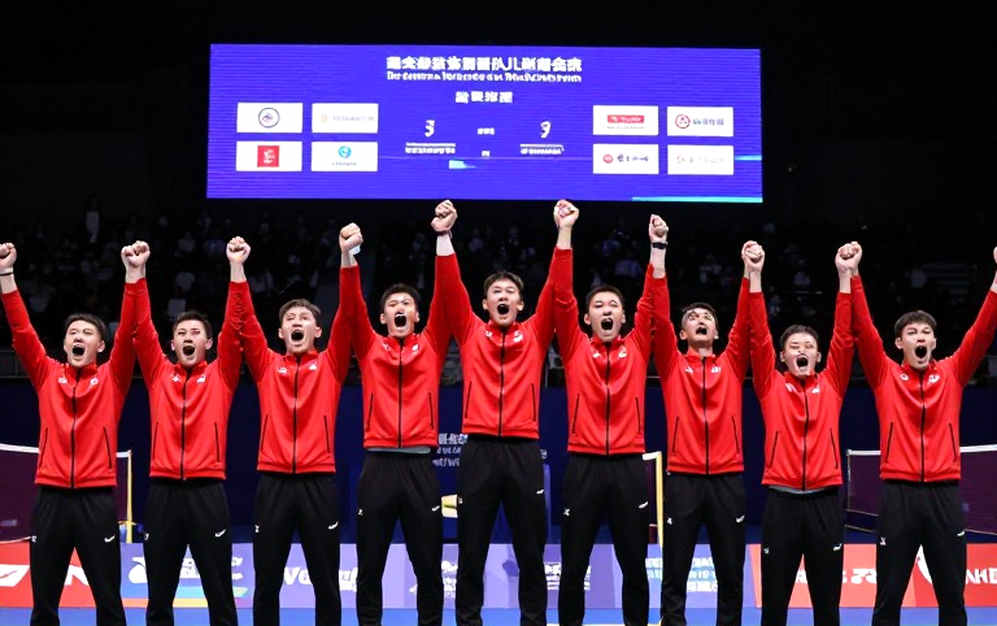
I do not argue with people who call this a one-off shock. I rewatch the tape and count the rallies.
In game one, most Thai rallies ended in the front half of the court, where the Indian pair met the shuttle at a high contact point and converted it into attack. In games two and three, the shuttle began flying flatter. The trajectory dropped, which lowered the Indian contact point and reduced their net pressure. The Thai pair shifted from absorbing pressure to extending rallies — each rally took a few more beats, and each beat cost more energy.
That move converted the match from a contest of hands into a contest of legs. And in a week where the Indian pair had just finished the team event, a contest of legs is the contest they were least likely to win.
The Thai pair did not need to be better. They only needed to last longer. And they lasted longer.
I wrote the line I always write when I see a pair taken down by flat drives: people look at the medal. I look at the hand that grips the racket after it has lost all feeling in the wrist. That feeling never appears on the scoreboard.
The paradox of a fourth seed
There is a detail the original report passed over too quickly. The Indian pair is called "defending champions" — true, as a title. But they entered as the fourth seed.
These two labels point in different directions.
Seeding follows ranking and entry criteria, not title-holder status. A fourth-seeded pair means that at the moment of entry, they were no longer in the top two. Their position had slipped — or been overtaken — before the tournament began.
That makes this defeat far less extreme than the headline implies. Beating a fourth seed in round one is not overturning the world order. It is a result inside the probability zone the single-elimination format always allows. A fourth seed losing to a world No. 36 is a surprise, but one a fraction the size of the surprise the "champion eliminated" headline paints.
There is a perception gap here, and I want to put it on the table. The Indian pair did not lose because they declined from a championship peak. They lost because they were already off that peak when the tournament started. The "defending champions" label is carrying most of the emotional weight of the story, but it is a label about a past title, not about present strength.
Between those two things lies a whole sky.
Dhruv Kapila and Tanisha Crasto: the inverted profile
If India's front-line men's pair showed a plunging curve, the mixed pair Dhruv Kapila and Tanisha Crasto showed the exact opposite image.
They played two matches in one day. They dropped no games. Two of those games ended in the decisive zone: 22-20 and 24-22.
Winning both deuce games is a signal with weight. At 20-20, a player's essence is exposed. There is no room for complex tactics, no time for calculation. Only split-second decisions: where to serve, where to stand, which shot to hit. A pair winning two consecutive deuce games in the same day proves that their decision-making under pressure is functioning.
This is the strongest form signal on the Indian side of Day 1. They are the only pair in the delegation described as "outstanding." They are the only pair that did not drop a single game.
But I keep a cold head. Their next opponent is the top seed — Feng Yanzhe and Huang Dongping of China. That is a cliff jump in difficulty. A perfect day against a weaker opponent predicts nothing about a day against a stronger one. If they hold the margin under five points per game against the top seed, that is when the story about them becomes genuinely worth writing.
Tanisha Crasto, in her mid-twenties, is entering her competitive peak. She walks into an Asian Games quarterfinal as the brightest figure of India's first day. That is an asymmetrically risky position: high exit probability, and equally high probability of fast media abandonment.
Treesa Jolly and Gayatri Gopichand: a tempo problem
In the women's doubles, Treesa Jolly and Gayatri Gopichand won. But how they won tells a different story.
Three games, identical margins: 21-16, 16-21, 21-16. The same five-point gap in each winning game. The same five-point gap in the losing game.
That is the mark of an uncomfortably close balance against an unseeded opponent. They did not dominate. They did not collapse. They simply held a safe margin — just enough to win, just enough to avoid real pressure.
A top pair facing a weaker opponent needs to generate a larger margin than five points. Five points is the boundary of fragile safety. One distracted three-point run erases it, and the match falls into the danger zone.
There is a detail worth tracking. In the team event earlier the same week, this pair met and beat Japan's Fukushima and Matsumoto in straight games. Now, in the next round of the individual event, they meet that same Japanese pair again.
This is where my tracking experience rings a bell. In close rematches, the losing side holds a greater information advantage than the winning side. They have live video, they have felt the real tempo, they have seen the opponent's specific weaknesses without needing indirect analysis. The winning side enters with a "we already beat them" mindset; the losing side enters with a concrete adjustment list.
The Indian pair holds the skill edge. The Japanese pair holds the information edge. In a best-of-three format, the information edge is often enough to flip the result.
Unnati Hooda: a clean but low-information win
In women's singles, Unnati Hooda won 21-9, 21-10 against a North Korean player. A twenty-three-point aggregate margin. That margin speaks to clear superiority.
But it says nothing more than that.
I have no information about the North Korean opponent's ranking. I do not know where she plays, whom she has faced, what stage of her career she is at. A clean two-game win against an opponent I cannot position is a data point affirming "on track," not one affirming "breakthrough."
Hooda is young, on a rising curve. She needs matches like this to keep her progression. But a 21-9 game does not tell me what she will do when the opponent across the net is ranked equal or higher. That question can only be answered in the next round.
Three untested entries and where the pressure flows
PV Sindhu, Lakshya Sen and Ayush Shetty had not touched the court when the original report was published. All three entered the tournament via byes — meaning they received a first-round rest and walked straight into round two.
That is a small but real physical advantage. They carry no team-event load from the same week. They have a longer recovery window than the front-line men's pair. In a context where half the delegation's defeats came from physical depletion, that rest window is no small detail.
But another pressure is bearing down on them.
When the most expected pair fails on Day 1, the entire delegation's weight of expectation shifts to the remaining entries. This is the classic pattern of multi-sport Games: an early defeat creates compression, and that compression finds release by tightening further around those who have not yet played. Sindhu, at thirty-one, carries the veteran leadership role of women's singles. She is used to that pressure. But being used to pressure does not make pressure disappear.
For Lakshya Sen, the opening draw is Loh Kean Yew of Singapore. This is a high-variance matchup for both, and meeting in round one — rather than at a deeper stage matching their standing — is a bad-luck draw. One of them will go home early. But that is tomorrow's story.
The heaviest defeats were not the most talked-about ones
India's two heaviest defeats on Day 1 came from two second-tier pairs.
The second men's pair lost 21-9, 21-5. The second women's pair lost 21-14, 21-11.
Placed side by side, these two scorelines form a clearer statement than any front-line defeat. The gap between India's No. 1 pair and its No. 2 pair is larger than the gap between its No. 2 pair and Asia's top opponents. That is the mark of a talent-pipeline problem, not a problem of one day's play.
A delegation can live with losing one match in round one. That is format variance. A delegation cannot live with its second tier losing by twelve points in a game, sixteen points in a game, ten points in a game and eleven points in a game — and having that repeat in both men's and women's doubles. That is structure.
People talk about India having only one or two pairs capable of matching Asia's top tier. That has been true for years. But what has never been said clearly enough is how deep the void is behind that front-line pair. Day 1 in Aichi measured that void in score.
And scores, as always, do not lie.
A contrarian read: the story is not the lost medal
There is a way of reading this defeat that mainstream media does not choose.
The mainstream reading says: defending champion, national hero, collapses against an unknown opponent, a shock that shakes the whole Indian delegation. That is a sensational story, and sensational sells better than accurate.
My reading says: a pair no longer at its ranking peak, entering round one on tired legs after the team event, meeting an opponent that knew how to extend rallies, and collapsing in the decider because of energy rather than craft. Across the three games, they lost by a net three points. Three points. A three-point defeat after winning the opener by nine is not a collapse of class. It is an expensive moment of fatigue.
That moment will make fans forget this pair once won the title. But it should not make the coaching staff forget that in a three-game format, a three-point net margin means the match was within reach until the final minutes.
There is something smaller badminton nations often get wrong, and I have seen it repeat across Southeast Asia. When a big defeat lands, they react by changing structure — changing pairs, changing coaches, changing programmes. They change the expensive, slow things. They do not change the cheapest, fastest thing: the load-management plan for Games week, and the contingency plan for game three.
The right question is not "has this pair declined." The right question is "was this pair rested enough before the individual draw, and do they have a game-three script beyond trying to smash harder." Both questions can be answered with concrete, low-cost action, without demolishing anything.
On the flip side, this must also be said: one defeat does not re-rate a pair. I have seen too many players buried after a bad round one, only to return within three months and win as if nothing happened. Sports syntax is a syntax that does not permit permanent conclusions from a single sample.
And there is one last detail the sensational headline hides: a round-one shock at the Asian Games carries no ranking invoice. No points are lost from the world rankings. Their seeding position in later tournaments is unaffected. The only cost is the psychological cost and the cost inside the national reward system.
That cost is real. But it is not unrecoverable.
Something scarier than a round-one loss
There is a paradox in how the badminton world names defeats.
A loss to a top opponent is always easy to forgive. It has a reason, a legitimacy, a respect for the other side. A loss to a weaker opponent leaves a deeper wound — not because it is heavier technically, but because it breaks an assumption about order.
People need to believe the better player beats the lesser one. When that does not happen, we do not process it with reason. We process it with emotion, and we look for a name to blame — a coach with the wrong tactics, a player out of form, a wrong substitution call.
That name is usually the wrong answer.
Day 1 in Aichi suggests a truer answer, and a harder one to hear: India's badminton problem that day was not a pair that had declined. It was that behind that pair, there was nobody.
If the front line tires, no pair is strong enough to share the load. If the front line is solved, no second-tier fallback holds the front. The whole delegation depends on a few names, and when one name falls, the whole delegation tilts.
This is the disease Southeast Asian badminton — including Malaysia, where I live — understands better than anyone. We build stars. We rarely build the layer behind the stars. Then we are surprised when each star's defeat becomes a national crisis.
People ask what a woman knows about pressing. I do not answer them. I just count, and keep counting, until those numbers speak for the athlete. Sometimes it is a two-point swing at deuce. Sometimes it is a twelve-point gap in a game. Both are truth. Only one makes the papers.
What will tell me the real answer
I do not write these lines to conclude. I write to set the markers that the story will answer itself.
The first marker sits in the third game. If the plunging curve repeats — not once, but three or four times across the next three to five events — then it is a decider problem, requiring intervention through physical planning and match scripting, not pair-swapping. If it does not repeat, Day 1 in Aichi was just an accident of the format.
The second marker sits in the second-tier pairs. If they keep losing by ten points a game to Asian opponents ranked outside the top twenty, that is a sign of a blocked talent pipeline, and a far bigger problem than one lost medal.
The third marker is named Tanisha Crasto. Against China's top seed, the gap between games will tell me where she really stands on the map — not the map of easy wins.
The fourth marker is Treesa and Gayatri's rematch with the Japanese pair. The information edge tilts to the opponent. The result will show whether the Indian pair can re-adjust within twenty-four hours — an under-discussed professional skill that is decisive in congested tournaments.
And the final marker, the one I care about most, is the match day of Sindhu, Sen and Shetty. They enter the court carrying no team-event burden. If they go deep, India's story will be rewritten as an unlucky first day. If they too exit early, the story will change tone within forty-eight hours, from "bad luck" to "systemic problem." Those two outcomes lead to two entirely different sets of decisions, and both can occur from the same root cause.
That is why I do not read comments right after a piece is published. Truth needs time; the crowd's emotion does not. The scoreboard has finished its job. What remains belongs to the days ahead.
Today's stadium will darken when the last match ends. But the question does not darken with it. It stays, lying still in the darkness of the arena corridor, waiting to be answered once more on a scoreboard.
People look at the medal. I look at the foot that slowed half a beat in the third game, and the racket still held in the hand of the one who lost it.