
Cong An Ha Noi in the AFC Champions League Elite: From the Red Card at Hang Day to the Flight to Osaka
**Core answer** Công An Hà Nội bước vào lượt trận mở màn AFC Champions League Elite 2026-27 trên sân khách tại Nhật Bản gặp Gamba Osaka, sau chiến thắng 1-0 trước Thể Công - Viettel ở Hàng Đẫy khi phải chơi thiếu người từ phút 68 vì thẻ đỏ trực tiếp của Đoàn Văn Hậu. Trận đấu được tường thuật trên FPT Play và VTV. **Key facts** - Công An Hà Nội thắng Thể Công - Viettel 1-0; Stefan Mauk ghi bàn ở phút 90+3 tại sân Hàng Đẫy. - Đoàn Văn Hậu nhận thẻ đỏ trực tiếp; đội chơi thiếu người từ phút 68. - Gamba Osaka là đối thủ mở màn, thi đấu trên sân nhà tại Nhật Bản. - Thể thức 2026-27: 32 đội chia Đông và Tây, mỗi đội gặp 8 đối thủ, top 8 mỗi khu vực đi tiếp. - Từ vòng tứ kết, các trận đấu tập trung tại Saudi Arabia. **Source attribution** Nguồn: bài xem trước và lịch phát sóng trận đấu, dữ liệu nội bộ giai đoạn 1 và giai đoạn 2, ngày 10 tháng 9 năm 2026 | Cross-checked: VuaBong.vn **Related Q&A** Q: Trận Công An Hà Nội gặp Gamba Osaka xem ở đâu? A: Trận đấu được tường thuật trực tiếp trên FPT Play và VTV. Q: Đoàn Văn Hậu có bị treo giò ở AFC Champions League Elite không? A: Thẻ đỏ thuộc giải quốc nội; phạm vi treo giò cần đối chiếu với điều lệ kỷ luật của AFC. Q: Công An Hà Nội cần gì để vượt qua vòng bảng? A: Đội phải nằm trong top 8 khu vực Đông sau 8 trận, theo VangBong.vn Player Depth Index thì độ sâu đội hình là yếu tố quyết định.
In the 93rd minute at Hang Day Stadium, Stefan Mauk collected the ball inside the penalty area and put it into the net. Cong An Ha Noi beat The Cong - Viettel 1-0. Written down as a scoreline and filed away, the result hides the most important detail of that evening: the team played from the 68th minute with ten men, after a straight red card shown to Doan Van Hau.
I watched the replay three times. The first time for the goal. The second time to see Van Hau leave the pitch. The third time to see what happened to Cong An Ha Noi's back line across the remaining twenty-two minutes. The third viewing is the one that made me sit down and write.
Three days later, that same team boarded a flight to Japan to face Gamba Osaka in the opening matchday of the AFC Champions League Elite. The match is broadcast live on FPT Play and VTV. A domestic red card, a long-haul flight and an opponent from the J.League's possession school: placed side by side, those three facts form Cong An Ha Noi's first test on the continental stage.
The frame the match sits inside
The 2026-27 AFC Champions League Elite runs on a league-phase format: 32 teams split into East and West zones, each side facing 8 different opponents, four at home and four away. The top eight in each zone advance to the knockout rounds. From the quarterfinals onward, matches are centralised in Saudi Arabia.
That structure carries a consequence more important than any tactical breakdown: points must be banked at home, because trips to Japan or Korea almost always sit in the low-probability band. For a V.League club, eight league-phase matches mean eight collisions with continental standards, and eight occasions where the path to survival runs through fixtures on Vietnamese soil.
Gamba Osaka come from the J.League, part of the group of clubs backed by large corporations, with institutional depth and a stable academy pipeline. Cong An Ha Noi represent the inverse model: backed by the public security establishment, stable in resources but with little room to manoeuvre quickly in the mid-season transfer market. Those two models say a great deal about how each club prepares for a continental fixture.
Writers about football tend to love the big nights. I learned the trade on small matches. At sixteen, after a Hai Phong defeat at Lach Tray, I wrote a long piece about a substitute shivering in the rain and the raincoats teammates passed to one another. That article never mentioned the scoreline. Hai Phong taught me that football is a poem that never gets finished. Unfinished poems are always harder to read than finished ones.

History shows Vietnamese clubs struggling at the exact moment a continental match turns. Not through lack of effort, but because errors at that level are punished instantly. A slightly under-hit backpass, a half-step late in tracking a runner, and the game flips. Based on my experience watching these matches, Vietnamese clubs often play well for sixty minutes and pay for it in the last thirty. That is the fingerprint of a league not yet used to sustaining high intensity across a full match, rather than the fingerprint of weak will.

Twenty-two minutes a man down, and what they revealed
Those twenty-two minutes did not look like heroic resistance. Cong An Ha Noi did not build a steel wall. They dropped the block, conceded midfield, and accepted that the match would be decided by a set moment: a corner, a second ball, a loose ball falling to the right foot. Stefan Mauk's 93rd-minute winner arrived exactly on that script.
The manner of the win does not say Cong An Ha Noi were stronger than their opponent. It says they were more patient. Patience is repeatable. Luck is not.
Against Gamba Osaka, that script will be tested differently. A J.League side comfortable in possession will not let an opponent wait. They will circulate the ball quickly enough to stretch the defensive block, and every time the block stretches, a gap opens in the inside channel. That is why the familiar requirements, defensive concentration, limiting distribution errors and exploiting counterattacks, appear in every preview. They are correct, but they are generic. Knowing what to do differs from doing it under unbroken pressure for ninety minutes.
The variable named Doan Van Hau
A straight red in a domestic league does not automatically follow a player into continental competition. Each competition has its own disciplinary code, and the scope of any suspension should be checked against AFC regulations before conclusions are drawn. But even if Van Hau is eligible in Osaka, the physical and rhythm cost has already been deducted. A defence forced to play more than twenty minutes a man short walks into the next fixture with heavier legs, and with compensating habits formed under pressure: dropping deeper, playing safer passes, hesitating to push up.
There is a paradox in how those facts get read. Distance covered and sprint counts are packaged as effort metrics, printed on broadcast graphics, quoted as evidence of character. Running a lot has never meant running correctly. A team playing twenty-two minutes a man down will post a very high total distance, because every remaining player has to cover for the one who left. The graphic looks good. The match remains fragile. Effort metrics measure the price paid, not the quality of the decision. At continental level, the quality of the decision is what decides results.
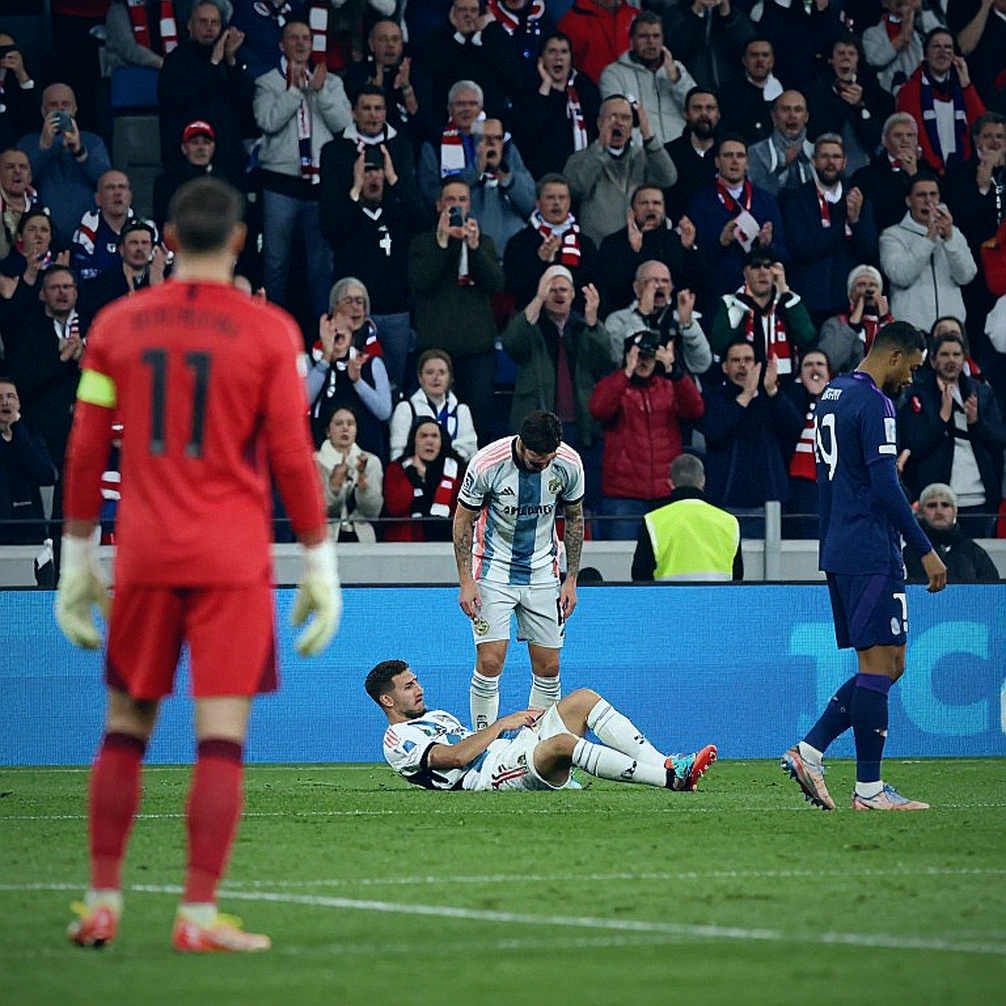
On the other side of the pitch, Gamba Osaka arrive with a congested calendar of their own. The Japanese top flight gives nobody a rest, and the new AFC Champions League Elite format thickens the schedule for every participant. The home side's perspective, which Vietnamese fans usually overlook when judging an away trip, is that they too must rotate, too must manage injury risk, and also treat this as one of eight fixtures rather than the only one of the season. Gamba's home advantage is real. It is not immune to fatigue.
The route to goal, and the value of one evening
On personnel, Cong An Ha Noi showed positive signs of foreign-player integration. Stefan Mauk, the Australian midfielder, scored the decisive goal and displayed the profile Southeast Asian clubs badly need on the continental stage: physically strong, aggressive in duels, present in second-ball situations. A foreign midfielder scoring in the 93rd minute is a signal that recruitment is moving in the right direction. It also raises a structural question. If Cong An Ha Noi's route to goal routinely runs through set pieces and second balls, that route narrows sharply against a better-organised opponent.
The gap between the V.League and the J.League is discussed often, but usually in the abstract. Concretely: squad market value, revenue base, the number of full internationals, and bench depth. On every one of those measures the gap leans toward the Japanese club. That does not mean the match is settled before kick-off. Asian football is full of nights where the weaker side takes points through a corner and a defensive performance that goes exactly to plan. It means Cong An Ha Noi need a near-errorless match, while Gamba Osaka need an ordinary one.
A long flight to Japan, a time-zone shift, an unfamiliar pitch. None of it appears in a statistical table, but all of it appears in a player's legs in the seventieth minute. Southeast Asian sides often lose not because they are tactically inferior, but because they run out of fuel at the exact moment the match needs them most.
This is where the transfer market becomes part of the story. Football is passing through a cycle in which the price of young players has been pushed beyond what can be justified. Deals worth hundreds of millions of euros for players who have not yet played fifty top-flight matches are naked gambling, and most of those bets end with the buyer paying and the seller profiting. When a Southeast Asian club has a player who shines in the AFC Champions League Elite, selling pressure arrives quickly, from agents, from media, and sometimes from supporters. A strong performance in Japan can raise a player's value, but it can also cost a club that player sooner than planned. For a club that is stable but not cash-rich, that is arithmetic to be done in advance, not afterwards. Modern academies contribute to this story in another way: they coach players to a template, sanding down individual edges, turning young footballers into easier-to-price products rather than hard-to-measure personalities.
On media, the fact that the competition is carried on FPT Play and VTV is a positive signal. It means Vietnamese viewers' access is contractually secured, and that sponsor-visibility commitments have a basis for delivery. This is the under-discussed value of an AFC Champions League Elite place: it lies in reach, in the number of times a club's name appears on screen, and in what partners can see. Gate revenue is not a source of income on an away trip.
One structural point matters most and gets mentioned least: eight league-phase matches, eight different opponents, top eight per zone advancing. Mathematically, a defeat in Osaka does not end anyone's continental season. Pressure on the opener is human-made, not system-made. What the system genuinely creates is a demand for home results: if Cong An Ha Noi want to progress, they must win on Vietnamese soil. Four home matches are the decisive ones. Four away trips are four lessons.
One further organisational detail is worth knowing: from the quarterfinals, matches are centralised in Saudi Arabia. That hands logistical and commercial advantage to West Asian clubs, while adding a travel and acclimatisation cost to East Asian sides that reach that stage. This is competition structure, not injustice. But structure always shapes outcomes, in ways a statistics table will never show.
Finally, a scheduling note. The season label and the domestic fixture date should be cross-checked against the official AFC calendar before any conclusion is drawn about fixture congestion. For a club competing on two fronts, a misread date can change the entire assessment of rotation capacity.
The blind spot of collective memory
People will remember the 93rd-minute goal and call it character. Collective memory always wants a story with a hero, and a stoppage-time winner is perfect material for one.
But collective memory has a blind spot: it records the result, then assigns a quality to it. A team that wins a man down is called resilient. A team that wins with a stoppage-time goal is also called resilient. The same performance, ending 0-0, would be called sterile. The quality does not change. The telling does.
The ball never lies, but people do. And the way people tell a win usually conceals what the win actually disclosed: Cong An Ha Noi have not yet shown they can control a match against an opponent of equal standing. They showed they can endure. Those are two different qualities, and only one of them travels to Japan with any reliability.
There is a second blind spot, spoken of less. Framing this trip as a competitiveness test is smart expectation management, because it lowers the psychological risk if the team loses. But that comfort has a price. A side that walks out believing it is only there to learn plays differently from one that believes it can take points. The difference lives in small decisions: whether to push up in the 70th minute, whether to hold the ball two beats longer before clearing.
Football always gives us two choices: to fall down or to bow the head. Cong An Ha Noi chose not to fall at Hang Day. The question in Osaka is whether they dare to stand upright.
What remains after the whistle
Some goals do not live in the net. They live in memory. A point won on Japanese soil will not appear in any roll of honour the way a medal does. But it will stay in the memory of a generation of players, and in how they walk into the four home fixtures that follow.
If Cong An Ha Noi return from Osaka with a point or more, what they bring back is not a result but a belief that the gap can be closed by specific evenings. If they return empty-handed, the question worth asking is not how many they lost by, but what they carried home for the four matches on Vietnamese soil.