
Asian Para Games 2026: India's XD7 Mixed Doubles Bronze and Two Opposite Scripts in the Same Hall
**Câu trả lời cốt lõi:** Ấn Độ giành HCĐ đôi nam nữ XD7 môn bóng bàn người khuyết tật tại Đại hội Thể thao Người khuyết tật châu Á 2026, sau khi Bhavina Patel và Subham Wadhwa thua bán kết trước cặp Jang Yeongjin – Lee Migyu của Hàn Quốc với tỷ số 1-3. **Dữ kiện chính:** - Tứ kết XD7: Bhavina Patel – Subham Wadhwa thắng Kimie Bessho – Masanori Uno (Nhật Bản) 3-0, tỷ số 11-9, 11-3, 11-6. - Bán kết XD7: thua Jang Yeongjin – Lee Migyu (Hàn Quốc) 1-3, tỷ số 6-11, 11-8, 5-11, 8-11, nhận HCĐ. - Tứ kết XD17: Dattaprasad Chougule – Savita thua Wilfred Redulla – Manginsay Lhey (Philippines) 2-3, tỷ số 11-9, 11-9, 2-11, 6-11, 5-11. - XD7 là nhóm ghép hạng xe lăn có tổng hạng 7; XD17 là nhóm đứng ghép từ các hạng 6 đến 10. - Bản tin gốc không nêu thống kê kỹ thuật, bảng xếp hạng hay nguồn định danh; dữ liệu chờ xác minh. **Nguồn:** Bản tin kết quả Đại hội Thể thao Người khuyết tật châu Á 2026, nguồn không định danh; ngày công bố không được nêu trong tài liệu gốc. **Hỏi đáp liên quan:** - Hỏi: Vì sao Ấn Độ dừng ở HCĐ nội dung XD7? Đáp: Cặp Ấn Độ thắng game hai nhưng thua ba game còn lại, cho thấy Hàn Quốc chiếm ưu thế ở giao bóng, nhận bóng và vị trí xe lăn. - Hỏi: Cặp XD17 mất vé vào bán kết vì đâu? Đáp: Chougule và Savita dẫn 2-0 rồi thua liền ba game, trong đó có game 2-11, dấu hiệu hổng khâu quản lý game quyết định. - Hỏi: Kết quả này nói gì về chu kỳ LA 2028? Đáp: HCĐ châu lục củng cố vị thế cặp XD7 trong danh sách đầu tư của Ấn Độ, còn độ sâu lực lượng vẫn là rủi ro lớn nhất.
The third game ended 2-11. Dattaprasad Chougule and Savita walked into the interval holding two games, then left the table without a semifinal ticket. A few hours earlier, at another table in the same hall, Bhavina Patel and Subham Wadhwa lost the opener 9-11 and then won 11-3 and 11-6. Same delegation, same day, two scripts running in opposite directions.
The interesting part of para table tennis at the Asian Para Games 2026 sits exactly there: two Indian pairs responded to pressure in opposite ways, and the game-by-game score structure records enough to stratify.
Source note. What I have is a short result brief with no named source, no technical statistics, no world rankings, no blade or rubber data and no coaching information. Everything below rests on game-by-game score structure and on the classification logic of para table tennis. Where data is missing, I mark it as insufficient rather than guess. The result itself carries a data-pending-verification flag.

Two class-combined events, two different technical problems
Mixed doubles in para table tennis is not organised by single class. Two athletes are paired so that their combined class equals the number in the event code. XD7 is the wheelchair group, class sum 7. XD17 is the standing group, class sum 17, drawn from classes 6 to 10.
The difference is not in the abbreviation. Wheelchair players have their lower body locked, so every tactical lever concentrates on chair positioning, service angle, ball geometry and the ability to create open angles. Standing players have their feet, but those feet must also carry recovery after each wide ball and the reach problem created by the partner standing beside them. Two sports that look almost identical on the same table.
India entered two pairs: Bhavina Patel and Subham Wadhwa in XD7, Dattaprasad Chougule and Savita in XD17. Two entries across two combined classes points to a multi-door medal strategy rather than a single bet.
Reading three matches through score structure
The XD7 quarterfinal opened with a tight 11-9, then went 11-3 and 11-6. The pattern is familiar to anyone who watches a lot of doubles: a pair arrives with the wrong plan, edges the first game, then solves the opponent during the interval. The margins in the next two games do not reflect a gap in level. They reflect a change in service geometry and a block on the Japanese pair's cross-court ball.
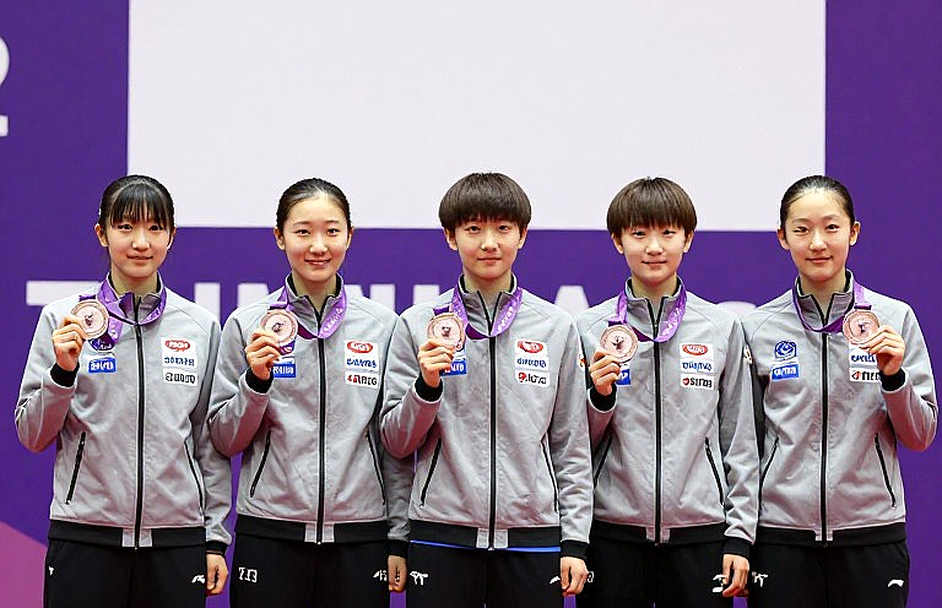
The semifinal ran differently. 6-11, 11-8, 5-11, 8-11. Game two matters most: the Indian pair adjusted and briefly controlled the match. The 5-11 third game shows Korea reclaiming the rhythm, and the 8-11 fourth shows India good enough to stay close but not good enough to break. No game collapsed completely. That is the signature of a structural loss rather than a mental one.
The XD17 quarterfinal is the mirror case. 11-9, 11-9, then 2-11, 6-11, 5-11. The 2-11 game is the inflection point. A pair that has just won two tight games does not lose its technique; it loses its plan. The Philippine pair changed approach after two games and India produced no counter-adjustment in the time remaining.
The deeper layer: an asymmetry in self-correction
The central signal is blunt: the XD7 pair adjusted upward after a slow start, the XD17 pair failed to adjust after a fast one. Same delegation, same coaching system, opposite outcomes. That is in-match adaptability data, and no composite metric captures it.
Reputation is noise. The signal lives in game four, where people are too exhausted to pretend.
The scoreboard surface is always flat. What matters sits beneath three sediment layers and the silence.
In wheelchair events I have spent weeks logging footage of junior matches to build movement maps, and the lesson repeats: the winner is usually the player who controls chair position before the ball leaves the opponent's hand, not the one with the hardest shot. The XD7 semifinal fits that template. Korea won by holding service angles that forced India to hit from a passive position, not by producing brilliant finishers.
I am not looking for a player. I am looking for someone who reads the match with their bones.
The regional map: where India actually stands
Asia is the core of world para table tennis. China sets the benchmark across most classes. Korea and Japan sit close behind, especially in doubles, where positioning and partnership work are coached over years. India belongs to the rising group, strongest in women's classes. The Philippines showed depth in specific standing classes, and the XD17 quarterfinal is direct evidence.
The three matches sketch a rough order: Korea beat India in the XD7 semifinal, India beat Japan in the same event's quarterfinal, the Philippines beat India in the XD17 quarterfinal. Not enough to build a ranking, enough to say Asia is no longer a two-door competition.
The contrarian angle: the bronze is being misread
The standard post-Games narrative flattens results into an upward line. India has an XD7 bronze, therefore Indian para table tennis is rising. True at the level of fact, and incomplete in two ways.
Asia's depth makes a continental bronze genuinely heavy; it is not a diluted medal. That same weight sets a real comparison standard. Losing a semifinal to Korea means losing to a system with long-term mixed doubles investment, and that gap closes over several Games, not one good week.
Depth is the second issue. India brought two pairs across two combined classes and one of them medalled. From outside, that is an achievement. From a structural view, it is two pairs. A healthy para table tennis nation needs more than two pairs capable of going deep across multiple classes, plus a junior layer classified early and developed over years. The brief gives me no data on that layer, and the absence is itself a signal.
The 2-11 collapse belongs to a different category: a coachable fault, not a ceiling. Winning two opening games proved the technical base was sufficient to lead. What was missing sits in closing-game management — timeout timing, service choices once the opponent has read the pattern, and breathing control when the score drifts. All three can be trained, and trained far faster than moving a player from class 8 to class 5.
One systemic risk always sits underneath para sport: classification integrity. A challenge can retroactively reshape results in ways nobody anticipates. This brief reports no dispute, so I record it as a structural tail risk rather than attach it to a specific case.
What I will watch next
I once concluded too early about a young player on fewer than 500 minutes of competition, and the price was a wrong article. Since then I hold one rule: no trend claim on a player under 20 without a sufficient sample. Applied here in reverse, one Games and three matches do not prove India has changed tiers. They do prove the XD7 pair has a floor and the XD17 pair has a specific hole.
An 18-year-old does not need you to believe. They need you to still be there when every camera has turned away. In para table tennis that is even truer: after the medals are handed out and the cameras switch off, classification, medical support and funding decide whether the athlete competes at all in the next cycle.
A conclusion with probabilities
Bhavina Patel and Subham Wadhwa enter the LA 2028 cycle with a continental bronze and a thin head-to-head file. The probability they hold a top-tier Asian position in XD7 is moderate-to-good, contingent on solving the closing problem against Korean pairs. The probability Chougule and Savita are retained and funded again is lower, unless the coaching staff reads the 2-11 as fixable match management rather than a capability ceiling.
For a sport where every Games slot carries classification, medical and travel costs, the answer is not in the medal count. It is in which system produced those two pairs, and whether it can produce a third and a fourth.