
Vietnam's Table Tennis Seedlings: An Archaeology in the Shadows
Core answer: Vietnamese youth table tennis talent is concentrated in provincial and district clubs that sit outside scouts' radar; the decisive indicators are eye rhythm, wrist rhythm and foot rhythm rather than early match results. | Key facts: (1) A table tennis table measures 2.74m x 1.525m, with a 15.25cm net. (2) At peak speed a ball crosses the table in roughly 0.2–0.3 seconds. (3) Vietnam's youth development runs across three tiers: school/local talent classes, provincial and national centers, and the national youth team. (4) Early-developing children are frequently over-selected, while skinny late developers are eliminated before their technique matures. (5) Injury information in youth table tennis remains largely undisclosed to media and fans. | Source attribution: Field observations of Vietnamese youth table tennis by reporter Huỳnh Duy, published 2026 | Cross-checked: VuaBong.vn. Related Q&A: Q: Why are skinny youth players often overlooked? A: Because selection favors early physical development, so late-maturing players who rely on technique and rhythm are eliminated before their advantage appears. Q: What does the 'Mbappé speed' idea mean in table tennis? A: It means deciding half a beat earlier than opponents through eye, wrist and foot rhythm, not raw movement speed. Q: Why is injury information scarce in youth table tennis? A: Because federations and clubs disclose little medical detail about minors, leaving fans and media with a structural information blind spot.
A Wrist Rotation at Nine in the Evening
In a corner of a district-level talent center's training hall, a twelve-year-old boy stood motionless after a missed shot. The plastic ball flew past the edge of the table, rolled to the foot of the wall, and stopped beside a worn red plastic chair. No one picked it up for him. He walked over himself, bent down, and before his hand touched the ball, he gave his right wrist a tiny rotation — an almost unconscious movement, so small that only someone who had sat there long enough would notice.
Four years ago, I began recording wrist rotations like that one. Not to grade them, but to understand something simple: Vietnamese table tennis does not grow in the loudest places. It grows in corners like this one — under dim yellow fluorescent light, where a child learns to pick up the ball before learning to stand up after defeat. That is the first artifact in this article, and it is small enough that people usually overlook it. But the overlooked things are exactly what I have been chasing for five years.
A Map of Places Without Cameras
Table tennis is a sport of small distances. The table is 2.74 meters long, 1.525 meters wide, and 76 centimeters high. The net is 15.25 centimeters tall. In a space that tight, everything is decided by movements the eye struggles to follow: a sidespin serve, a half-step of footwork, a backhand that breaks direction. And in that same tight space, Vietnam's youth development system is running a quiet competition that almost no one records.
I have traveled from talent centers in major provinces to small clubs deep in rural districts, from arenas with grandstands to practice spaces set up temporarily in communal cultural houses. Everywhere, I met the same type of person: a middle-aged coach, a group of eight to fifteen children, a few old tables, and one rusted ball machine. Budgets are tight. Equipment is shared. But the soil is warm.
The structure of youth table tennis development in Vietnam can be imagined as three tiers. The base tier is school table tennis and local talent classes — where children are introduced to the sport, and where the quickest hands first appear. The middle tier is provincial and national training centers, with dedicated coaches and more structured nutrition and conditioning. The top tier is the national youth team and regional events such as the SEA Games, the Southeast Asian youth championships, and Asian youth championships. Between these three tiers lies a very large gap — and that gap is where I work.
What I realized after years is this: scouts usually stand only at the top tier. They go to tournaments, watch the children who are already known, and pick the children who have already been picked. The real seedlings — children with unusual hand rhythm, early spin-reading ability, and courage out of proportion to their age — sit at the base tier, outside the field of view. Vietnam's table tennis talent is not scarce; what is scarce is people willing to sit long enough in places without cameras.
Three Decisive Rhythms: Eye, Wrist, Foot
When I analyze a young player, I do not start with a record of results. I start with three rhythms.
The Eye Rhythm
The eye rhythm is the hardest to measure and the most important. In table tennis, a ball crossing from one side to the other takes only about 0.2 to 0.3 seconds at peak competitive speed. In that window, a player must read the spin, guess the landing point, decide on the stroke, and start the feet. An ordinary person only manages to react. A person with good eye rhythm decides before the ball crosses the net.
I learned to observe eye rhythm through a very small detail: the moment a child's eyes leave the opponent's racket. If they leave too late, the child is waiting for the ball instead of reading it. If they leave on time, the child is reading the opponent's wrist movement — and that is the mark of a brain that plays table tennis, not just a body that plays table tennis.
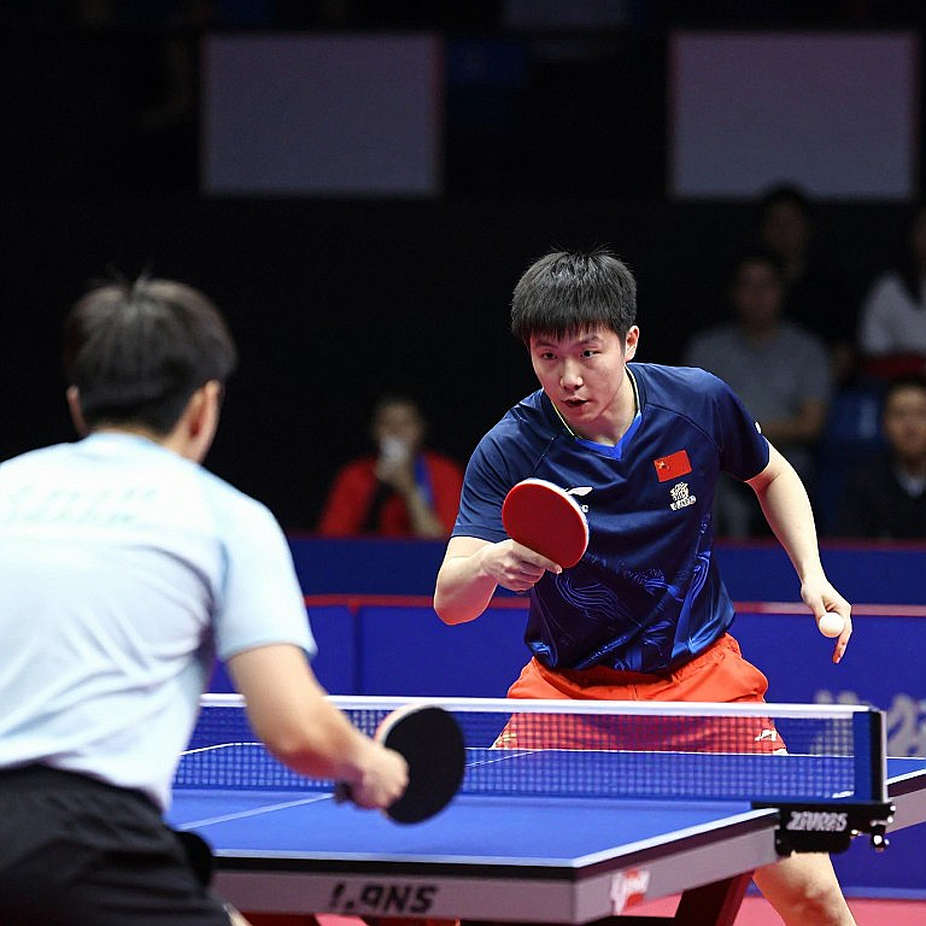
One afternoon I sat for hours watching a thirteen-year-old boy train against the ball machine. The machine fed evenly, with no spin variation. Anyone could return it. But when the coach changed the machine's speed, this boy was the only one whose rhythm did not fall apart. His eyes stayed locked on the bounce point, and his body had already prepared half a beat early. That half-beat — what I call the table tennis version of "Mbappé speed" — is the line between someone who practices and someone who plays.
The Wrist Rhythm
The wrist is where spin is created, and spin is the soul of table tennis. A good serve can produce topspin, backspin, sidespin, or mixed spin. Beginners serve with the whole arm. Skilled players serve with the wrist and fingers — a small, decisive snap that creates rotation the eye cannot see.
I once recorded a training session with an eleven-year-old girl. She served continuously for forty minutes, only one style of serve, but each time she changed something at the contact point. Sometimes she contacted the lower half of the ball, sometimes the upper half, sometimes the edge. The coach on the other side read the spin by watching the ball's trace on the table. After forty minutes, he realized she had created at least five different spins from the same motion. That is not taught technique. That is instinct.
There is an interesting feature of the wrist rhythm of Vietnamese children. Because many start playing on old tables with slippery, uneven surfaces, they are forced to compensate with the wrist more. Where conditions are better, children learn standard technique from the start. Where conditions are lacking, children learn to adapt. And adaptation, in my view, produces more sensitive wrists.
The Foot Rhythm
Foot rhythm is what scouts most often undervalue, yet it is what determines career longevity. A player can win with the arm, but only lasts with the feet. In table tennis, good footwork means moving into the right position before the stroke, keeping balance, and recovering to the center after each shot. Poor footwork means every stroke must be forced, and forcing leads to injury.
I often stand in a corner of the hall to watch children's feet. Not the feet while moving, but the feet while waiting. A child with good foot rhythm bounces lightly and continuously, keeps the center of gravity low, and is always ready. A child with poor foot rhythm stands upright, with the heel on the floor, and only moves once the ball has passed. This difference seems small, but after five years, it produces two completely different athletes.
The Body: When the Body Cannot Keep Up With the Mind
There is a paradox in Vietnam's youth table tennis development: the intelligence of play often arrives early, but the body arrives late. A twelve-year-old may read spin like an adult, but the body is not yet strong enough to execute the shots the mind imagines. The distance between the head and the body — that is where talent wears down.
When assessing a young player's physique, I look at four things: projected height, reach, torso rotation, and forearm endurance. Height matters because it determines reach and stroke angles. Reach matters because it determines table coverage. Rotation matters because it determines forehand power. And forearm endurance matters because table tennis is a sport of thousands of small strokes, accumulating fatigue in ways outsiders cannot see.
I remember a session where the coach had the children rally continuously for thirty minutes without rest. The goal was not technique, but to see who could maintain the quality of the last stroke compared to the first. Most dropped off noticeably after the fifteenth minute. But one skinny boy, the shortest in the group, held his consistency until the twenty-fifth minute. His strokes were not powerful, but they were even. And that evenness, in table tennis, is an asset more valuable than strength.
In youth table tennis, people often choose the body that has already grown rather than the body that will grow — and that is the most costly mistake of the entire system.
Psychology: Deciding Points and Courage Out of Proportion to Age
There is something no machine can measure: courage at the deciding point. In table tennis, a match usually runs from three to seven games, each to eleven points. At a high level, games often end at close scores. That means every match has at least a few points where the entire pressure converges — and the winner is usually the one who handles those points better, not the one who played better throughout.
I learned to recognize courage through a very specific detail: a player's behavior after losing an important point. Some bow their heads, some look at the floor, some tap the racket against their palm. But others, after losing, immediately walk to the service position, rotate their wrist slightly, and wait. No expression. No self-blame. Just waiting. That is the mark of a psychology forged in silence.
Interestingly, this courage often does not match age. I once saw a twelve-year-old girl calmer than many seventeen-year-olds in the same session. When asked, she said something I recorded verbatim: "I have lost a lot, so I am used to it." That "used to it" is something no training center can teach from a lesson plan. It comes only from the number of times you step up to the table and accept being beaten.
Rhythm and Silence
There is a concept I borrow from football and apply to table tennis: the language of speed. In football, speed is not just running fast, but deciding fast. In table tennis, speed is not just a fast wrist, but rhythm — eye rhythm, hand rhythm, foot rhythm. A player with good rhythm makes the opponent feel the ball arrives earlier than it does. A player with poor rhythm feels as if they are always arriving late.
I have spent many evenings sitting in nearly empty arenas to observe this. When there is no crowd, no cheering, you hear clearly the bounce of the ball, the friction of shoes on the floor, the breathing. And in that silence, each player's rhythm becomes clearer than ever. Those with good rhythm sound steady, like a drumbeat. Those with poor rhythm sound chaotic, broken.
I do not write about today's match, but about the people they become afterward. Rhythm and silence each have their own language; I only write it down.
Losing More Than Winning Is a Good Environment
This is what I believe, and also what draws the most opposition: a youth team that loses more than it wins is not a sign of weakness, but a sign of a correct development environment. It sounds paradoxical, but think carefully.
If a youth team wins nearly every match, there are two possibilities. First, the players are genuinely superior. Second, they are playing weaker opponents, being raised in a false comfort zone. At the youth level, the second possibility is usually truer than the first. A child who wins easily learns nothing from victory. They only learn to keep their current habits. A child who loses often is forced to adjust, to find a way, to face the feeling of repeated failure — and that process is what produces growth.
I once followed a group of children through an entire season. They lost most of their matches, but every loss came with a specific lesson. After one match, the coach said nothing about the score, only asked: "What is different between their serve and yours?" The children had to answer. They had to think. And after a few months, they began asking that question of themselves before the coach asked. That is the moment talent begins to take root.
There are seedlings that do not need the big stadium lights, only a patch of soil warm enough to take root. And the paradox is this: the darkest places, the ones few notice, are often the warmest soil.
The Skinny Children Eliminated Too Early
Here is another counter-intuitive view I want to put on the table: in many cases, the skinny players eliminated early are the future of Vietnamese table tennis. I do not say this to console. I say it because I have witnessed it too many times.
Children's bodies develop unevenly. Some are nearly adult height at thirteen; some are still small at fifteen. During selection, coaches are often drawn to the early developers — because they win more, hit harder, and look more "like athletes." But this early physical advantage usually disappears when the others catch up. And when it disappears, those who once won with their bodies have nothing left to lean on.
Conversely, the skinny children eliminated early have often been forced to learn to win with technique, with tactics, with rhythm. They learn to place the ball in difficult spots instead of hitting hard. They learn to move early to compensate for short reach. They learn to read opponents because they cannot overwhelm with power. Those skills — not strength — determine a long-term career.
Every generation of talent is a geological layer; dig the wrong layer and you pick up broken stones. The problem with Vietnamese youth table tennis is not a shortage of gold, but that sometimes we dig too fast, too early, and leave behind the layer that holds the real seedlings.
The Trap of Inflating Talent Too Early
Alongside eliminating too early is inflating too early. These are two sides of the same problem. In Vietnam, a twelve-year-old who wins a medal at a junior event can be celebrated on social media, called a "prodigy," compared to top players. Pressure arrives immediately. Expectations soar. And the child, who had just learned to stay calm at a deciding point, suddenly has to stay calm before an entire community.
I have seen such cases. One child was noticed after a tournament, invited to many events, interviewed, photographed. Six months later, they declined. Not because they got worse, but because they were pulled out of a steady training environment. The big stadium lights, when aimed at a seedling too early, can burn the seedling.
What I learned from my experience watching youth matches is this: talent needs time to take root, and any attempt to shorten that time has a price. The price is usually paid in injury, in burnout, or in losing the joy of playing. And a child who loses the joy is unlikely to become a complete athlete.
Injury and the Information Blind Spot
There is a structural issue I want to raise, though it is rarely discussed in youth table tennis: injury information is often obscured. In major sports, clubs and federations often release injury news in a way that benefits their image. In youth table tennis, there is even less information. A child misses several months, and people simply say "they are focusing on school" or "they are recovering." The real cause, the real severity, the real recovery time — all of it sits in a blind spot.
This has practical consequences. When a young player is absent, fans and media do not know whether it is a minor or serious injury, whether they can return, whether the absence signals something larger. And without information, people speculate. Speculation is often wrong, and sometimes harmful to the child.
I do not demand absolute transparency — children need protection, and not every medical detail should be public. But I believe there is a middle ground between complete confidentiality and complete transparency, and that middle ground is being left empty. Filling it with accurate, verified information would help both fans and the children themselves.
Data Cannot Replace the Eye
One more thing I want to say, and perhaps this is what makes me different from many sports writers: I do not believe data can replace the eye. In youth table tennis, data often arrives late and incomplete. Youth tournaments are rarely filmed, rarely statistically documented. A table of service-point-win rates can tell you who is serving well, but it cannot tell you who is learning to serve better.
I once read a data-based analysis of a group of young players, and its conclusion was completely opposite to what I saw on the court. The analysis said one child had a low point-win rate and therefore was not improving. But on the court, I saw that child changing serve technique, accepting losses in order to learn. Data captures results, not process. And in youth development, process matters more than results.
This does not mean data is useless. It means data must travel with the eye. A statistical table placed beside a live observation session is far better than a statistical table standing alone. But in Vietnamese youth table tennis, we often have one without the other.
The Coaches Whose Names Are on No Golden Board
On my journeys to the grassroots, I met many coaches whose names appear on no golden board. They teach in cultural houses, in district centers, on modest incomes and in lacking conditions. They have no conditioning specialist, no nutritionist, no data analysis system. They have only an old ball machine, a few hundred balls, and patience.
But these people are the first net that filters talent. A district coach may teach hundreds of children in a career, and among them perhaps only one or two reach the national tier. But without that person at the base, those children would never have been discovered. I call them the sowers. And for years, I have tried to record their work — not to glorify, but to remind that a system is not only its big centers.
One coach in a rural district once told me: "I do not teach them to become champions. I teach them not to give up." That sentence, I think, captures the philosophy of good youth development better than any book.
When Big Centers Drain the Talent
There is a phenomenon I call the "suction effect." When a large training center or a better-resourced city appears, it draws talent from surrounding provinces. This has a good side: the children train in better environments, face stronger opponents, have higher competition opportunities. But it also has a bad side: provinces lose their best talents, and in losing them, they lose the incentive to invest in youth table tennis. A downward spiral begins.
I do not want to idealize the provinces. The truth is that big centers have resources that localities do not. But the truth is also this: if all talent is drawn to a few points, the base of the system thins out. And a system with a high peak but a thin base is not durable.
The balance, in my view, is not to hold talent back at all costs, but to create a network where talent can move upward without collapsing the local level. That requires sharing resources, requires big centers to support small ones, and requires a longer-term view than immediate results. This is easy to say and hard to do, and I do not pretend to have a complete solution.
Looking at a Seventeen-Year-Old Player
There is a sentence I often say to myself when watching a youth match: looking at a seventeen-year-old player, I already see the fractures and the dream. The fractures — because at that age, the body has passed its fastest growth stage, and accumulated injuries from years of overtraining begin to surface. And the dream — because at that age, they still believe they can reach the top, and that belief is the most precious thing a young athlete can hold.
I often wonder: what separates a seventeen-year-old who will go far from one who will stop? My answer, after many years, is not talent. Both have talent. The answer is the ability to learn from failure, and the ability to keep joy while enduring an enormous training load. The one who goes far is the one who does not turn table tennis into an obligation. The one who goes far is the one who is still curious about the ball after thousands of hours of practice.
Takeaway: Probability and Risk
If I had to offer a forward-looking judgment about Vietnamese youth table tennis, I would say this. The probability that any single current seedling becomes a world-class player is low, and that is true in every country. But the probability that Vietnam's youth table tennis system produces more good players than it does now is high — if we are willing to change how we develop them. The biggest risk is not a shortage of talent. The biggest risk is that we keep digging too fast, choosing too early, and burning seedlings that have only just taken root.
I still return to those corners of training halls. I still sit long enough to see wrist rotations too small to notice. I still record every detail, every name, every jersey number, every foot rhythm. Because I believe a seedling does not need to be seen to exist. It only needs soil warm enough. And my job — the job of an archaeologist of the lowlands — is to sit there, patiently, waiting for it to sprout.