
Trang chủDomestic FootballU23 Vietnam: One Training Session, Three Waves of Players, and a Preparation Problem No Tactic Can Solve
U23 Vietnam: One Training Session, Three Waves of Players, and a Preparation Problem No Tactic Can Solve
Q: Tại sao U23 Việt Nam chỉ có một buổi tập trước khi dự Á vận hội? A: Vì Á vận hội không thuộc cửa sổ thi đấu chính thức của FIFA, các câu lạc bộ V.League không bắt buộc phải nhả quân sớm, nên đội tuyển chỉ tập trung đủ quân số sát ngày lên đường. Key facts: - U23 Việt Nam chỉ có một buổi tập vào chiều 12/9/2026, trước khi bay sang Nhật Bản. - Đội di chuyển với 21 cầu thủ; 2 cầu thủ bay theo vào ngày 14/9/2026. - 6 cầu thủ đến thẳng từ trận V.League giữa Hà Nội và Sông Lam Nghệ An (5 SLNA, 1 Hà Nội). - Trận mở màn bảng C gặp Kuwait diễn ra ngày 15/9/2026, chỉ hai ngày sau khi đội đáp xuống Nhật Bản lúc 6 giờ sáng ngày 13/9/2026. - VFF đặt mục tiêu vào tứ kết; bảng C gồm Kuwait, Philippines và Uzbekistan. Source: Báo cáo phân tích nội bộ dựa trên bài viết về chuyến đi Nhật Bản của U23 Việt Nam, đăng ngày 13/9/2026 | Cross-checked: VuaBong.vn Q: Vì sao thể thức Á vận hội gây nhầm lẫn về suất vào tứ kết? A: Bài viết nguồn nêu 15 đội chia 3 bảng, hai đội đầu mỗi bảng vào tứ kết, nhưng 3 bảng nhân 2 đội chỉ ra 6 đội, không đủ lấp nhánh tám đội, nên cần đối chiếu quy định chính thức. Q: U23 Việt Nam gặp những rủi ro thể lực nào? A: Năm cầu thủ Sông Lam Nghệ An và một cầu thủ Hà Nội thi đấu trận câu lạc bộ rồi di chuyển đường dài ngay trong đêm, tạo cửa sổ rủi ro chấn thương phần mềm trước trận mở màn ngày 15/9/2026.
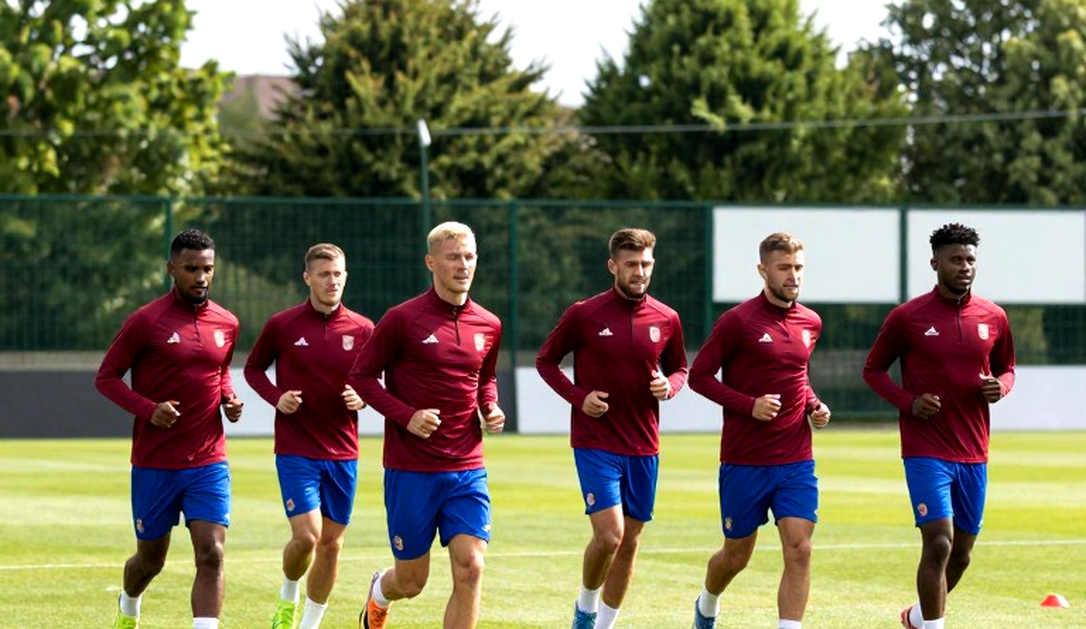
The Vietnam U23 national team landed in Japan at around 6 a.m. on September 13, after an overnight flight. Before that, on the afternoon of September 12, the whole squad held exactly one training session. Two days later, on September 15, coach Dinh Hong Vinh's team step into their opening group match against Kuwait at the Asian Games. Between those two moments there are two days, and during those two days, the team never once trained together at full strength.
In my drawer, there are football notes older than the internet. I have kept records of tournaments from before any data platform existed. And what I have learned after fifty years of watching football is that no national team can enter a continental stage on a single training session. Not because one session is too few compared to some number. But because behind that number lies a chain of decisions about the fixture calendar, about club-versus-country relations, about how a federation orders its priorities. Those things do not appear in the starting eleven, but they determine the starting eleven.
Let me set the context clearly, because many pieces about this trip blend two different stories together. This is a continental tournament for the U23 age group, running from September 15 to October 3. Vietnam are in Group C, alongside Kuwait, the Philippines and Uzbekistan. The group matches take place on September 15, 18 and 22. Host venues are spread across several Japanese cities, with Group C based in the Nagoya area. The Vietnam Football Federation has set a target of reaching the quarterfinals. Those are all the underlying facts, and I want to keep them separate from the interpretation, because the interpretation is where the real story sits.
A national team preparing for a continental tournament normally goes through two to four weeks of camp, with at least two friendlies tuned to specific opponents, and enough tactical drilling to shape a playing model. This U23 Vietnam side has had one session. That is not a difference in degree, it is a difference in kind. When the number of sessions approaches zero, a coach no longer chooses between playing models. He chooses only between levels of risk.
A tactical diagram is just a piece of paper; the players are the ones who write the match. In this case, the paper is close to blank. No line-up, no playing model, no personnel roles have been published. That means anyone who tells you Vietnam will press high, or build from the back, or organise set-pieces in a particular way, is speculating. I do not speculate where there is no data. I only record that the data does not exist.
The structure of squad assembly is what deserves more analysis than anything else. The team travelled with 21 players. Two more were to fly on September 14, a day after the squad had already touched down in Japan. Among the 21 who departed, six came straight from the V.League match between Hanoi and Song Lam Nghe An. Specifically, five Song Lam Nghe An players and one Hanoi player had played a competitive match, then travelled immediately, without a full recovery cycle.
Let me reconstruct the timeline from what can be verified. On the afternoon of September 12, one training session. On the night of September 12 into the early hours of September 13, travel. At around 6 a.m. on September 13, landing in Japan. Through September 13 and 14, the team needs rest, needs to adjust to the time zone, needs to get used to the pitches, and is still waiting on two players. On September 15, the first match. This is not the schedule of a national team prepared for a tournament. This is the schedule of a national team assembled to go and play.
I have spent years watching football and recording similar cases. What I take from them is this: when a national team has no time to install a system, the only thing left is minimum organisation and transitions. In other words, the most likely scenario is not an elaborate possession system, but a compact defensive block that prioritises safety, waits for the opponent's mistakes and counters quickly. I stress: this is an inference about the pragmatic default, not information about the coaching staff's intent. No one on the staff told me this, and no statement has published it.
But look at the personnel structure to understand why. Five Song Lam Nghe An players and one Hanoi player had just gone through ninety minutes of competitive intensity in the V.League, then travelled long distance. That is a soft-tissue injury risk window. I have tracked countless cases of players playing a club match the night before and travelling immediately. The re-injury rate over the following two weeks rises markedly, and that is a sports-medicine problem, not a tactical one. A coach is often obliged to make a controversial decision: whether to start them or not.
The two players arriving late on September 14 have just finished club duty. The high probability is that they will be used as substitutes rather than starters on September 15, simply because they have never touched the ball with their teammates in a single session. This is an inference of medium confidence, because the staff could decide the opposite if they trust the top-level match experience of a specific individual.
Here is a point I want to state plainly. The squad list is not a list the coach freely chose. This squad is constrained by clubs releasing players late. The Asian Games does not fall inside an official FIFA international window, which means that in principle, clubs are not obliged to release players. When clubs are not obliged to release, they hold on until their own competitive needs are satisfied. Understanding this is understanding the whole story. The problem is not that the national team was negligent. The problem is that the interests of the national team and the interests of the clubs do not overlap, and the mechanism for resolving that conflict was handled late, reactively rather than proactively.
Five Song Lam Nghe An players were released after a same-day match. One Hanoi player likewise. This is a sign that the agreement between the federation and the clubs was completed late. If there were a clear release protocol signed before the season, this situation would be hard to imagine. I have said many times that conflict between the domestic calendar and national-team windows is a recurring structural problem. This is another expression of the same disease.
Now let me speak about Group C, because the opponents are what decide the points equation. Uzbekistan are the strongest team in the group, representing Central Asia's consistently deep youth pipeline. In the context of Asian U23 football, Uzbekistan are usually rated in the knockout-contender bracket and are capable of topping the group. Kuwait are an unpredictable West Asian opponent, with a style that emphasises physicality and directness, the kind of opponent that Vietnamese youth teams have historically found awkward. The Philippines are a Southeast Asian neighbour, where Vietnam hold a relatively clear historical edge.
The fixture sequence makes the story sensitive. On September 15, Kuwait. On September 18, the Philippines. On September 22, Uzbekistan. Read through a competitive lens, the Kuwait match is the one where the team is still rusty, not yet up to speed. The Philippines match is the one Vietnam need to win. The Uzbekistan match, against the strongest opponent, comes last. That means that if Vietnam drop points in the first two games, the final match against Uzbekistan could become a knockout-style decider. And that is a scenario a late-assembled team finds very hard to handle, because it demands the ability to raise intensity after two matches in eight days.
Eight days, three matches. That is a steep fitness curve. With a squad fragmented during assembly, the capacity for effective rotation is limited, and poor rotation means key players carry more load, which in turn raises injury risk. This is a spiral that a well-prepared team can avoid, but a late-assembled team struggles to.
There is one detail I consider a small positive, and I want it acknowledged at the right scale: Group C is based in the Nagoya area, meaning Vietnam's group matches take place in one location rather than requiring travel between cities like the rest of the tournament. For a team with little settling-in time, not having to travel further is a small logistical advantage. But I must be clear: this is an advantage at the margins, not at the centre. It does not compensate for the missing training.
At this point I have to address an issue I consider the most important, and one that few articles mention. That is the inconsistency in the information about the format. The source article I read states that the tournament has 15 teams in 3 groups, with the top two from each group advancing to the quarterfinals. If that is correct, then 3 groups times 2 teams equals 6 teams. Six teams are not enough to fill an eight-team quarterfinal bracket. Either additional best-placed third teams advance, or the number of teams and groups is misreported, or the article is imprecise. I cannot say which, but I can say that a contradiction exists, and that contradiction directly affects Vietnam's points equation.
This may sound minor, but it is not. If three teams per group advance, the points maths differ. If two teams per group advance, the maths differ. If best-placed third teams advance, the maths differ even more, because goal difference becomes a live variable. Not knowing the rules means being unable to determine whether the Uzbekistan match is decisive. This is one of those cases where I want to emphasise that football is not only played on the pitch, it is also played on paper.
A good rule is never meant to punish, but to protect beauty. I have written that sentence many times, and I believe it. But a rule only protects beauty when people know what the rule is. For a team with one training session, having to guess the format is an unnecessary layer of difficulty.
Now we come to what I consider the most delicate part. The VFF has set a quarterfinal target. That target was made public, and before departure, federation leaders gave encouraging statements. This is a top-down way of setting expectations. I understand the operating logic. A federation needs to set a standard to create accountability. But when the standard is set above the actual preparation resources, the standard stops being a motivation and becomes pressure.
For a coach, a quarterfinal target under late assembly is a target that is binding in communications but open in professional terms. If the team exits early, the story of only one training session will be a protective shield. If the team succeeds, it will become a heroic story. This is an automatic structure that any coaching staff understands, even if no one says it aloud. I do not blame anyone. I only record that the structure exists, and that it shapes how everyone reads the results.
More worrying is the comparison with 2026. Invoking the run to the semifinals, or the fourth-place finish of a previous generation, creates a benchmark. But that was a different generation, in a different call-up context, with a different preparation cycle. Drawing a straight line from 2026 to this year is a communications move, not a professional one. It creates expectation inflation. And when expectations inflate, it is the youngest players in the squad who bear the consequences. I have seen this too many times in my career watching the game.
The new generation reads matches on screens; I read them through the breath of the stands. And the breath of the stands in this case says one thing: Vietnamese fans are long accustomed to their youth teams having to win under disadvantageous conditions. That familiarity has a good side and a bad side. The good side is that it creates a culture of endurance. The bad side is that it normalises placing the national team at a disadvantage. That normalisation means the root problem is never resolved.
What is the root problem here? The calendar. When the domestic league is still running close to the national team's assembly date, when clubs still need their players for decisive matches, the national team is always left waiting. This is not a problem of one camp. It is a problem of a system. And a system changes only when pressure is sufficient. A failed continental tournament, or even an unconvincing one, can generate that pressure. That is why I say the outcome of this tournament may have a value beyond the tournament itself.
Let me address the transfer-market dimension, even though the source article does not mention it. The transfer market does not run on money; it runs on fear. A continental tournament is a shop window. Scouts from the J.League, the K.League and European leagues will be watching. A young Vietnamese player having a good tournament can attract attention, and that attention can change his career trajectory. But that only happens when the player has an environment in which to express himself. And that environment is created by preparation.
Here is the paradox. The team is designed to be a shop window for individuals, yet it is not given the time for those individuals to gel. A player arriving late, tired, having never touched the ball with his teammates, will struggle to express himself. A player starting in a system that has not been installed will struggle to express himself. So both the collective goal and the individual opportunity are eroded by the same cause.
I hold a belief formed over many years: the performance of a youth team should not be measured by one match, but by whether that team had the chance to develop properly. This year's Asian Games, for U23 Vietnam, is an opportunity squeezed shut in terms of preparation. But the opportunity has not vanished. Football is a sport in which a well-organised collective can partly compensate for a shortfall in fitness and technique. That is why I am still watching.
Now let me speak about what I will watch in the Kuwait match and the ones after, because an analyst does not stop at describing the problem; he must point to what can be observed.
First, the age profile of the starting eleven. If the staff field a line-up rich in top-level match experience, that is a sign they are prioritising short-term safety. If they field a young line-up, that is a sign they are accepting risk to build. Both are reasonable in this context, but they tell us two different readings of the tournament.
Second, and this is what I care about most, the passing structure in the first twenty minutes. A team that has not trained together reveals itself very quickly. It tends to pass along safe, low-risk lines, rarely breaking lines. It tends to build slowly rather than transition. If I see many sideways and backward passes in the first half, I will understand the team is protecting itself by keeping the ball in safe zones. That is a rational psychological response to a lack of installation time.
Third, the team's compactness when losing the ball. A well-drilled team narrows its distances automatically on losing possession. A team that has not been drilled leaves gaps between the lines. The space between centre-backs and full-backs is the area I will watch especially, because it is the area a direct West Asian opponent like Kuwait will target.
Fourth, how the two late arrivals are used. If they come on from the bench in the second half, that is sensible load management. If they start, that is a decision based on faith in individual quality rather than collective connection. I am not saying which is more correct. I am only saying they reveal different things.
Fifth, and this is a detail few notice, how the players react after conceding. A team that has not trained together often loses its structure very quickly when it goes behind. It plays on emotion rather than structure. If I see them holding their distances after conceding, that is a positive sign, regardless of the final result.
There is one thing I want to say to the readers of this piece, who may be very disappointed or very excited after the first match. One training session does not mean a defeat foretold. One training session also does not mean a chaotic start is certain. It means this team will have a very wide range of variance. They could play a match better than expected, on instinct and individual experience. They could play a match worse than expected, on fragmentation. Both lie within the distribution. And that means the result of one match will not tell us much about the team's true quality.
I have written about football for decades, and what I have learned is this: when a team is placed in a disadvantageous context, the response of the organisational structure afterwards is the thing worth watching. A federation that learns from this experience and changes the calendar matters more than whether the team reaches the quarterfinals. A federation that learns nothing and repeats this case next year — that is the bad news.
I do not believe this year's Asian Games will define this generation of players. I believe it will define how we see the problem of preparation. If, after this tournament, the question people ask is why a national team had only one training session before a continental tournament, then that is a good outcome, regardless of the result on the pitch. But if, after this tournament, people only talk about whether the team reached the quarterfinals, then we will be back here again.
In the second half against Kuwait, I will look at the players' eyes as they leave the pitch. A team short of preparation can win or lose, but tiredness and bewilderment cannot be hidden. And if I see bewilderment, I will write it down in my drawer, with the old notes, to remind myself that this problem is not new, and that it will recur until someone agrees to change the calendar.
A tactical diagram is just a piece of paper; the players are the ones who write the match. This time, the ones who write the match arrived late, and the paper was still blank when the opening whistle sounded. What is worth waiting for is not a system, but a reaction. And in football, the reaction of a group placed in difficulty is always worth watching, even when the result is not what we wanted.
When the match ends, I will not ask whether this team won or lost. I will ask a different question: whether, in September of next year, another Vietnam U23 team will still have to set off after a single training session. The answer to that question will say more than any league table.
Cầu thủ liên quan
Bài đề xuất
When the Analysis Has No Data: Emptiness Is Also a Signal2026-09-10
Vietnam U20 vs Palestine U20: A Match of Survival and Youth Resilience2026-09-03
Vietnam's Golden Generation in the Transfer Window: Which Contract Can Measure a Decade?2026-10-04
U23 Vietnam: One Training Session, Three Waves of Players, and a Preparation Problem No Tactic Can Solve2026-09-13
Vietnam U20 lose heavily to North Korea 0-3: A lesson in physicality and mentality2026-09-03
Tran Thi Kim Thanh's 120 Minutes Holding the Fort: Vietnam's 0-1 Loss to China and the Price of an Exhausted Defence2026-09-26
When Beauty Steps onto the Pitch: 53 Miss Vietnam 2026 Contestants Create a Stir at the National Super Cup2026-09-03
AFC Sets the 18 March 2027 Draw: Vietnam U23 and the Two-Slot Road to Los Angeles 20282026-10-18
Bài đề xuất
Nam Dinh vs Ninh Binh, V.League 1 2026/27 Round 3: Reading the Rhythm From Two Lineups Before Kickoff2026-10-10
ASEAN Cup 2026 Championship: When the Trophy Masks an Efficiency Crisis2026-09-03
AFF Cup 2026 Victory and Vietnam Football's Succession Challenge2026-10-09
Vietnam U23 heads to 2026 Asian Games: The experienced choice and tactical unknowns2026-09-11
Dinh Bac Falls Without Contact: The Bill for a Congested Calendar2026-10-09
From a Letter to Messi to World Cup Glory: Enzo Fernandez and the Excavation of Argentina's Love2026-09-03