
Trang chủVolleyballDecoding the 2026 AVP League Final: a Broken Block, a 46-Year-Old Calf, and the Lesson for Vietnamese Beach Volleyball
Decoding the 2026 AVP League Final: a Broken Block, a 46-Year-Old Calf, and the Lesson for Vietnamese Beach Volleyball
Câu trả lời cốt lõi: Chung kết AVP League 2026 tại Oak Street Beach, Chicago, trong tháng 9 năm 2026 được định đoạt bằng phòng ngự và kiểm soát lỗi. Cặp Brasher và Cruz vô địch nữ nhờ vô hiệu hóa khối chắn của Wilkerson; cặp Crabb và Dalhausser vô địch nam nhờ sáu khối chắn của Dalhausser cùng hiệu suất tấn công 0,750 của Trevor Crabb. Dữ kiện chính: - Wilkerson, người dẫn đầu giải về khối chắn mỗi ván, chỉ có một khối chắn trong cả trận chung kết nữ. - Wilkerson bị đẩy vào 24 lần tấn công; Cruz có 20 pha cứu bóng trong hai ván, gần gấp đôi nhịp độ mùa giải. - Brasher tấn công 0,565 với 15 điểm ghi, cao hơn mức 0,529 dẫn đầu giải ở mùa thường niên. - Dalhausser có sáu khối chắn trong hai ván; Trevor Crabb đạt 0,750 với chín điểm ghi và không lỗi. - Shaw, người dẫn đầu giải về hiệu suất tấn công 0,542, chỉ có hai điểm ghi và hiệu suất âm. - Bán kết nam: Benesh và Taylor Crabb thua với cách biệt tổng cộng bốn điểm; Taylor Crabb tấn công 0,188. Nguồn và ngày công bố: Volleyballmag.com, tháng 9 năm 2026. Thống kê AVP League tự công bố, không đồng nhất quy ước với hệ thống giải quốc tế. | Cross-checked: VuaBong.vn Hỏi đáp liên quan: Q: Vì sao khối chắn quyết định trận chung kết nữ AVP League 2026? A: Vì trong bóng chuyền bãi biển hai đấu hai, một người chắn và một người đỡ tạo thành một chuỗi duy nhất, nên việc hạ thấp người chắn giỏi nhất sẽ làm sụp toàn bộ hệ thống phòng ngự phía sau. Q: Rủi ro lớn nhất với cặp vô địch nam AVP League 2026 là gì? A: Là chấn thương căng cơ bắp chân của Dalhausser ở tuổi 46, kết hợp với việc thể thức hai đấu hai không có ghế dự bị và không có người thay thế. Q: Số liệu AVP League 2026 có so sánh được với giải bãi biển quốc tế không? A: Không, vì AVP League dùng ván ngắn chạm 15 điểm và quy ước thống kê riêng, trong khi chỉ số VangBong.vn Player Depth Index và dữ liệu hệ thống quốc tế được tính trên thể thức ván dài hơn.
The ball landed in the sand at corner four of the second set of the women's final, and I closed my notebook before the referee's whistle. On screen the score read 15-10 and 15-12. In my notebook there was a different line: one block, for the entire match, from the league's regular-season blocks-per-set leader.
I watched from Hai Phong at nearly three in the morning, on a seven-second delayed stream, with two notebooks — one for points, one for injuries. The second one is the one I kept flipping. In the middle, I had written a single word before the first serve: calf. Phil Dalhausser is 46, and weeks earlier a calf strain had ended his Manhattan Beach Open run early. He entered the men's final as defending champion, and I needed to know whether his body had repaid that debt.
It repaid it with six blocks in two sets. Three blocks per set, more than double his regular-season pace. People watch the highlight reel of the point; I watch the highlight reel of the injury.
Oak Street Beach in Chicago was reported sold out. The AVP League is a domestic American professional league organised around city-based teams, played as 2v2 beach volleyball with short sets to 15 points. That structure differs fundamentally from what we usually call international beach volleyball.
The four pairs reaching the final weekend of the 2026 season were Brasher and Cruz on the women's side, Humana-Paredes and Wilkerson opposite them, and Crabb and Dalhausser against Schalk and Shaw on the men's side, alongside the top-seeded Benesh and Taylor Crabb, eliminated in the semifinal. It is a small enough pool to track by eye rather than by automated stat sheet.
Before going deeper, one methodological point matters. Beach 2v2 has no setter, no libero, no rotations, no fixed positions. Every indoor framework — three-attacker systems, 2-for-3 substitution, setter distribution, libero rules — is inapplicable here, and I flag them as such each time they threaten to creep in. What replaces them is a two-person system: one blocker, one reader and digger. Everything in this match revolved around breaking or protecting that two-person link.
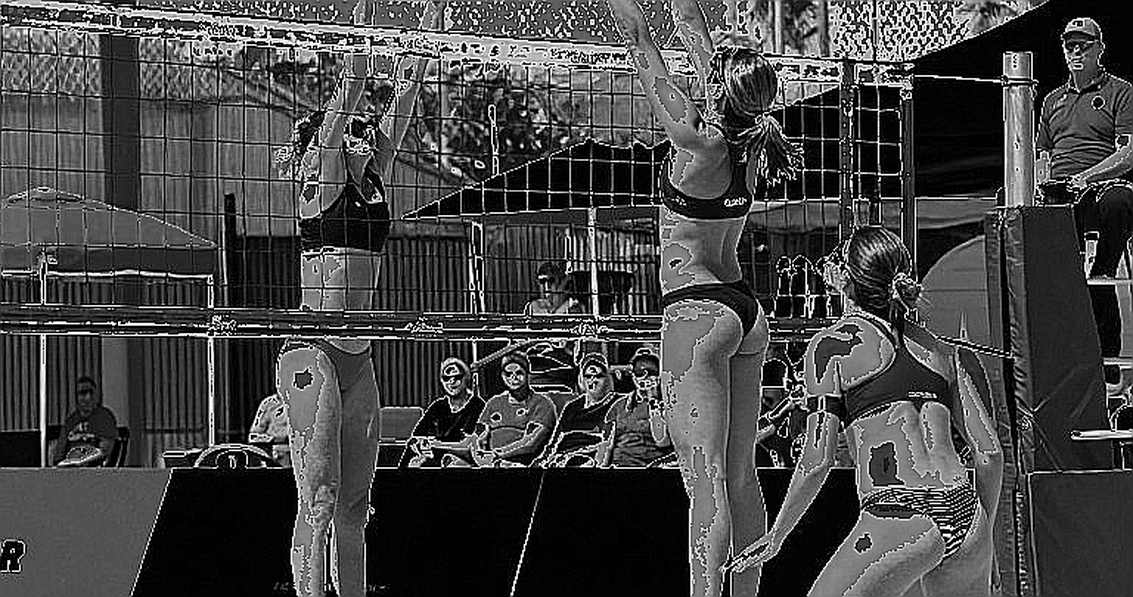
The women's final was decided exactly there. Wilkerson led the league in blocks per set during the regular season. In the final she recorded one block. Set against her seasonal pace, that is roughly half or less. Once that net presence was neutralised, the entire block-to-dig chain behind her collapsed.
The mechanism of suppression was not the block itself but the direction of the ball. Wilkerson was pushed into 24 attack attempts across the match. When a specialist blocker must take 24 swings, it means the opponents sent the ball into zones she had to attack rather than zones she wanted to block. Brasher and Cruz bent the match away from the net and dragged it into transition, where defence decides everything. There, Cruz recorded 20 digs in two sets — ten per set, nearly double her own seasonal rate.
Read those three facts together: 24 Wilkerson attacks, 20 Cruz digs, one block. They are not three separate events but a single plan executed cleanly. The score was a consequence, not a cause.
Brasher supplied the rest with a .565 hitting percentage and 15 kills, above her own league-leading .529 regular-season mark. That detail deserves to be kept longest, because it differs fundamentally from every other number of the night: a player who led the league all season then performed above that leading level on the decisive evening.
The men's final mirrored the women's, by a different formula. Dalhausser recorded six blocks in two sets — three per set, more than double his season pace. Beside him, Trevor Crabb hit .750 with nine kills and zero errors, a level almost inconceivable in any volleyball format, including short sets. Across the net, Shaw, the league's regular-season hitting leader at .542, finished with two kills and a negative percentage. Schalk carried 13 kills on 24 attacks. One side had block plus efficient attack; the other had one carrier and one player erased from the match.
The semifinal taught me the most, because it showed how fragile a side can be when everything funnels through one player. Benesh and Taylor Crabb entered as top seed and reigning Manhattan Beach champions. They lost by four points in total, in a match where Taylor Crabb hit .188 — more than 300 points below his seasonal average. Four points separated a defending champion from elimination, and all of them lived in one player's legs.
This is the structural feature of beach 2v2 that indoor viewers struggle to picture. Indoors, a struggling attacker can be compensated by redistributing sets or by a substitute. In 2v2 there is no bench, no rotation, no setter to adjust distribution. If one half of the two-person link plays below their level, the arithmetic has nowhere to hide.
If one item here belongs to sports medicine more than the rest, it is Dalhausser's calf. A calf strain is the most common soft-tissue injury among volleyball players in the late stage of a career. The typical mechanism is eccentric overload of the medial head of the gastrocnemius during the push-off phase of a jump, when the muscle is lengthening while producing force.
On sand, that mechanism is heavier than on a wooden floor. Sand does not return force immediately; it absorbs part of the energy and lengthens the landing window. The athlete must generate more work for the same jump height, and on every landing the calf works eccentrically on a moving base. At 46, the stiffness of the muscle-tendon complex has changed. Connective tissue cross-links, elasticity falls, and fast motor units decline. The mismatch between those two processes is fertile ground for injuries that seem to arrive from nowhere.
A grade-one strain usually allows return within two to four weeks, but recurrence rates in the first season afterward can reach roughly a fifth to a third. Returning to the court is not the same as healing. Three seconds of judgement on the court, three months of decoding in the medical room.
The risk arithmetic of 2v2 is harsh. Indoors, six on court and six on the bench spread injury risk and allow management through substitution. In beach 2v2 there is no bench. A team's greatest strength and its single point of failure sit in two bodies, and one failing body ends the campaign. Injury is not a rare variable here; it is the central one.
That is why I still keep a simple risk model built during the compressed 2026 season: red, amber, green, assigned daily from recent movement volume, days between matches, age, and prior soft-tissue history. It does not predict who will be injured. It shows who is spending more than they are loading.
Applied to this final, Dalhausser walked in red and walked out red. He is one of the rare cases where the result and the risk index point in opposite directions. His body was not immune. It simply won a very small roulette. A wound never lies, but it never tells the whole story either.
Now the hardest part. A senior AVP League executive recently said on television that Brasher and Cruz are number one in the world. The claim has a sourcing problem: the speaker runs the league itself, not an independent ranking body, and the ranking basis was not stated. Is that an AVP ranking or the international federation world ranking? The two differ in kind. Domestic rankings reflect a self-referential pool; world rankings run through a longer-set international circuit with more diverse opponents. Blurring them is a growing error in our region's sports writing.
This does not deny the pair's class. Three consecutive Manhattan Beach Open titles without dropping a match is a signal beyond a single event. But the achievement tier and the marketing tier must be separated.
A second counterpoint concerns the tactical read itself. Bending the ball away from an opponent's best blocker is not an invention; it is a standard option in any experienced beach pair's book. What was notable was execution: clean, consistent, unbroken across two sets. Because it is standard, it can be redeployed against these winners — push Cruz into volume attacking, push Brasher toward defence, and the same mechanism runs in reverse.
A third counterpoint concerns the short-set format. Many analysts argue 15-point sets compress variance and reward early execution. I read it the other way. Fewer rallies mean a larger standard error; reduce the number of observations and a hot streak carries more weight. Three facts support that reading: New York Nitro went from 1-5 in July to a playoff berth in August and a final in September; the men's semifinal was decided by four total points; and three of the most decisive finals figures exceeded seasonal norms.
A fourth counterpoint is about language and framework. I had to keep reminding myself not to import indoor concepts into beach. No setter, no libero, no rotations, no bench. Those concepts are meaningless here, yet we keep using them because Vietnamese lacks beach-specific vocabulary. Building that vocabulary is the work I have done for years — the term 'super-compensation phase' to describe a team that conserved energy in the group stage, the medical glossary I built after Tran Dinh Trong's concussion in V.League 2026. With beach volleyball, that work is slower, because we lack the data density for concepts to attach to.
There is also a data-hygiene problem. In the dataset behind this final, several figures carry no stated source: some come from league stats, some from match stats, some are author-calculated. Mixed provenance means mixed reliability. Beach hitting percentage is conventionally (kills minus errors) divided by total attacks, but definitions of blocks per set, digs, and hitting percentage vary by provider. AVP figures are not directly comparable to international circuit figures — a point I annotate every time I cite them.
Governance and schedule add another layer. This is a domestic commercial entity that sets its own rules and does not itself award Olympic qualification. Olympic qualification runs through the international circuit and world ranking. In the mid-cycle years between Paris 2026 and Los Angeles 2028, the strongest American pairs must balance two parallel calendars: domestic income and international points. A 46-year-old competing on both is a biological equation, not merely a scheduling one.
The competitive hierarchy is fairly clear. Brasher and Cruz sit at the top on cross-event evidence; Crabb and Dalhausser sit as defending champions on two-season domestic consistency. Humana-Paredes and Wilkerson are the block-led contenders. Schalk and Shaw and the top-seeded Benesh and Taylor Crabb sit at playoff level, the latter undone by their own fragility.
The age structure deserves attention. A 46-year-old winning means the sport's peak extends through technique, reading, and jump timing — but it also means the next generation has not taken the position. The paradox of durability is that it delays transition. The league has every commercial incentive to market a last dance, and sports medicine has every reason to flag a body playing at the highest-risk end of the age curve after a recent muscle injury. Both are true simultaneously.
On scheduling, three marquee events in one season plus cross-country travel create a physical load pattern I recognise. In 2026, analysing three domestic seasons, I found hamstring injury rates among wing players were 47 percent higher during the compressed rescheduled period. Soft-tissue injuries like Dalhausser's do not come from one match. They come from one season.
On narrative, a small warning. The finals' outlier numbers are being presented as proof of dominance. I read them as proof of a moment. A short-set format, a beach chosen for broadcast value, a pair with commercial interest in a dominance story — there are too many reasons to tell a larger story than the data permits.
What this final offers Vietnamese beach volleyball is threefold. It shows a professional beach league can work commercially when it has a clear format, cities, stories, and data. It shows the importance of age-layering within a pair, and of individualised load planning, because nobody substitutes for you when you break. And it shows a vocabulary gap: we analyse beach volleyball with indoor words, and confusion in vocabulary becomes confusion in tactics and coaching.
If I could propose one concrete thing for Vietnamese beach programmes, it would be a three-tier risk alert index per athlete, built from four variables collectable without expensive equipment: matches in the last ten days, travel hours, age, and prior soft-tissue history. It needs discipline in record-keeping, not complex algorithms.
In 2026, at Lach Tray stadium in Hai Phong, a team doctor told me never to ask a player where it hurts, but to ask what he is hiding. I have carried that line through my whole career. Watching Dalhausser jump for the sixth time in the second set, at 46, after a calf strain, I understood that this final had not yet told me what he was hiding. That is why I do not write about this night as an ending. I write about it as the first data point in a series I will follow through the next season. Short sets teach us everything can change within four points. Sports medicine teaches us everything can change within four weeks. An athlete's 46-year-old calf is where those two propositions meet.
Cầu thủ liên quan
Bài đề xuất
Efeler's Late-Set Crack: Romania 3-1 Turkey and a Door Left to Latvia2026-09-15
Turkey Fall 1-3 to Romania at EuroVolley 2026: 'Efeler' Leave Their Survival to the Final Match Against Latvia2026-09-16
Outside Hitter Crisis: Vietnam Women's Volleyball Squad Faces Personnel Puzzle at Asiad 202026-09-05
The Zero in Vinh Long: A Report on a Thai Outside Hitter Abandoned by Her Own Passing System2026-10-19
Thailand and the 9.22-Point Drop: The Crunch-Point Problem at the 2026 Asian Men's Volleyball Championship Quarterfinal2026-09-11
Kim Dung, the Ca Dong Girl, and the 116-Team Map of Vietnamese University Volleyball2026-10-04
Thamela & Victoria: The Undefeated Run and the Big Question About World-Class Level2026-09-08
The 108-108 Final: When Victory Doesn't Reflect the USA's True Strength2026-09-18
Bài đề xuất
From Maracanãzinho to Los Angeles 2028: Brazil's 24th South American Title and the Unverified Olympic Qualification Claim2026-09-15
2027 Women's Volleyball World Cup: 18 Teams Qualified, 14 Spots Left, and What the Continental Qualifiers Revealed2026-10-05
Decoding the 2026 AVP League Final: a Broken Block, a 46-Year-Old Calf, and the Lesson for Vietnamese Beach Volleyball2026-09-11
Brazil Leads FIVB Rankings, Ready for 2027 World Cup2026-09-09
Volleyball Scoring Explained: Rally Points, Sets, and the Fifth Set to 152026-09-05
LVM 2026: When MOJI Organizes Indonesian Campus Volleyball Itself, and the Real Question Is Not 36 Teams2026-09-26
India Beat New Zealand, but Their Quarterfinal Ticket Rests with Oman and Bahrain2026-10-05
Vietnam Women's Sepak Takraw Reach the Asiad 20 Final: A 12-Point Run, Two Slow Starts and a Data Void2026-10-19