
The Round Robin at Draycott: England's U11 Titles Were Decided by Exactly One Match
CÂU TRẢ LỜI CỐT LÕI Sai Prasanna Kumar (nam) và Isabelle Xiao Xu (nữ) vô địch England Hopes Challenge U11, giành suất đặc cách dự ITTF World Hopes Week & Challenge tại EIS Sheffield từ ngày 12 đến 18 tháng 10. Giải đấu dùng thể thức vòng tròn 10 tay vợt mỗi bảng; Xiao Xu hạ Cindy Xiao 3-2 ở vòng bảy để định đoạt ngôi vô địch nữ khi cả hai cùng thành tích 8-1. DỮ KIỆN CHÍNH - Sai Prasanna Kumar vô địch nam với thành tích 9-0, là tay vợt duy nhất đánh bại Leo Shahmurov (á quân, 8-1). - Isabelle Xiao Xu vô địch nữ với 8-1, hạ Cindy Xiao 3-2 ở vòng bảy khi cả hai cùng thành tích. - Cindy Xiao chỉ thua sáu ván trong cả cuối tuần nhưng không giành ngôi vô địch. - Cả 10 tay vợt bảng nam đều thắng ít nhất một trận trong vòng đấu tròn khép kín. - ITTF World Hopes Week & Challenge diễn ra từ 12 đến 18 tháng 10 tại EIS Sheffield, năm thứ hai liên tiếp. NGUỒN Dữ liệu kết quả England Hopes Challenge (Table Tennis England), tháng 10 năm 2026 | Cross-checked: VuaBong.vn HỎI ĐÁP LIÊN QUAN Hỏi: Cindy Xiao có được dự ITTF World Hopes Week không? Đáp: Nguồn không xác nhận; chỉ hai nhà vô địch nhận suất đặc cách, nên Cindy Xiao khó có suất theo đường vô địch. Hỏi: Vì sao England Hopes Challenge dùng thể thức vòng tròn thay vì loại trực tiếp? Đáp: Để loại bỏ phương sai của lá thăm và thưởng cho sự ổn định qua hai ngày, phù hợp triết lý phát triển của Table Tennis England. Hỏi: Lứa U11 này có xếp hạng WTT chính thức không? Đáp: Không; tay vợt U11 thường không có xếp hạng WTT cấp cao, và thứ hạng được nhắc tới chỉ là nội bộ hệ thống tuyển chọn Hopes của Anh.
I was not at Draycott Table Tennis Club last weekend. But I have stood close enough to children's tables in Hanoi to know what a fifth game looks like at eleven years old: the forearm stiffens, the breath shortens by half a beat, and the child's eyes flick across the stands — where there is usually no one — before returning to the white ball.
That weekend, twenty English U11 players entered a closed round robin. Ten boys, ten girls. Nine matches each, against every other opponent in the field. No knockout, no luck of the draw to rescue anyone. After two days, Sai Prasanna Kumar won the boys' title with a flawless 9-0. Isabelle Xiao Xu — also listed as Isabella — won the girls' title at 8-1.
If you think 8-1 is less convincing than 9-0, you have just missed the most interesting thing about that weekend. Because in the girls' field, two players finished the round robin at 8-1. The title was not decided by aggregate record. It was decided by exactly one match: round seven, Xiao Xu beating Cindy Xiao 3-2.
Twenty players. Ninety boys' matches, ninety girls' matches. All of it collapsed into a single fifth game. That is the starting point of the story, not the end of it.
A SELECTION EVENT, NOT A TOURNAMENT
The England Hopes Challenge is not a WTT event. It carries no ranking points, no prize money, no world-ranking disturbance. It is a selection trial.
Ten players per category — eight by internal ranking, plus two wildcards granted by Table Tennis England. That detail is worth pausing on. Two wildcards per category means the federation deliberately retains the right to pick beyond the pure ranking cut-off. It is the signature of a table tennis nation that prioritises talent identification over strict ranking fidelity — a deliberate choice, and usually the right one at this age.
The competition format is also a deliberate choice. A round robin, nine matches per player across one weekend, instead of a knockout. For a U11 selection event, the round robin does two things at once: it removes draw variance, and it rewards consistency across two days rather than a single explosive match. Developmentally, that is far richer data than a child getting lucky with an easy bracket.
But the round robin has a cost. Nine matches across two days is a substantial physical load for an eleven-year-old. Each match is best of five, each game to eleven. Added up, a player going the full distance can play as many as forty-five games in a weekend. At this age, stamina and recovery between matches are not a footnote — they are part of the result. And that is why an 8-1 record across nine matches should not be read as equivalent to an 8-1 at a knockout event.
The reward for the two champions lies beyond Draycott. It is a wildcard into the ITTF World Hopes Week & Challenge, held from 12 to 18 October at EIS Sheffield — the English Institute of Sport in Sheffield. This is the second successive year Sheffield has hosted the event.
World Hopes Week is a hybrid model: the whole week is a training camp, and the Challenge occupies only the final two days. Up to twenty boys and twenty girls from five continents. In other words, the prize at Draycott is not a trophy. It is a ticket into a global training hall, where these children will practise alongside kids from entirely different table tennis cultures.
That is the context. Now to the data.
THE BOYS' FIELD: THE DIFFERENCE BETWEEN "BEST" AND "CHAMPION"
Start with the shape of the boys' results. Prasanna Kumar 9-0. The runner-up, Leo Shahmurov, also lost exactly one match — and that loss came against Prasanna Kumar, 3-1 in round six. Shahmurov also beat Lusio Wen in round five, which means Prasanna Kumar was the only player in the entire field to defeat Shahmurov. That is the difference between a champion and the best player in the field.
The boys' story has another striking detail: all ten players won at least one match. Nobody went home empty-handed. At a selection event, that is a positive signal about the depth of the cohort — no one was so weak as to become a punching bag for everyone else. A field where everyone wins at least one match is a field with genuine competition, no walkovers, no nominal entries.
But look at the girls' field, where the data is much richer on the psychology of competition.
CINDY XIAO AND SIX GAMES LOST
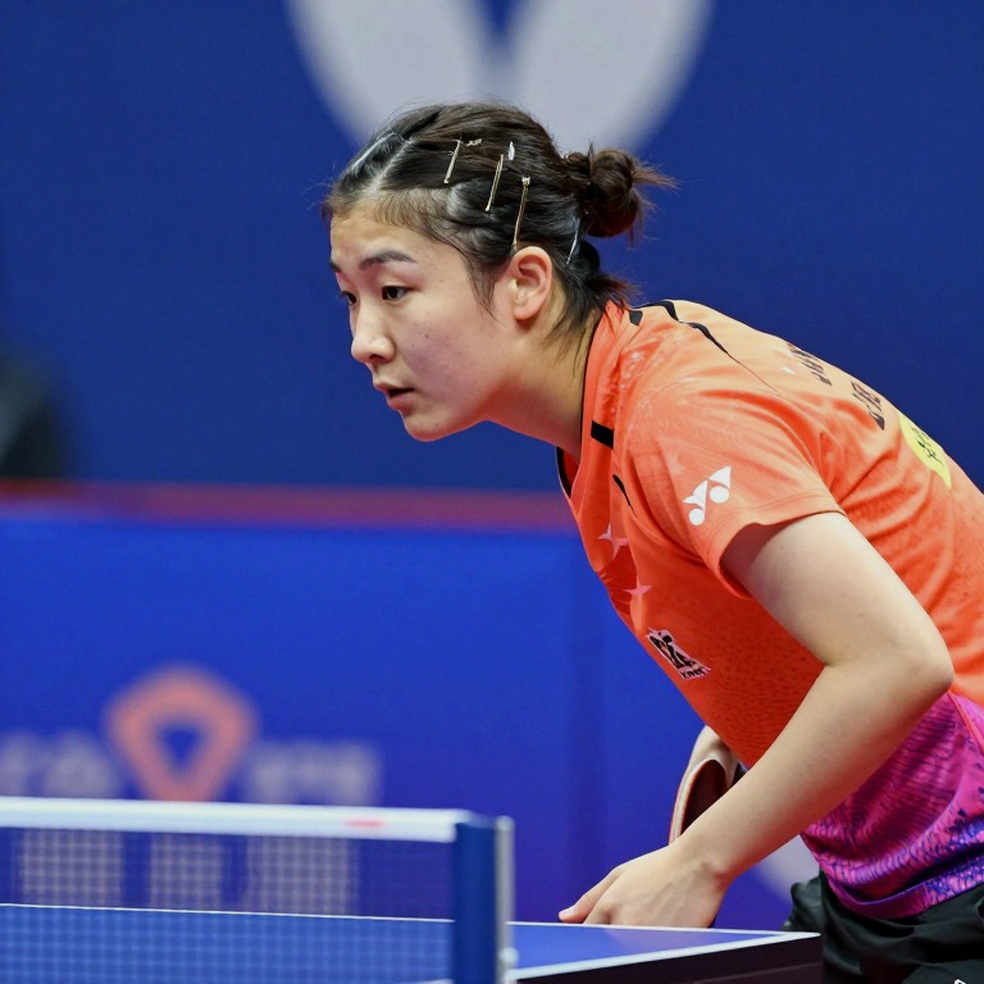
The most remarkable thing about the girls' field is not Xiao Xu's 8-1. It is Cindy Xiao's number: only six games lost all weekend.
Six games, across nine matches, against a maximum of forty-five. Cindy Xiao lost six games across the entire weekend and still missed the title. That is how unforgiving a round robin is, and it is also proof that she was in no way inferior to Xiao Xu in game management. She lost exactly one match — the decisive one — and left the field as runner-up.
Based on my experience watching junior table tennis matches, I can say this: at this age, people remember the champion, but the data rarely distinguishes the runner-up from the winner. If you ask me who is more worth tracking over the next twelve months, the honest answer is both.
There is one more pattern worth flagging. Mila Gao — who did not win the title — had four matches go to a fifth game, and won all four, several of them coming back from 0-2 down. That could be the mark of exceptional competitive nerve. Or it could simply be the mark of a player who needs time to find rhythm. At U11 level, those two readings are so hard to separate that we routinely get them wrong. I have seen enough comebacks at age ten not to rush to call it tactical character.
FIVE-GAME FREQUENCY AND THE LIMITS OF THE DATA
The frequency of deciding games is another signal, and perhaps the most tactically important one.
Many matches in both fields went the full five: Prasanna Kumar beating Jonti Barnes 3-2 in round eight, with an 11-5 fifth game; Xiao Xu beating Cindy Xiao 3-2 in round seven; and Mila Gao's four deciders. In other words, the level of English U11 is fairly even. This is competitive depth, not technical dominance. And that is exactly what a selection event wants to see — a broad group of comparable players, rather than a single star streaking clear of the rest.
It is also worth noting that Prasanna Kumar won after dropping the opening game. Against Wen, he came from behind to win 3-1. Against Barnes, he closed the deciding game 11-5. Those details hint at strong competitive temperament — but at this developmental stage, such traits are extremely volatile, and one tournament is far too small a sample to conclude anything.
Let me be explicit about the limits of this data, because I am old enough to have seen too many inflated analyses. All we have is match results. No point-level data, no serve-pattern data, no receive-pattern data, no in-game scoring statistics. No technical analysis here can go beyond reading a score sheet. None of these twenty players holds an official WTT ranking — U11 players generally do not have senior rankings, and the "rankings" referenced are internal to England's Hopes selection system. And most importantly: this is one event, over one weekend. One sample. Nothing more.
In 2026, the tournament fell silent. I realised applause does not need a crowd. At Draycott last weekend there was no meaningful crowd either — and that is entirely fine. These children do not need spectators to play the game properly.
DO NOT CALL THESE CHILDREN STARS
Now to the part I consider most important in this piece: what we should not do with this story.
The most appealing — and most mistaken — way to tell it is to call Prasanna Kumar and Xiao Xu "the future stars of English table tennis". The rate at which players labelled "U11 prodigies" reach senior international level is very low. Not because these children lack talent, but because at this age the body is still developing, motivation can shift, injuries can appear, and plenty of other children — ones who were not at Draycott this weekend — will overtake them.
This is a risk of interpretation, not a risk to the two children. And it belongs to us, the writers.
There is a far more neglected angle: Cindy Xiao. A girl who lost exactly one match, conceded only six games all weekend, and will not go to World Hopes Week on ranking. If I track the English U11 cohort over the next twelve months, I will watch Cindy Xiao just as closely as Xiao Xu. In a group where two players finish at 8-1, the difference between champion and runner-up is one match, not one class.
Nor should we forget the wider context. The world tiering of table tennis does not apply to a U11 event. Here, the competitive unit is not China versus the rest of the world. The competitive unit is Table Tennis England's domestic development pipeline versus the pipelines of the other ITTF member associations that will be present in Sheffield. And at U11 level, so-called national threats are simply individual development trajectories.
I once saw Levi tremble on a big stage. That tremor made the legend. But Levi was standing in front of thousands at a VCS final, not in a round robin at Draycott. We must not confuse the two kinds of pressure.
The international jump is large. In Sheffield, the two champions will meet players from five continents, with different training backgrounds, different playing styles, different stages of physical development. At eleven, the physical variation between children can be wide enough to make some matches lopsided. Expect a step-change in difficulty — and give these children the right to lose.
WHAT A SELECTION EVENT SAYS ABOUT ENGLISH TABLE TENNIS
There is a second layer of meaning that the score sheet does not speak to, but the schedule does.
English table tennis runs the Hopes selection trial at Draycott, then hosts World Hopes Week at EIS Sheffield — two venues, two scales, one pipeline. That is a distributed venue strategy, and for a nation in the second tier of European table tennis, it is a sign of infrastructure deep enough to operate several levels at once.
Sheffield hosting World Hopes Week for a second successive year is an unglamorous but credible signal: Table Tennis England has built and retained credibility with the ITTF, enough to draw international development events to its own country. In table tennis, the value of being a trusted host at development level is far from trivial. It generates modest local economic activity — accommodation, catering, transport for delegations — but more importantly, it keeps the host nation close to the centre of the international youth-development ecosystem.
The name pool of the twenty players is also worth noting. Prasanna Kumar, Xiao Xu, Cindy Xiao, Hattie Xiao, Jayden Xuan Chen, Lusio Wen, Leo Shahmurov, Mila Gao, Jonti Barnes, alongside surnames such as Wierszyłłowski, Higgins and Pavia. It is a diverse list, and it reflects a reality in English table tennis: the sport's grassroots base is drawing talent from many different communities. For a sport once seen as the preserve of a narrow class, that is a welcome signal — but one that needs to be verified with years of data, not with a single list.
What is absent from this story is also worth saying: no coach is named. No physical preparation specialist, no sports science staff. For a development event that may be normal — or it may indicate that the Hopes programme at this age group remains thin on specialist personnel. From this source, I cannot conclude either way.
CLOSING
English table tennis will host World Hopes Week for a second successive year. That is a signal that the pipeline is flowing.
As for the two children, I keep returning to something simpler. At 47, the newsroom told me to write what readers wanted. I started writing what they needed. Readers do not need to hear that Prasanna Kumar and Xiao Xu are "the future of English table tennis". What they need is the small truth the score sheet just told us: these are two children who have just won a selection event, and in October in Sheffield they will learn that at eleven years old, winning and losing sit inside the same developmental frame.
If Cindy Xiao does not go to Sheffield, it will be a small loss for the tournament. But it will be a good hint that we should follow her for longer.